
High-Viscosity Heavy-Duty Planetary Mixer (up to 2,000,000 cP)
A heavy-duty high-viscosity planetary mixer uses reinforced sigma-profile or anchor-type planetary blades in a robust bowl with a high-torque gearbox, designed to process very high viscosity materials such as stiff pastes, battery electrode slurries, pharmaceutical ointment bases, and high-solids sealants. It bridges the gap between standard planetary mixers and sigma-blade contra mixers, handling ultra-viscous materials in a planetary geometry with reasonable discharge capability.
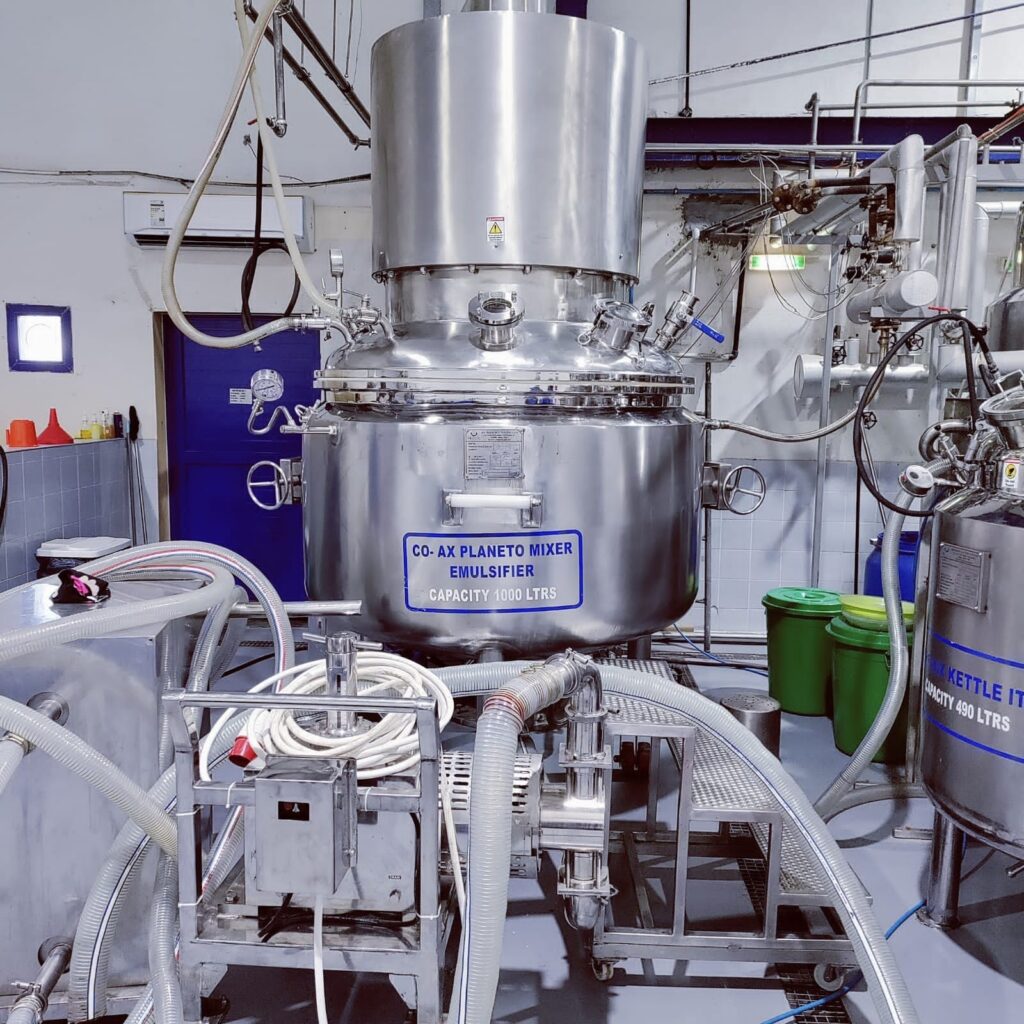
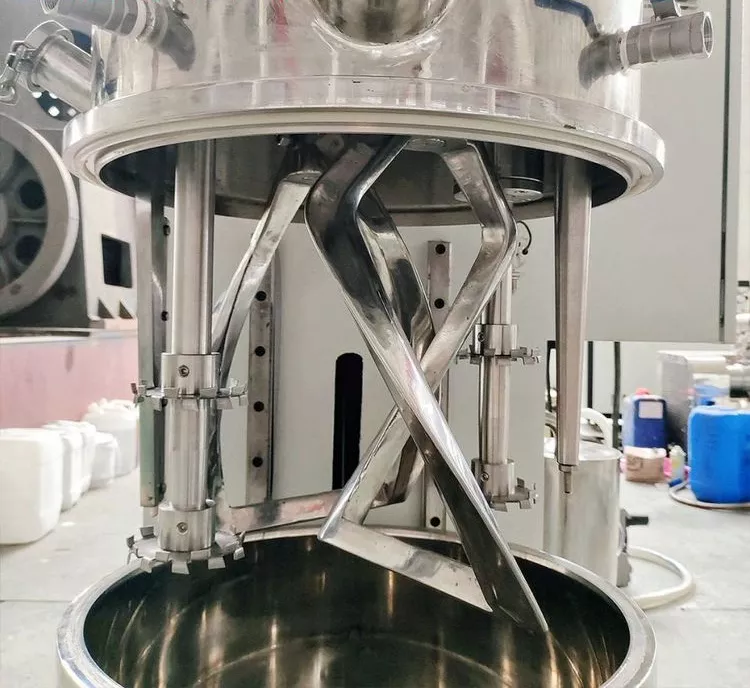
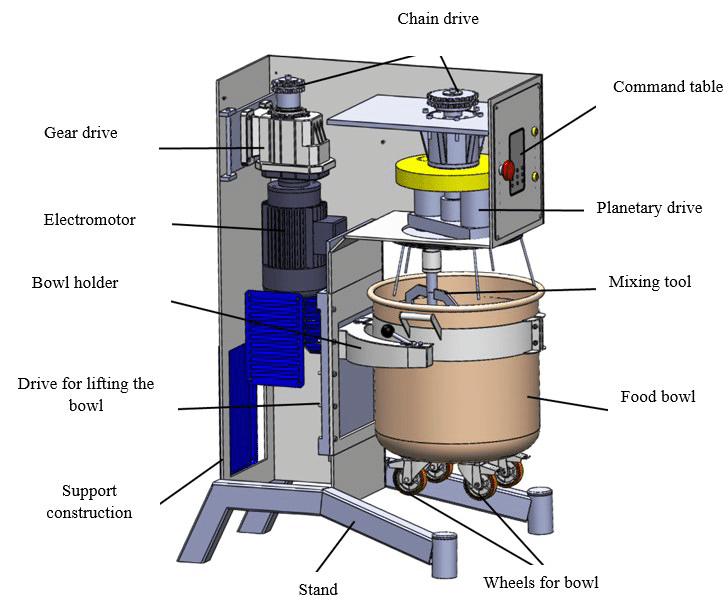
A heavy-duty high-viscosity planetary mixer uses reinforced sigma-profile or anchor-type planetary blades in a robust bowl with a high-torque gearbox, designed to process very high viscosity materials such as stiff pastes, battery electrode slurries, pharmaceutical ointment bases, and high-solids sealants. It bridges the gap between standard planetary mixers and sigma-blade contra mixers, handling ultra-viscous materials in a planetary geometry with reasonable discharge capability.
Heavy-duty sigma or anchor blades orbit the bowl at low speed, sustained by a high-ratio gearbox rated for continuous high-torque service. The reinforced bowl structure handles the reactive torque forces generated by ultra-viscous media, preventing structural flex under maximum load. A jacketed bowl provides thermal control throughout the kneading cycle. At the end of the batch, hydraulic bowl tilting assists gravity discharge of the product.
Challenges
Cold Start Overload
When processing very high viscosity materials, starting the blades in a cold, stiff charge places immediate excessive torque demand on the motor and gearbox before any material warming has occurred, risking motor trip or mechanical damage.
Sustained Peak Torque on Gearbox
Continuous operation at or near maximum viscosity places the gearbox under prolonged high torque, generating heat and accelerating wear beyond what standard planetary gearboxes are designed to handle.
Incomplete Product Discharge
High yield-stress materials resist gravity discharge even when the bowl is tilted, leaving significant product adhering to bowl walls and blade surfaces, reducing batch yield and increasing cleaning time.
Scraper Blade Damage
Wall scrapers designed for standard viscosity ranges can fracture or deform when forced against a near-stationary ultra-viscous wall layer, leading to unplanned downtime and potential product contamination.
Thermal Stratification Across the Batch
Slow blade-induced circulation in the laminar flow regime allows temperature differences to develop between the heated wall region and the cooler batch centre, leading to uneven processing.
Solutions
- Soft-Start with Torque-Limited VFD Ramp: Gradually increasing blade speed over an extended start-up period limits the initial torque demand, allowing the material to begin warming and softening before full operating speed is reached, reducing the risk of motor trip.
- Oversized Gearbox for Continuous High-Torque Duty: Specifying a gearbox rated significantly above the motor nominal torque ensures the drive train can sustain the loads imposed by ultra-viscous materials during continuous operation without overheating.
- Hydraulic Bowl Tilt with Manual Discharge Assistance: Combining hydraulic bowl tilting with manual or mechanical product scraping at the discharge point improves batch recovery from high yield-stress materials that resist gravity alone.
- Flexible Spring-Loaded Scraper Blades: Scrapers that flex under excessive load rather than remaining rigid are less likely to fracture when contacting a stiff wall layer, extending blade service life and reducing contamination risk from blade fragments.
- Jacketed Bowl with Optimised Heating Profile: Careful management of jacket temperature throughout the mixing cycle, starting with higher wall temperatures to reduce initial viscosity and adjusting as the batch warms, helps reduce thermal stratification and promotes more uniform processing across the batch volume.
Applications
- Battery & Energy: Electrode slurry (NMC, LFP, graphite anode) -- high solids loading, viscosity-critical mixing.
- Pharmaceutical: Ointment base kneading above 100,000 cP, suppository wax compound, ultra-viscous GMP paste.
- Adhesives & Sealants: High-solids structural adhesive, pressure-sensitive compound above standard planetary limit.
- Chemical: Highly filled polymer compound, ceramic paste, abrasive slurry with solids above 60% w/w.
- Cosmetics: Dense anhydrous cream, ultra-thick pomade, high-wax-content cosmetic base above standard planetary.
Models & Capacities
Type E — High-Viscosity Heavy-Duty Planetary Mixer: Models & Capacities | |||||||||||||
Model | Net Vol. [L] | Planetary RPM | Motor [kW] | Visc. Max [cP] | Re Range | Jacket Area [m2] | Op. Temp [deg C] | Bowl Dia [mm] | Bowl H [mm] | Weight [kg] | Overall Dimensions [mm] | ||
|
|
|
|
|
|
|
|
|
|
| L | W | H |
PM-E-005 | 5 | 5-60 VFD | 5.5 | 2,000,000 | Re <100 | 0.12 | -5 to 150 | Dia380 | 420 | 180 | 650 | 650 | 1,100 |
PM-E-020 | 20 | 5-60 VFD | 11 | 2,000,000 | Re <100 | 0.35 | -5 to 150 | Dia580 | 620 | 420 | 950 | 950 | 1,500 |
PM-E-050 | 50 | 5-50 VFD | 18.5 | 2,000,000 | Re <100 | 0.68 | -5 to 150 | Dia780 | 820 | 850 | 1,300 | 1,300 | 1,900 |
PM-E-100 | 100 | 5-40 VFD | 30 | 2,000,000 | Re <100 | 1.10 | -5 to 150 | Dia980 | 1,020 | 1,600 | 1,650 | 1,650 | 2,300 |
PM-E-200 | 200 | 5-35 VFD | 45 | 2,000,000 | Re <100 | 1.80 | -5 to 150 | Dia1250 | 1,260 | 3,000 | 2,050 | 2,050 | 2,800 |
PM-E-500 | 500 | 5-30 VFD | 75 | 2,000,000 | Re <100 | 3.50 | -5 to 150 | Dia1650 | 1,700 | 6,800 | 2,700 | 2,700 | 3,600 |
PM-E-1000 | 1,000 | 5-25 VFD | 110 | 2,000,000 | Re <100 | 5.80 | -5 to 150 | Dia2100 | 2,100 | 13,000 | 3,400 | 3,400 | 4,400 |
PM-E-2000 | 2,000 | 5-20 VFD | 160 | 2,000,000 | Re <100 | 9.50 | -5 to 150 | Dia2700 | 2,600 | 25,000 | 4,300 | 4,300 | 5,400 |
PM-E-3000 | 3,000 | 5-15 VFD | 220 | 2,000,000 | Re <100 | 13.0 | -5 to 150 | Dia3200 | 3,000 | 40,000 | 5,200 | 5,200 | 6,200 |