
Planetary Mixer
Category Overview
A planetary mixer is a batch reactor in which one or more stirrer assemblies simultaneously orbit the bowl axis while rotating on their own axes, generating overlapping paths that ensure broad bowl coverage. Used across laboratory and production scales, it handles a wide range of viscosities and is available in several configurations: standard single-planetary for general mixing applications; multi-head designs with two or more stirrers for improved coverage and reduced mixing time; vacuum-sealed variants for air-sensitive or degassing applications; dual-shaft designs combining a planetary stirrer with a high-speed disperser for simultaneous bulk mixing and dispersion; and heavy-duty configurations for high-viscosity materials such as ointment bases, electrode slurries, and stiff pastes that exceed the capability of standard planetary designs.
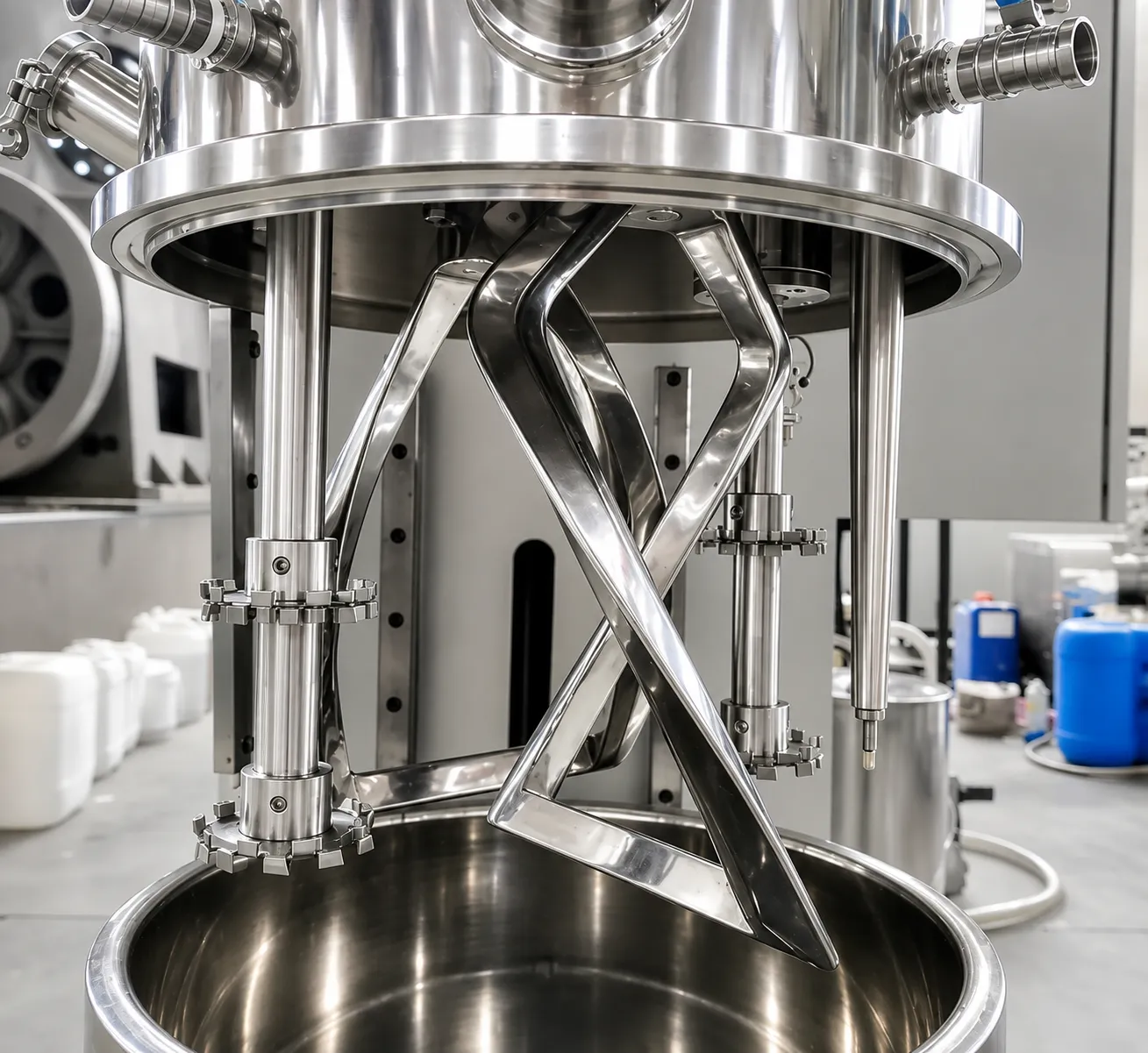
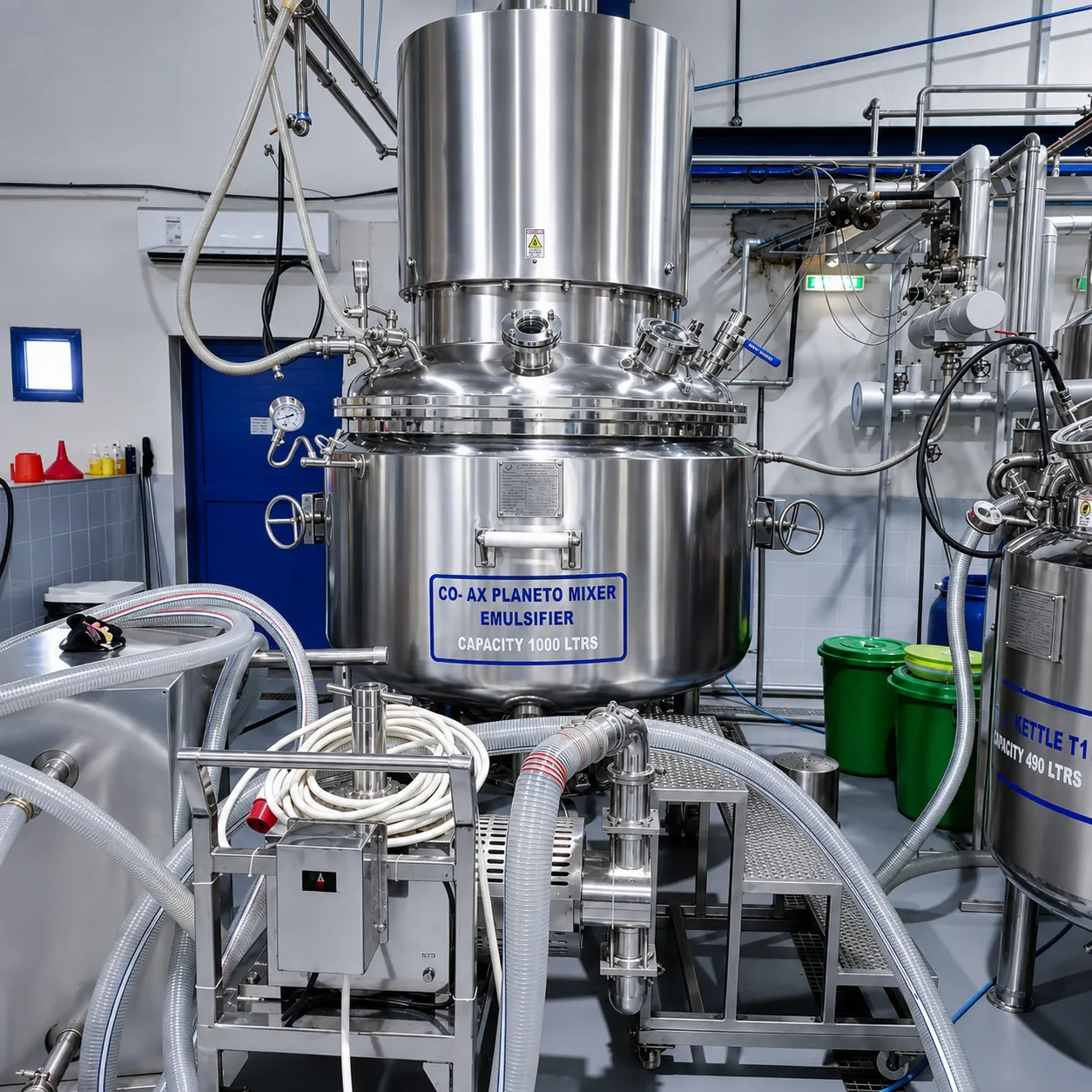
A standard single-planetary mixer is a batch reactor with one stirrer assembly that simultaneously orbits the bowl axis while rotating on its own axis, generating overlapping three-dimensional paths that ensure broad bowl coverage. It accommodates interchangeable attachments including a wire whisk, flat beater, dough hook, and disperser head, making it adaptable across a range of mixing duties. Widely used across food, pharmaceutical, cosmetic, and bakery applications, it serves as a versatile batch mixer for low to moderately viscous materials at both laboratory and production scale.
The stirrer orbits the bowl while rotating on its own axis, tracing overlapping paths that contact all bowl regions repeatedly, ensuring uniform blending. Interchangeable attachments adapt the mixer to different duties: wire whisk for aeration, flat beater for creams and batters, and dough hook for stiff materials. Where fitted, a jacketed bowl provides thermal control. Motor torque monitoring gives operators a non-invasive indication of when the batch has reached its target consistency.
Challenges
Uneven Mixing at Large Scale
At production scale, a single stirrer can leave concentration and temperature differences between the centre and bowl wall, affecting batch consistency.
Over-Aeration at High Speed
Running at high speed for extended periods introduces more air than required into foam-sensitive products.
High Viscosity Limitation
Above approximately 100,000 cP, the stirrer struggles to circulate the bulk material effectively, extending mixing time.
Tool Changeover Downtime
Manual attachment changes slow production in facilities running multiple products per shift.
Gearbox Wear
Variable torque loads over time cause wear on the gear train, increasing maintenance requirements.
Solutions
- Variable Speed Control: PLC-programmed speed profiles maintain the correct orbit-to-rotation ratio throughout the batch, improving uniformity.
- Pulsed Speed Sequences: Alternating speed rather than running continuously at high speed prevents excess air incorporation.
- Heavy-Duty Dough Hook: Sustains bulk circulation in high-viscosity materials, extending the practical working range of the mixer.
- Quick-Change Tool Coupling: Bayonet-style attachment allows tool changes in under five minutes without additional tools.
- Sealed Oil-Bath Gearbox: Full oil immersion of the gear train reduces wear and supports long service intervals.
Applications
- Food & Bakery: Cake batters, bread dough, meringue, icing, cream -- precise aeration control and gentle shear under temperature.
- Pharmaceutical: Oral suspension development, capsule fill blending, soft gel compounding, dental paste -- GMP conditions.
- Cosmetics: Cream, lotion, conditioner, foundation -- shear-sensitive emulsion gentle mixing without phase separation.
- Confectionery: Fondant, aerated chocolate, nougat, cream centres -- controlled gas holdup and emulsion stability.
- Research & Development: Formulation scale-up parameter generation, texture development, laboratory analog to production mixers.
Models & Capacities
Type A — Standard Single-Planetary Mixer: Models & Capacities | |||||||||||||
Scale | Net Vol. [L] | Planetary RPM | Disperser RPM | Motor [kW] | Visc. Max [cP] | Op. Temp [deg C] | Bowl Dia [mm] | Bowl H [mm] | Weight [kg] | Overall Dimensions [mm] |
| ||
|
|
|
|
|
|
|
|
|
| L | W | H |
|
Micro Lab | 0.05 | 100-600 | 1,000-3,000 | 0.12 | 100,000 | -5 to 100 | Dia120 | 100 | 8 | 280 | 280 | 550 |
|
Lab | 0.5 | 80-500 | 1,000-3,000 | 0.25 | 100,000 | -5 to 120 | Dia200 | 180 | 18 | 420 | 420 | 650 |
|
Lab | 2 | 60-400 | 1,000-3,000 | 0.55 | 100,000 | -5 to 120 | Dia280 | 280 | 38 | 550 | 550 | 800 |
|
Lab | 5 | 60-400 | 1,000-3,000 | 0.75 | 100,000 | -5 to 120 | Dia350 | 380 | 58 | 650 | 650 | 950 |
|
Lab/Pilot | 20 | 40-300 | 1,000-3,000 | 1.5 | 100,000 | -5 to 120 | Dia550 | 550 | 120 | 900 | 900 | 1,300 |
|
Pilot | 50 | 30-200 | 500-3,000 | 3.0 | 100,000 | -5 to 120 | Dia750 | 700 | 280 | 1,200 | 1,200 | 1,650 |
|
Production | 100 | 25-150 | 500-3,000 | 5.5 | 100,000 | -5 to 120 | Dia950 | 900 | 480 | 1,500 | 1,500 | 2,000 |
|
Production | 200 | 20-120 | 300-2,500 | 11 | 100,000 | -5 to 120 | Dia1200 | 1,100 | 850 | 1,850 | 1,850 | 2,400 |
|
Production | 500 | 20-100 | 200-2,000 | 22 | 100,000 | -5 to 120 | Dia1600 | 1,450 | 1,800 | 2,400 | 2,400 | 3,000 |
|
Production | 1,000 | 20-80 | 150-1,500 | 37 | 100,000 | -5 to 120 | Dia2000 | 1,800 | 3,200 | 3,000 | 3,000 | 3,600 |
|
Large Prod | 2,000 | 20-60 | 100-1,200 | 55 | 100,000 | -5 to 120 | Dia2600 | 2,200 | 5,800 | 3,800 | 3,800 | 4,400 |
|
Large Prod | 5,000 | 20-50 | 100-1,000 | 90 | 100,000 | -5 to 120 | Dia3500 | 2,800 | 11,000 | 5,000 | 5,000 | 5,500 |
|