
Standalone Fluid Bed Dryer (FBD)
A standalone fluid bed dryer accepts wet granules discharged from an RMG, high-shear granulator, or plough shear mixer and dries them to target LOD (<2%) using fluidised heated air (40–90°C, 0.5–2.5 m/s) without a spray system. Processing 1–500 kg batches in 15–60 minutes with inlet air volumes of 50–30,000 m³/h, it is the most widely used standalone pharmaceutical drying unit — complementing batch RMG lines in dedicated granulation suites.
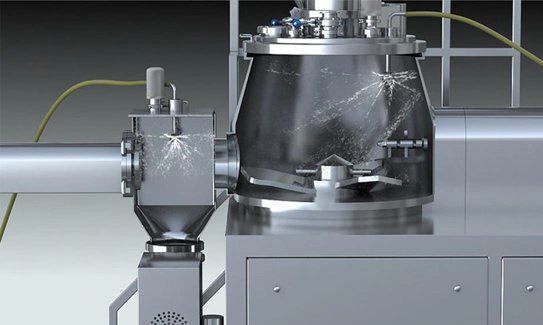
A standalone fluid bed dryer accepts wet granules discharged from an RMG, high-shear granulator, or plough shear mixer and dries them to target LOD (<2%) using fluidised heated air (40–90°C, 0.5–2.5 m/s) without a spray system. Processing 1–500 kg batches in 15–60 minutes with inlet air volumes of 50–30,000 m³/h, it is the most widely used standalone pharmaceutical drying unit — complementing batch RMG lines in dedicated granulation suites.
Challenges
Granule Attrition at High Fluidisation Velocity
Fragile wet granules fracture above minimum velocity — fines increase in final product.
Granule Channelling from Distributor Plate Blockage
Product fines block plate holes initially — channelling and incomplete fluidisation.
Over-Drying After LOD Endpoint at Extended Cycle
Continued airflow dries granules below target LOD — over-dried brittle granule results.
Transfer Loss and Segregation Between RMG and FBD
Open gravity transfer generates dust and causes granule size segregation.
Filter Bag Cross-Contamination in Multi-Product Suite
API powder trapped in bag fabric between changeovers — cross-contamination risk.
Solutions
- Inlet Air Velocity Ramp (0.3 m/s Start → 2.0 m/s at 5 min): Gradual increase allows granule strength to develop before full fluidisation velocity.
- Vibration-Assisted Distributor Plate Cleaning (Pulse Every 5 min): Plate vibration dislodges fines from holes — sustained uniform air distribution.
- LOD-Based Automated Endpoint (Exhaust Humidity PID + Temperature Plateau): Dual-parameter control stops drying at target LOD — prevents over-drying.
- Contained SBV RMG-to-FBD Transfer: Split butterfly valve connection eliminates open transfer, dust, and segregation.
- Single-Use PE Filter Bag Liner (HPAPI) or Validated Ultrasonic Bag Wash: PE liner disposed per batch (HPAPI); ultrasonic wash validated for standard products.
Applications
- Pharmaceutical: Wet granule final drying after RMG granulation for tablet and capsule manufacture.
- Nutraceuticals: Supplement granule drying after wet agglomeration — vitamin, mineral, herbal.
- Food & Beverage: Instant food granule drying, seasoning granule moisture reduction.
- Chemical: Specialty chemical granule drying after wet agglomeration process.
- Cosmetics: Pressed compact granule drying after wet granulation.
Models & Capacities
2D. Standalone Fluid Bed Dryer (FBD) — Models & Capacities (Indicative values; performance depends on product properties and process parameters. * At jacket surface temperature 60°C) | |||||||||||
Model | Net Vol. [L] | Batch Size [kg] | Inlet Air [m³/h] | Inlet Temp [°C] | Max Evap. Water* [kg/h] | Max Evap. Ethanol* [kg/h] | LOD [%] | Filter Area [m²] | Bowl Ø [mm] | Bowl H [mm] | Overall H [mm] |
FBD-001 | 1.5 | 1 | 50–250 | 30–90 | 1 | 3 | <2 | 0.5 | 300 | 350 | 2,000 |
FBD-003 | 5 | 3 | 100–500 | 30–90 | 2 | 5 | <2 | 1.0 | 400 | 450 | 2,200 |
FBD-010 | 15 | 10 | 300–1,000 | 30–90 | 5 | 12 | <2 | 2.0 | 550 | 600 | 2,600 |
FBD-030 | 45 | 30 | 800–2,500 | 40–90 | 12 | 30 | <2 | 4.0 | 750 | 800 | 3,100 |
FBD-060 | 90 | 60 | 1,500–5,000 | 40–90 | 20 | 50 | <2 | 7.0 | 1,000 | 950 | 3,700 |
FBD-120 | 180 | 120 | 3,000–9,000 | 40–90 | 35 | 85 | <2 | 12 | 1,200 | 1,150 | 4,200 |
FBD-200 | 300 | 200 | 5,000–15,000 | 40–90 | 55 | 130 | <2 | 18 | 1,500 | 1,380 | 5,000 |
FBD-300 | 450 | 300 | 7,000–22,000 | 40–90 | 80 | 190 | <2 | 25 | 1,800 | 1,600 | 5,800 |
FBD-500 | 750 | 500 | 10,000–30,000 | 40–90 | 120 | 280 | <2 | 40 | 2,200 | 1,900 | 7,000 |