
Bottom-Spray Fluid Bed Coater — Wurster Column
A Wurster bottom-spray coater uses a vertical partition tube inside the bowl to create a controlled riser-annulus circulation — suspending particles past an upward-facing spray nozzle at the base for precise film coating, taste masking, or enteric membrane application. Processing 0.5–300 kg batches, it achieves coating uniformity of ±2–5% weight gain and film thickness of 5–200 µm — the GMP standard for modified-release pellet and multi-particulate coating in pharmaceutical solid dosage manufacture.
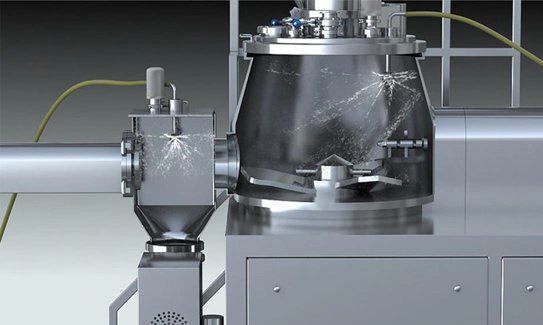
Particles are loaded; Wurster tube and partition height are set for product bulk density. High-velocity air through the central partition creates a riser zone — drawing particles up past the bottom spray nozzle where atomised coating solution is applied. Particles decelerate at the top, cascade down the annulus, and return to the base — achieving 50–200 coating passes per batch. Inlet air (30–70°C) simultaneously evaporates the coating solvent, building the film layer by layer with each pass through the spray zone.
Challenges
Particle Agglomeration from Excess Spray Rate
Excess coating rate creates liquid bridges — agglomerate formation during coating run.
Non-Uniform Coating Annulus vs. Riser Particles
Annulus particles receive fewer spray passes — coating weight gain variance increases.
Nozzle Wear from Abrasive Coating Suspension (TiO₂, CaCO₃)
Abrasive pigment erodes nozzle orifice — spray angle changes and pattern becomes non-uniform.
Friable Pellet Attrition in High-Velocity Riser Zone
Soft MCC or starch pellets fracture at riser air velocity above 12 m/s.
Film Defects from Spray Drying at High Inlet Temperature
Inlet air above 65°C dries droplets before impact — porous, rough coating results.
Solutions
- Mass-Flow Peristaltic Pump (±2% Spray Rate Control): Gravimetric control maintains coating rate at setpoint — prevents liquid bridge formation.
- Adjustable Partition Height (5 Positions, 5 mm Increments): Partition height matched to product bulk density — equalises riser velocity and spray passes.
- Ceramic or Tungsten Carbide Nozzle Orifice Insert: Hard-material insert extends nozzle life 10× against abrasive pigment suspensions.
- Inlet Air Velocity Ramp (3 m/s Start → 8–12 m/s Steady State): Gentle ramp prevents high-velocity impact on friable pellets at start-up.
- Inlet Temp Reduction to 45–55°C for Aqueous Coating: Lower temperature maintains droplet moisture during flight — smooth, non-porous film.
Applications
- Pharmaceutical: Enteric coating (Eudragit), sustained-release pellet, taste masking, immediate-release film coating.
- Nutraceuticals: Vitamin pellet coating, probiotic microencapsulation, omega-3 lipid protection coating.
- Food & Beverage: Sugar-free coating, flavour microencapsulation, controlled-release salt and sweetener pellet.
- Chemical: Catalyst pellet functional coating, controlled-release fertiliser, agrochemical surface coating.
- Cosmetics: Fragrance microsphere coating, active ingredient pellet protection coating.
Models & Capacities
2B. Wurster Bottom-Spray Coater — Models & Capacities | |||||||||||
Model | Net Vol. [L] | Batch Size [kg] | Inlet Air [m³/h] | Inlet Temp [°C] | Spray Rate [g/min] | Coating Unif. [%] | Film [µm] | Bowl Ø [mm] | Bowl H [mm] | Overall H [mm] | Connected Load [kW] |
FBG-WU-0.5 | 1 | 0.5 | 30–150 | 25–70 | 5–30 | ±2–5 | 5–200 | 250 | 350 | 2,400 | 6 |
FBG-WU-003 | 5 | 3 | 150–600 | 25–70 | 20–100 | ±2–5 | 5–200 | 400 | 500 | 2,800 | 12 |
FBG-WU-015 | 22 | 15 | 500–2,000 | 25–70 | 80–300 | ±2–5 | 5–200 | 650 | 700 | 3,400 | 25 |
FBG-WU-030 | 45 | 30 | 1,000–4,000 | 25–70 | 150–600 | ±2–5 | 5–200 | 900 | 900 | 4,000 | 40 |
FBG-WU-060 | 90 | 60 | 2,000–7,000 | 25–70 | 300–1,000 | ±2–5 | 5–200 | 1,200 | 1,150 | 4,800 | 65 |
FBG-WU-150 | 225 | 150 | 4,000–14,000 | 25–70 | 600–2,000 | ±2–5 | 5–200 | 1,600 | 1,380 | 5,800 | 100 |
FBG-WU-300 | 450 | 300 | 8,000–25,000 | 25–70 | 1,000–3,500 | ±2–5 | 5–200 | 2,000 | 1,700 | 7,000 | 160 |