
Hopper-Bottom Mass Flow Silo
A hopper-bottom mass flow silo uses a steep 70 degree polished cone engineered from measured powder flow properties so the entire contents move together in first-in first-out sequence. It prevents ratholing, caking, and batch mixing for cohesive and segregation-prone powders, serving pharma, food, and specialty chemical process feeds from 2 to 100 m3.
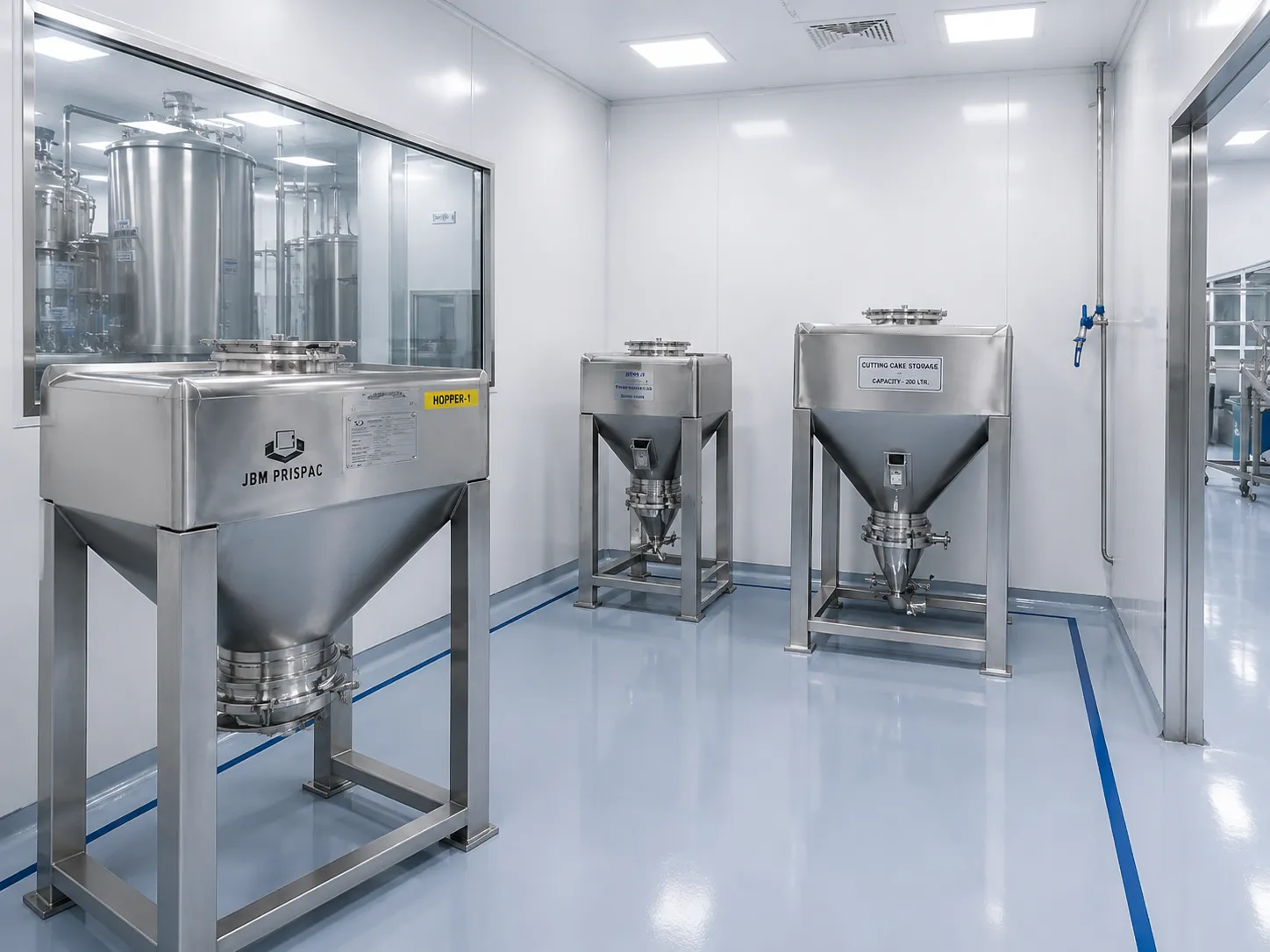
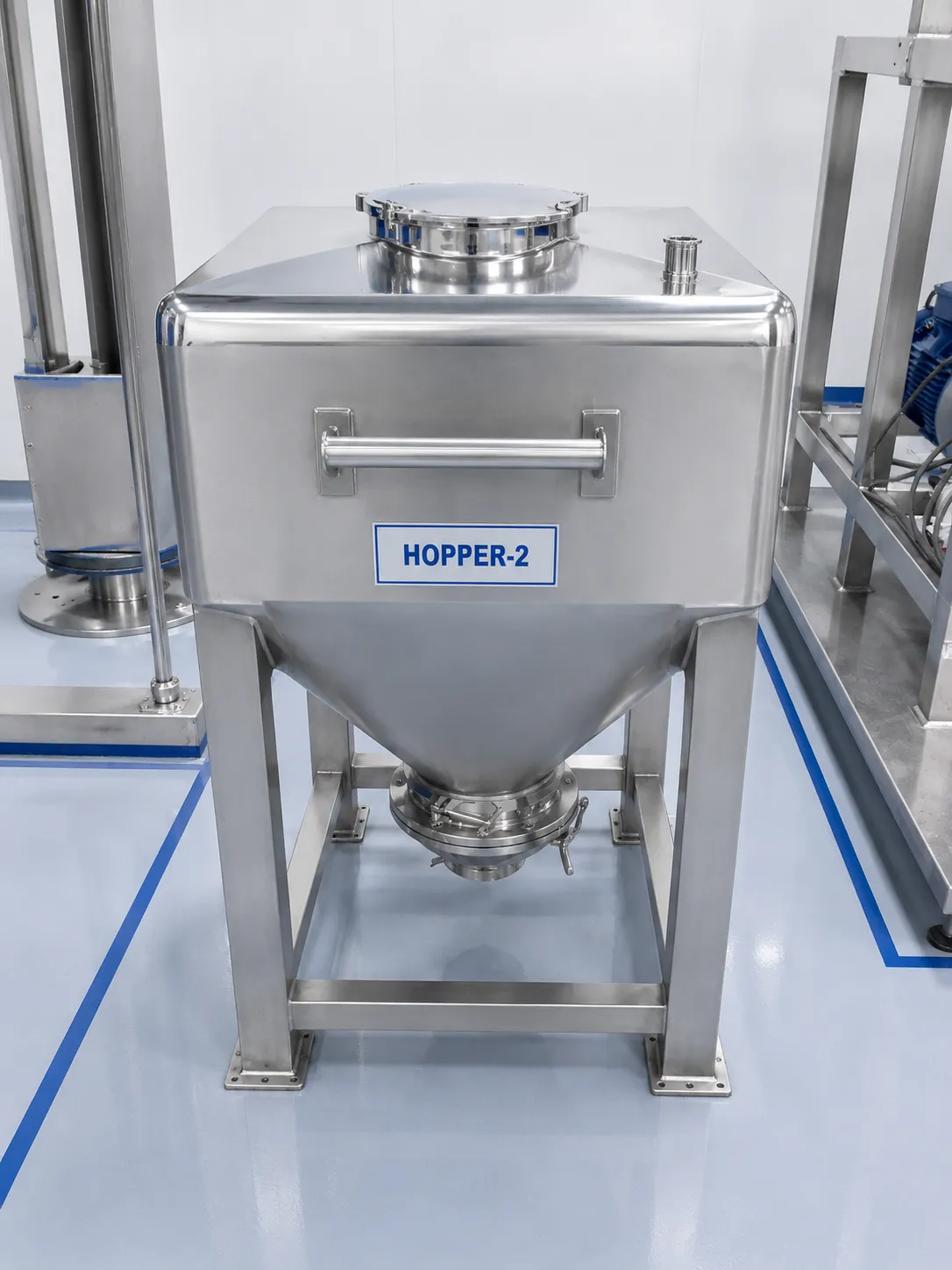
Wall friction angle and flow function of the actual powder are measured by shear cell testing. Cone angle and outlet diameter are then selected so wall shear exceeds the powder’s flow resistance everywhere in the hopper, producing uniform velocity across the full cross section. Every particle moves whenever the outlet valve opens, so the first powder in is the first powder out.
Challenges
Cohesive Arch Formation at the Outlet
Cohesive powders form a stable arch spanning an undersized outlet, stopping flow completely until the arch is broken.
Wall Friction Increase Over Service Life
Surface roughening from abrasion or product film build-up raises wall friction, degrading a designed mass flow pattern into funnel flow.
Excessive Headroom Requirement
Steep 70 degree cones add substantial height, frequently conflicting with existing building headroom during retrofit projects.
Flushing of Aerated Fine Powders
Freshly conveyed fine powders retain entrained air and can flood uncontrolled through the outlet like a liquid.
Segregation During Top Filling
Central filling still causes trajectory segregation at the surface even when mass flow discharge later limits its effect.
Solutions
- Outlet Sized Above Critical Arching Diameter: Setting the outlet at least equal to the shear-test critical arching dimension, with a suitable feeder, prevents stable arch formation across the powder's moisture range.
- Mirror-Polished or Lined Cone Surface: Internal polish to Ra 0.4 micron on SS, or UHMWPE lining on carbon steel, maintains low wall friction throughout the silo service life.
- Expanded Flow Hybrid Geometry: A mass flow cone beneath a funnel flow upper section reduces total height while keeping mass flow across the critical discharge zone.
- Deaeration Residence and Controlled Feeder: Sizing the silo for minimum deaeration residence time and discharging through a rotary valve or screw feeder prevents flooding of aerated powder.
- Tangential or Distributor Inlet Arrangement: Inlet distributors that spread the fill stream limit surface segregation, and mass flow discharge then re-merges layers in fill order.
Applications
- Tablet Compression Feed Hopper Duty: FIFO feeding of final blends to tablet presses where batch integrity and blend uniformity are mandatory.
- Infant Formula and Nutritional Powder Feed: Segregation-free discharge of agglomerated nutritional powders to filling lines protecting scoop dose accuracy.
- Coffee, Cocoa, and Beverage Premix Feed: Controlled discharge of cohesive beverage powders to sachet and jar filling machines.
- Pigment and Toner Powder Handling: Reliable discharge of highly cohesive pigment and toner powders that arch in conventional hoppers.
- Catalyst and Specialty Chemical Dosing: First-in first-out storage of costly catalyst powders where shelf-life and lot traceability are controlled.
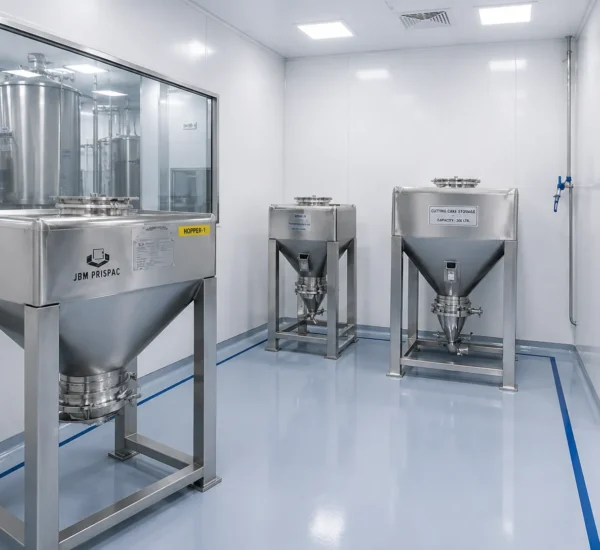
Model Range and Capacity: JBM-HS Series
Basis: 70 degree polished cone, 250 mm outlet, working volume 90 percent of gross.
| Model | Dia (m) | Cyl. Ht (m) | Overall Ht (m) | Gross Vol (m3) | Working Vol (m3) | Capacity (t) @ 0.6 t/m3 |
|---|---|---|---|---|---|---|
| JBM-HS-02 | 1.2 | 1.5 | 3.3 | 2.3 | 2.1 | 1.2 |
| JBM-HS-05 | 1.6 | 2.0 | 4.4 | 5.5 | 4.9 | 3.0 |
| JBM-HS-12 | 2.0 | 3.0 | 5.9 | 12.3 | 11.1 | 6.6 |
| JBM-HS-25 | 2.5 | 4.0 | 7.6 | 25.2 | 22.7 | 13.6 |
| JBM-HS-45 | 3.0 | 5.0 | 9.3 | 45.0 | 40.5 | 24.3 |
| JBM-HS-78 | 3.5 | 6.5 | 11.5 | 78.0 | 70.2 | 42.1 |