
Rotor-Stator Homogenizer
A rotor-stator homogenizer drives a precision-machined rotor at 3,000–30,000 RPM within a closely toleranced stator, generating intense shear in the narrow annular gap. Material is drawn axially into the generator and expelled radially through stator slots. Processing 1 mL to 20 L, it is the standard instrument for emulsification, particle size reduction, cell disruption, and powder dispersion across laboratory and pilot scales.
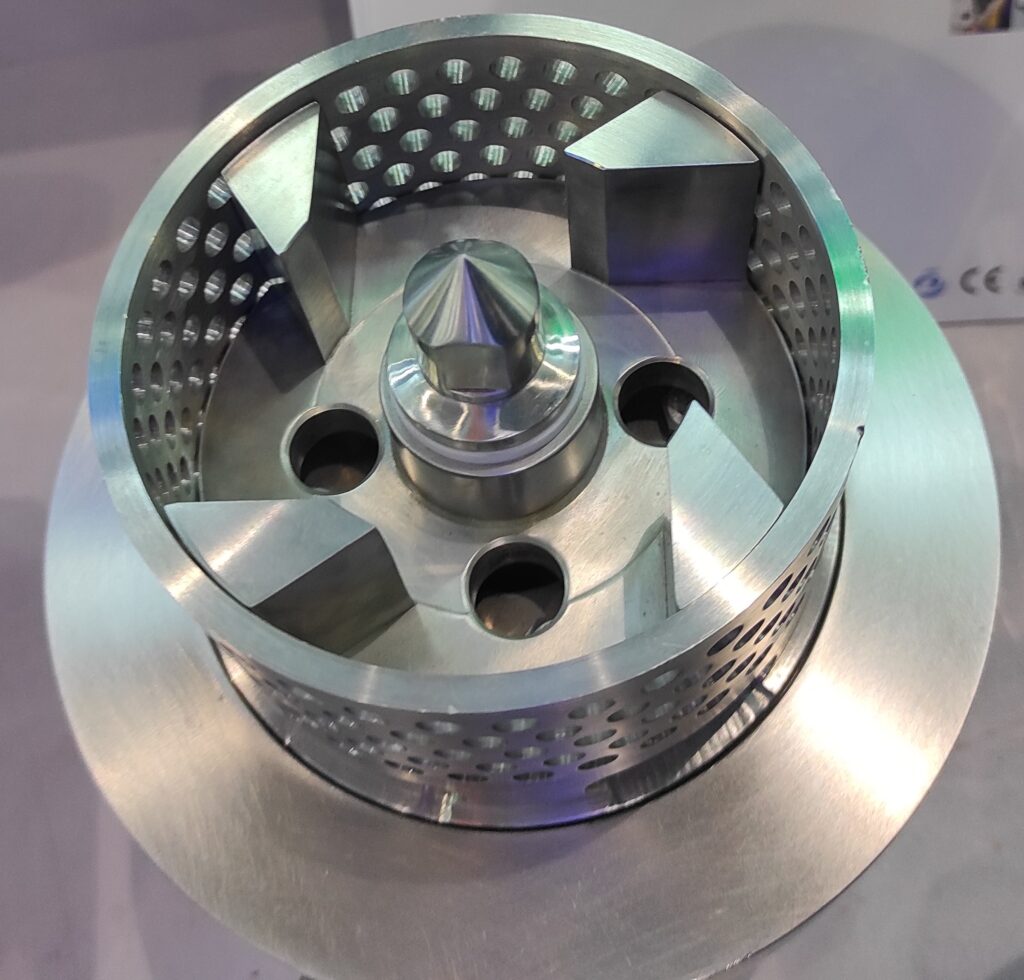
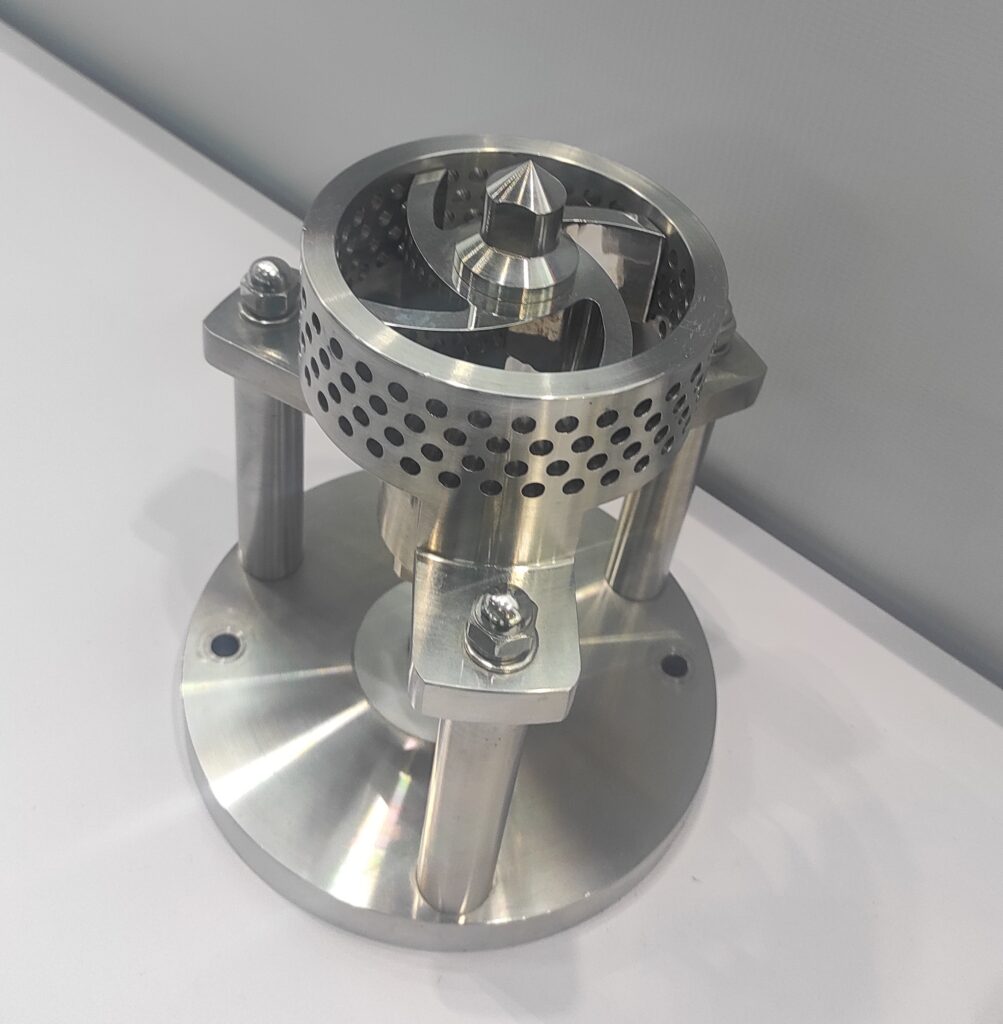
A rotor-stator homogenizer drives a precision-machined rotor at 3,000–30,000 RPM within a closely toleranced stator, generating intense shear in the narrow annular gap. Material is drawn axially into the generator and expelled radially through stator slots. Processing 1 mL to 20 L, it is the standard instrument for emulsification, particle size reduction, cell disruption, and powder dispersion across laboratory and pilot scales.
The spinning rotor draws liquid upward through the central bore and expels it radially at high velocity through stator slots, creating intense localised shear in the gap. This drives bulk recirculation throughout the vessel. Multiple passes progressively reduce droplet or particle size. Fine stator configurations maximise shear for emulsification and cell disruption; coarse stators suit viscous mixing and powder incorporation.
Challenges
Sample Overheating
Continuous high-speed operation transfers significant frictional energy into the sample, rapidly raising temperature and risking degradation of heat-sensitive biologics, proteins, and labile active ingredients.
Air Entrainment and Foam Formation
High-velocity fluid ejection at the stator outlet draws headspace air into the dispersion, generating foam that compromises product quality and homogeneity.
Rotor-Stator Gap Erosion
Abrasive particles in the sample progressively erode the precision-machined gap surfaces, reducing achievable shear rate and altering particle size reduction performance over time.
Non-Uniform Processing at Small Volumes
At very small working volumes, the recirculation path is short, creating uneven shear history across the sample and localised overprocessing near the generator.
Cross-Contamination Between Samples
Protein residues, cell debris, and pigments adhere within the tight gap geometry, requiring thorough cleaning validation between samples in multi-product environments.
Solutions
- Pulsed Operation with Ice Bath Cooling: Running in short alternating on and off cycles while the vessel is immersed in an ice bath limits cumulative heat input, protecting thermally sensitive samples during processing.
- Submerging Generator to 70–80% Vessel Depth: Positioning the generator well below the liquid surface prevents direct air entrainment into the high-shear zone, significantly reducing foam generation.
- Hardened or Ceramic Generator Sets: Specifying tungsten carbide or ceramic rotor-stator assemblies for abrasive applications extends service life and maintains gap geometry, preserving consistent shear performance.
- Microvolume Probe Sets for Small Samples: Using close-fit generator geometry designed specifically for small working volumes ensures complete sample recirculation and uniform shear history at volumes below 2 mL.
- Autoclavable or Single-Use Generator Assemblies: Using autoclavable stainless steel generators with validated cleaning protocols, or disposable single-use generators, eliminates cross-contamination risk between biological or pharmaceutical samples.
Applications
- Pharmaceutical Nanoemulsion and Nanosuspension Preparation: Reduction of API particle size and droplet size in oil-in-water nanoemulsions and nanosuspensions for improved bioavailability in oral and injectable formulations.
- Liposome Size Reduction for Drug Delivery: Controlled reduction of liposome particle size during formulation development of lipid-based drug delivery systems for parenteral administration.
- Cell Disruption for Intracellular Protein Extraction: Mechanical disruption of bacterial, yeast, and mammalian cells to release intracellular enzymes, recombinant proteins, and viral particles in bioprocess workflows.
- Food-Grade Emulsification (Dairy, Sauces, Dressings): Primary emulsification of oil-in-water food systems including mayonnaise, dairy creams, and salad dressings at laboratory and pilot scale prior to high-pressure homogeniser processing.
- Cosmetic Primary Emulsification (Creams, Lotions, Sunscreens): Formation of stable oil-in-water and water-in-oil emulsions during cosmetic formulation development, including dispersion of mineral UV filters in sunscreen bases.
Product Catalogue & Technical Datasheet
Handheld / Overhead Batch Rotor-Stator Homogeniser (0.05 mL Nano-Volume to 500 L Large Production) | ||||||||||||
Model | Scale | Working Vol. [mL – L] | Generator Ø [mm] | Speed Range [RPM] | Tip Speed [m/s] | Shear Rate [s⁻¹] | D50 [µm] | Max Visc. [cP] | Motor [W] | Shaft L [mm] | Shaft Ø [mm] | Weight [kg] |
RSH-NANO | Nano/micro | 0.05–1 mL | Ø4 | 5,000–30,000 VFD | 3–19 | 20,000–200,000 | 0.1–5 | <5,000 | 50 | 280 | Ø6 | 0.4 |
RSH-MICRO | Micro | 0.2–5 mL | Ø7 | 5,000–25,000 VFD | 4–23 | 15,000–150,000 | 0.2–10 | <8,000 | 80 | 310 | Ø8 | 0.6 |
RSH-LAB-080 | Lab | 1–50 mL | Ø8 | 3,000–25,000 VFD | 4–26 | 10,000–120,000 | 0.2–20 | <10,000 | 100 | 340 | Ø10 | 0.8 |
RSH-LAB-100 | Lab | 5–100 mL | Ø10 | 3,000–24,000 VFD | 5–25 | 10,000–100,000 | 0.5–30 | <15,000 | 150 | 360 | Ø10 | 1.0 |
RSH-LAB-130 | Lab | 10–250 mL | Ø13 | 3,000–22,000 VFD | 5–24 | 8,000–80,000 | 0.5–50 | <20,000 | 200 | 390 | Ø12 | 1.2 |
RSH-LAB-180 | Lab | 30–600 mL | Ø18 | 3,000–20,000 VFD | 5–19 | 5,000–60,000 | 1–80 | <30,000 | 300 | 430 | Ø12 | 1.5 |
RSH-LAB-250 | Lab | 50–1,000 mL | Ø25 | 3,000–18,000 VFD | 5–24 | 4,000–50,000 | 1–100 | <40,000 | 400 | 480 | Ø14 | 2.0 |
RSH-PIL-340 | Lab/Pilot | 100 mL–2 L | Ø34 | 3,000–16,000 VFD | 5–28 | 3,000–40,000 | 2–150 | <50,000 | 600 | 530 | Ø16 | 2.8 |
RSH-PIL-480 | Pilot | 500 mL–5 L | Ø48 | 1,500–12,000 VFD | 4–30 | 2,000–30,000 | 5–200 | <60,000 | 1,000 | 580 | Ø20 | 4.5 |
RSH-PIL-650 | Pilot | 1–10 L | Ø65 | 1,000–9,000 VFD | 3–31 | 1,500–25,000 | 5–300 | <80,000 | 1,500 | 640 | Ø25 | 7.0 |
RSH-P-095 | Production | 5–50 L | Ø95 | 500–5,000 VFD | 2–25 | 1,000–15,000 | 10–500 | <100,000 | 3,000 | 720 | Ø35 | 18 |
RSH-P-130 | Production | 10–100 L | Ø130 | 300–3,500 VFD | 2–24 | 800–12,000 | 10–500 | <120,000 | 5,500 | 800 | Ø45 | 32 |
RSH-LP-180 | Large Prod | 50–500 L | Ø180 | 200–2,500 VFD | 2–24 | 500–8,000 | 20–1,000 | <150,000 | 11,000 | 900 | Ø60 | 75 |