
Contained ANFD (HPAPI / OEB 3–5)
A contained ANFD achieves operator exposure below 1 µg/m³ (OEB 5) through split butterfly valve (SBV) or rapid transfer port (RTP) connections at every product inlet and outlet, glove-port-only internal access, a dedicated local exhaust ventilation system (LEV) maintaining −30 to −50 Pa vessel differential, and HEPA H14 exhaust filtration on all vent lines. Processing the same 5–4,000 L batch range as standard ANFD, it enables manufacture of cytotoxic, hormonal, and potent API at OEB 3–5 without any open product contact.
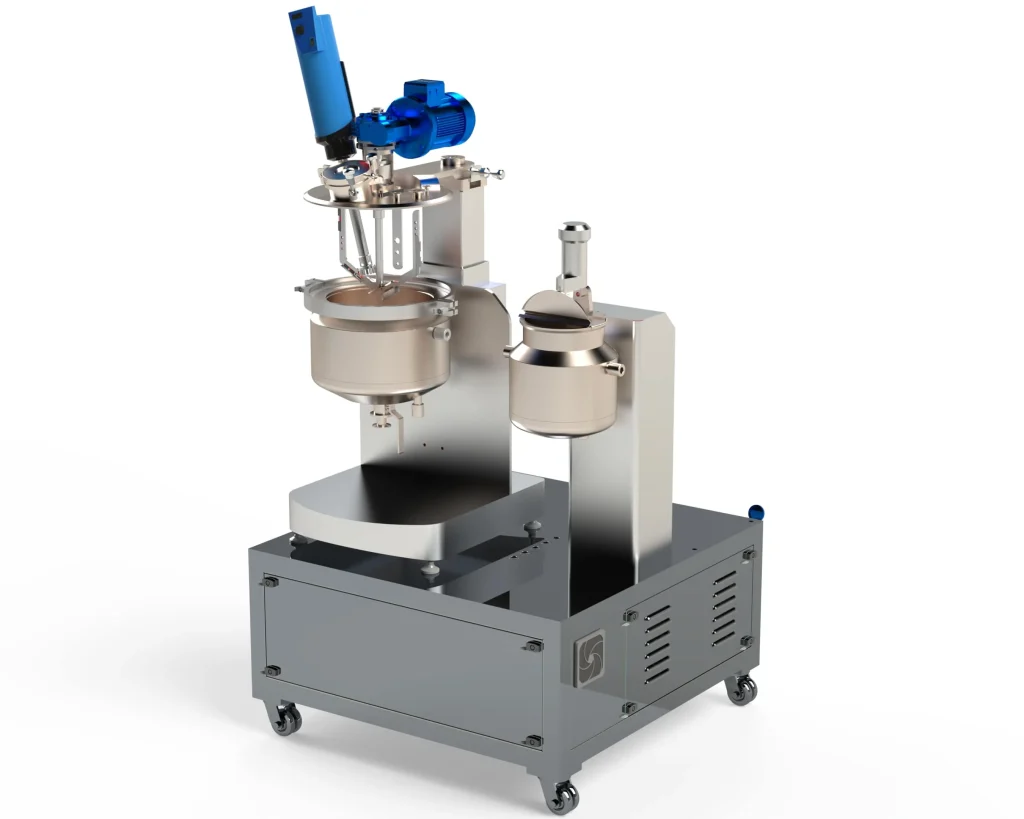
A contained ANFD achieves operator exposure below 1 µg/m³ (OEB 5) through split butterfly valve (SBV) or rapid transfer port (RTP) connections at every product inlet and outlet, glove-port-only internal access, a dedicated local exhaust ventilation system (LEV) maintaining −30 to −50 Pa vessel differential, and HEPA H14 exhaust filtration on all vent lines. Processing the same 5–4,000 L batch range as standard ANFD, it enables manufacture of cytotoxic, hormonal, and potent API at OEB 3–5 without any open product contact.
All product transfer steps — slurry charge, solvent wash addition, and dried cake discharge — use SBV or RTP mechanical docking interfaces that maintain double-interlock containment throughout each transfer. The vessel interior is maintained at negative differential pressure (−30 to −50 Pa) by a dedicated LEV with HEPA H14 exhaust — any seal leak draws filtered room air inward rather than releasing API outward. All sampling for IPC is performed through contained sampling valves without breaking the vessel seal. Cake discharge uses a bottom SBV into a nitrogen-purged lined drum or IBC.
Challenges
SBV/RTP Docking Misalignment During High-Frequency Production Transfers
Repeated docking cycles accumulate dimensional tolerance errors — misalignment risks containment breach at connection face.
LEV Negative Pressure Maintenance During Positive-Pressure Filtration
LEV suction must be balanced against positive filtration pressure on the process side — differential control is critical.
Glove-Port-Only Agitator Seal Inspection Without Opening Vessel
Agitator seal cannot be directly inspected without opening the vessel — degradation detected only after containment compromise.
Contained Cake Discharge of Sticky or Cohesive API Without Plugging
Bottom discharge valve can plug with cohesive dried cake — back-pressure or vibration needed to initiate flow.
Validated CIP of Contained Vessel Interior Including Glove Ports
All CIP operations performed through the sealed vessel — spray coverage must be validated at all glove-port-accessible surfaces.
Solutions
- Laser-Guided Docking Alignment System (±0.5 mm Tolerance): Docking station with laser guide ensures SBV face alignment within ±0.5 mm — zero leakage at connection.
- Pressure-Cascade Control (LEV Adjusts Automatically to Filtration Pressure): PLC-controlled LEV modulates suction to maintain −35 Pa differential regardless of filtration pressure on process side.
- Continuous Barrier Gas Monitoring (Nitrogen Pressure at Seal, PLC Alarm on Loss): Real-time barrier gas pressure monitoring — alarm triggers before seal integrity is compromised.
- Pneumatic Discharge Vibrator + N₂ Back-Pressure Assist on Bottom Valve: Pneumatic vibrator on vessel wall + N₂ back-pressure breaks cohesive cake arch — initiates contained discharge.
- Riboflavin Spray Test + TOC Swab Validation (Target <10 ppm TOC): Riboflavin spray test maps CIP spray coverage; TOC swab validates cleaning at all surfaces including glove-port zones.
Applications
- Pharmaceutical (Cytotoxic): Oncology API final isolation — OEB 5 validated; zero operator exposure throughout filtration, wash, and drying cycle.
- Pharmaceutical (Hormonal): Hormonal and steroidal API contained isolation — SBV connections throughout; HEPA-filtered exhaust.
- Pharmaceutical (Potent OEB 4): High-potency API (OEL 1–10 µg/m³) isolation in contained single-vessel operation with glove-port access only.
- Pharmaceutical (Controlled Substance): Schedule I–IV controlled substance isolation with full audit trail, access control, and electronic batch record.
- Research & Development: Gram-to-kilogram HPAPI feasibility isolation at pilot scale — contained, validated, and flexible.
Models & Capacities
Contained HPAPI ANFD — Models & Capacities (OEB 3–5, 0.10 m² Lab to 8.0 m² Production) | ||||||||||||
Model | Scale | Filter Area [m²] | Working Vol. [L] | Batch Size [kg] | OEB Level | LEV ΔP [Pa] | Inlet Connection | Outlet Connection | Glove Ports | Motor [kW] | Vacuum [mbar] |
|
ANFD-HP-010 | Lab | 0.10 | 15 | 1–6 | OEB 3–5 | −30 to −50 | SBV DN 50 | SBV DN 50 | 2 | 0.18 | 10–200 |
|
ANFD-HP-020 | Lab | 0.20 | 30 | 2–12 | OEB 3–5 | −30 to −50 | SBV DN 65 | SBV DN 65 | 2 | 0.25 | 10–200 |
|
ANFD-HP-050 | Pilot | 0.50 | 80 | 5–30 | OEB 3–5 | −30 to −50 | SBV DN 80 | SBV DN 80 | 2 | 0.37 | 10–100 |
|
ANFD-HP-100 | Pilot | 1.0 | 160 | 10–60 | OEB 4–5 | −30 to −50 | SBV DN 100 | SBV DN 100 | 4 | 0.75 | 10–100 |
|
ANFD-HP-200 | Pilot | 2.0 | 320 | 20–120 | OEB 4–5 | −30 to −50 | SBV DN 100 | SBV DN 100 | 4 | 1.5 | 10–80 |
|
ANFD-HP-040 | Production | 4.0 | 640 | 50–250 | OEB 4–5 | −30 to −50 | RTP DN 150 | SBV DN 150 | 4 | 3.0 | 10–50 |
|
ANFD-HP-060 | Production | 6.0 | 1,000 | 75–380 | OEB 4–5 | −30 to −50 | RTP DN 150 | SBV DN 150 | 4 | 5.5 | 10–50 |
|
ANFD-HP-080 | Production | 8.0 | 1,300 | 100–500 | OEB 4–5 | −30 to −50 | RTP DN 200 | SBV DN 200 | 6 | 7.5 | 10–50 |
|