
Agitated Rotary Cone Vacuum Dryer
An agitated rotary cone vacuum dryer adds an internal paddle or plough agitator (5–30 RPM) within the rotating cone the dual-motion drying combines conical tumbling (1–6 RPM cone rotation) and internal agitation to process cohesive pastes, filter cakes, and high-solids slurries that would otherwise form static zones in a standard RCVD. Processing 50–5,000 L, it provides 30–50% shorter drying cycles vs. standard RCVD on cohesive products and extends the RCVD's applicability from free-flowing powder to viscous pastes (up to 200,000 cP).
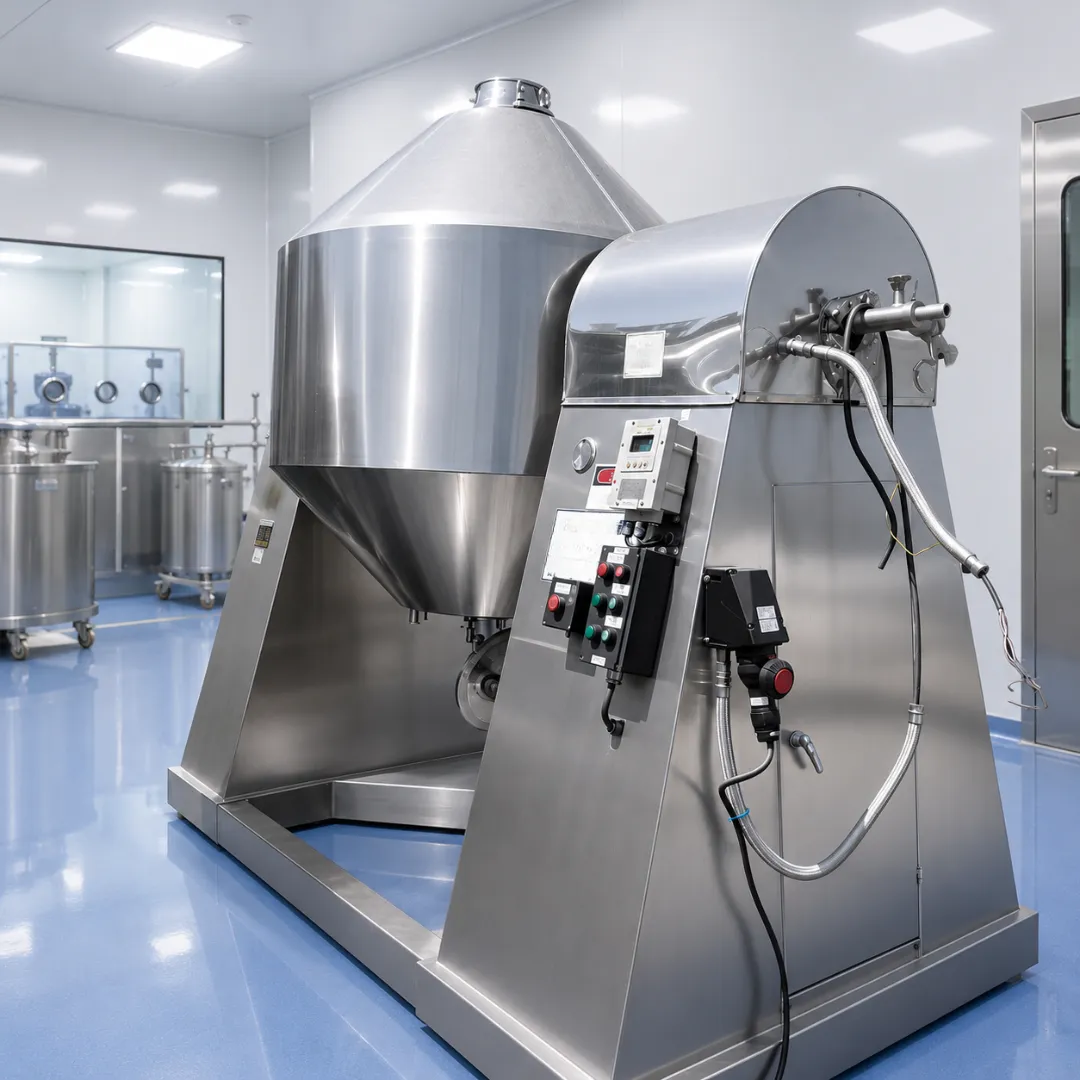
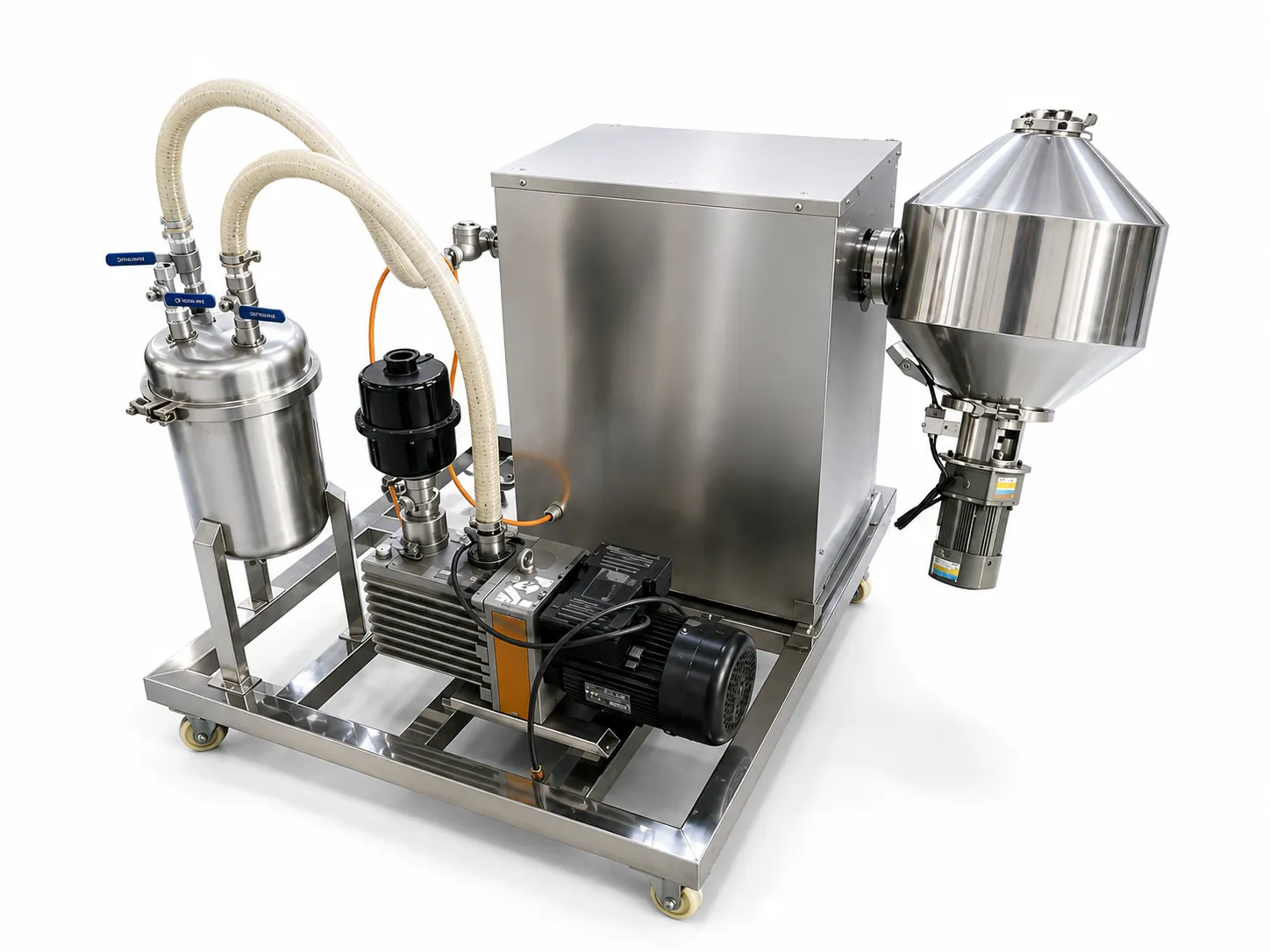
An agitated rotary cone vacuum dryer adds an internal paddle or plough agitator (5–30 RPM) within the rotating cone the dual-motion drying combines conical tumbling (1–6 RPM cone rotation) and internal agitation to process cohesive pastes, filter cakes, and high-solids slurries that would otherwise form static zones in a standard RCVD. Processing 50–5,000 L, it provides 30–50% shorter drying cycles vs. standard RCVD on cohesive products and extends the RCVD’s applicability from free-flowing powder to viscous pastes (up to 200,000 cP).
The conical vessel rotates at 1–6 RPM (outer tumbling motion) while an internal contra-rotating paddle or plough agitator rotates at 5–30 RPM in the opposite direction the differential rotation shears and redistributes material that would otherwise pack in the cone. Jacket heating and vacuum operate simultaneously as in the standard RCVD. The internal agitator is driven through a co-axial sealed hollow shaft the outer shaft rotates the cone and the inner shaft drives the agitator at independent speed from a dual-drive gearbox.
Challenges
Co-Axial Dual Drive Shaft Seal Integrity (Inner + Outer Shaft Simultaneously Rotating)
Two concentric rotating shafts at different speeds under vacuum dual seal complexity.
Agitator-to-Cone Wall Clearance at Thermal Expansion
Cone wall thermal expansion may reduce agitator tip clearance contact risk at elevated temperature.
Higher Drive Train Maintenance vs. Standard RCVD
Dual gearbox (cone + agitator) at different speeds more complex scheduled maintenance.
CIP of Co-Axial Shaft Assembly
Co-axial shaft annular space between outer and inner shafts creates CIP dead zone.
Agitator Blade Wear from Abrasive Crystalline Feed
Internal agitator contacts abrasive crystals at tip wear increases clearance over time.
Solutions
- Pressurised Dual Mechanical Seal Assembly (API-682, Co-Axial Rated): Dual co-axial mechanical seal with individual barrier fluid per shaft rated to −0.95 bar.
- Thermal Expansion Compensated Agitator Tip (Spring-Loaded Ceramic Tips): Spring-loaded ceramic tip inserts on agitator blades absorb thermal expansion zero contact.
- Modular Dual-Gearbox Cartridge (Single-Lift Extraction): Both drives housed in extractable cartridge 60-minute service swap vs. full disassembly.
- Annular Shaft CIP Flush Circuit (Dedicated Port, Full-Length Flush): CIP fluid injected through annular flush port purges co-axial space from base to top.
- HVOF Hard-Facing on Agitator Blade Tips (Tungsten Carbide, HRC 60): Hard-faced tips resist abrasive crystal wear 5× service life vs. standard SS 316L blade.
Applications
- Pharmaceutical: API paste and filter cake drying where RCVD lacks agitation reduced cycle time vs. standard RCVD.
- Chemical: High-viscosity intermediate drying, paste-to-powder transition, solvent-wet resin drying.
- Nutraceuticals: Viscous botanical extract paste drying agitation achieves uniform LOD on cohesive material.
- Agrochemical: Filter cake and slurry drying of active ingredient agitation prevents cake cracking.
- Cosmetics: Viscous wax-cream intermediate drying agitation prevents wall crust formation.
Models & Capacities
| Type 2B Agitated Rotary Cone Vacuum Dryer: Models & Capacities (* At jacket surface temperature 50°C) | ||||||||||||||
|---|---|---|---|---|---|---|---|---|---|---|---|---|---|---|
| Model | Scale | Working Vol. [L] | Batch Size [kg] | Cone Rotation [RPM] | Agitator Speed [RPM] | Cone Motor [kW] | Agitator Motor [kW] | Jacket Temp [°C] | Vacuum [bar abs.] | Max Evap. Water* [kg/h] | Max Evap. Ethanol* [kg/h] | Jacket Area [m²] | Overall H [mm] | Weight [kg] |
| RCVD-AG-050 | Lab/Pilot | 35 | 10–25 | 1–6 VFD | 5–30 VFD | 0.75 | 0.37 | 30–150 | 0.02–0.15 | 1.5 | 4 | 0.22 | 2,200 | 480 |
| RCVD-AG-100 | Pilot | 70 | 20–50 | 1–6 VFD | 5–30 VFD | 1.1 | 0.55 | 30–150 | 0.02–0.15 | 3 | 8 | 0.40 | 2,800 | 780 |
| RCVD-AG-250 | Pilot/Prod | 175 | 50–125 | 1–6 VFD | 5–25 VFD | 1.5 | 0.75 | 30–150 | 0.02–0.15 | 7 | 18 | 0.80 | 3,600 | 1,500 |
| RCVD-AG-500 | Production | 350 | 100–250 | 1–5 VFD | 5–25 VFD | 2.2 | 1.1 | 30–150 | 0.02–0.15 | 12 | 30 | 1.35 | 4,400 | 2,800 |
| RCVD-AG-1000 | Production | 700 | 200–500 | 1–5 VFD | 5–20 VFD | 3.0 | 1.5 | 30–150 | 0.02–0.15 | 20 | 50 | 2.20 | 5,500 | 5,500 |
| RCVD-AG-2000 | Production | 1,400 | 400–1,000 | 1–4 VFD | 5–15 VFD | 4.0 | 2.2 | 30–150 | 0.02–0.15 | 35 | 88 | 3.80 | 6,800 | 10,500 |
| RCVD-AG-3000 | Large Prod | 2,100 | 600–1,500 | 1–4 VFD | 5–15 VFD | 5.5 | 3.0 | 30–150 | 0.02–0.15 | 50 | 125 | 5.50 | 8,200 | 17,000 |
| RCVD-AG-5000 | Large Prod | 3,500 | 1,000–2,500 | 1–3 VFD | 4–12 VFD | 7.5 | 4.0 | 30–150 | 0.02–0.15 | 80 | 200 | 8.00 | 10,000 | 28,000 |