
Multi-Stage Inline Vacuum Siever (2–3 Screen Stages)
A multi-stage inline vacuum Siever houses 2 or 3 stacked screen stages of decreasing aperture within a single sealed body powder drawn by vacuum passes through each screen stage sequentially, receiving progressive de-lumping and classification in one inline pass. Processing 100–5,000 kg/h, it simultaneously removes large lumps on the coarse top screen (2–5 mm) and oversized particles on the fine bottom screen (150–500 µm) providing dual-stage quality assurance in a single compact inline unit without requiring two separate Siever installations in series.
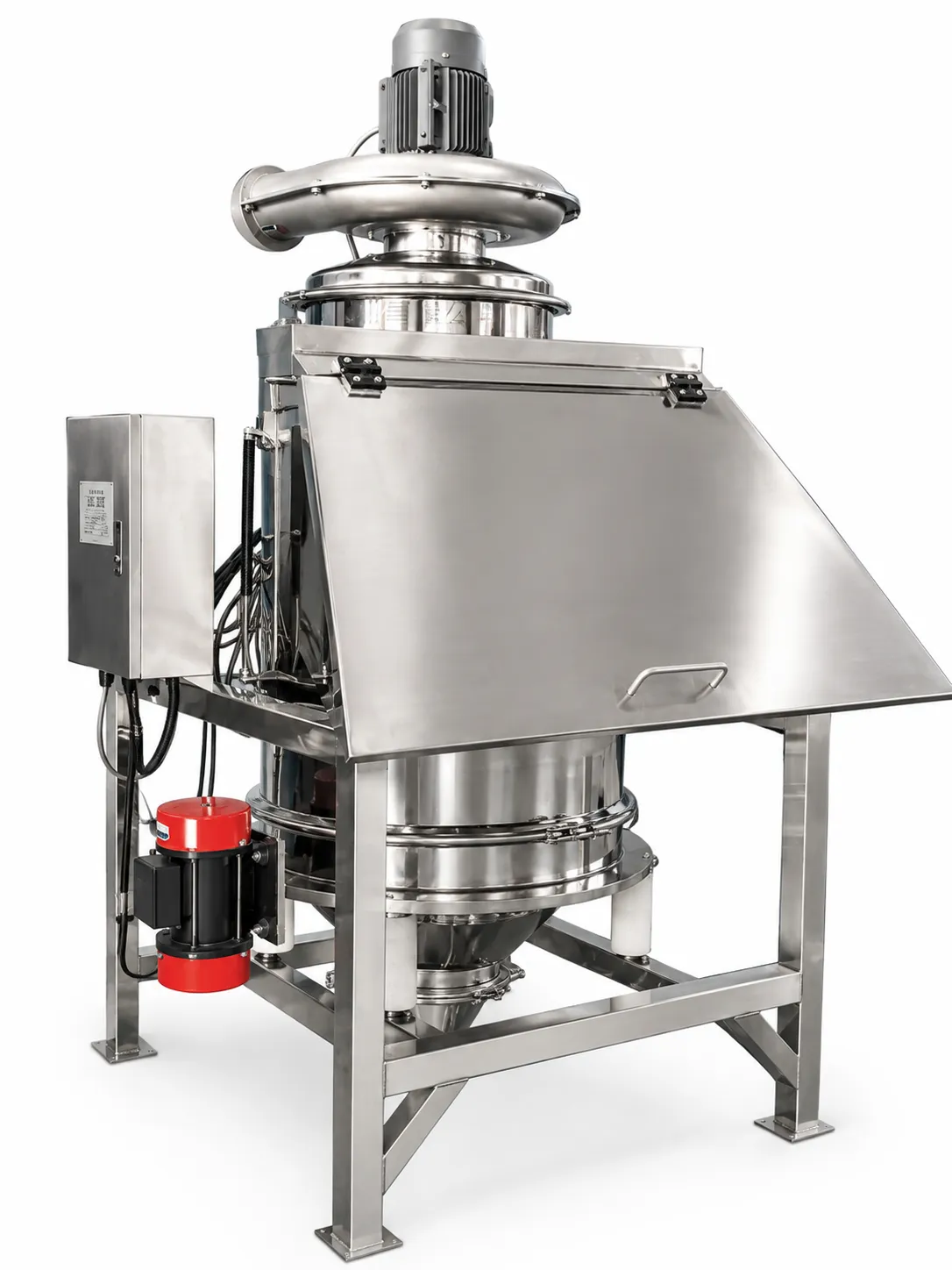
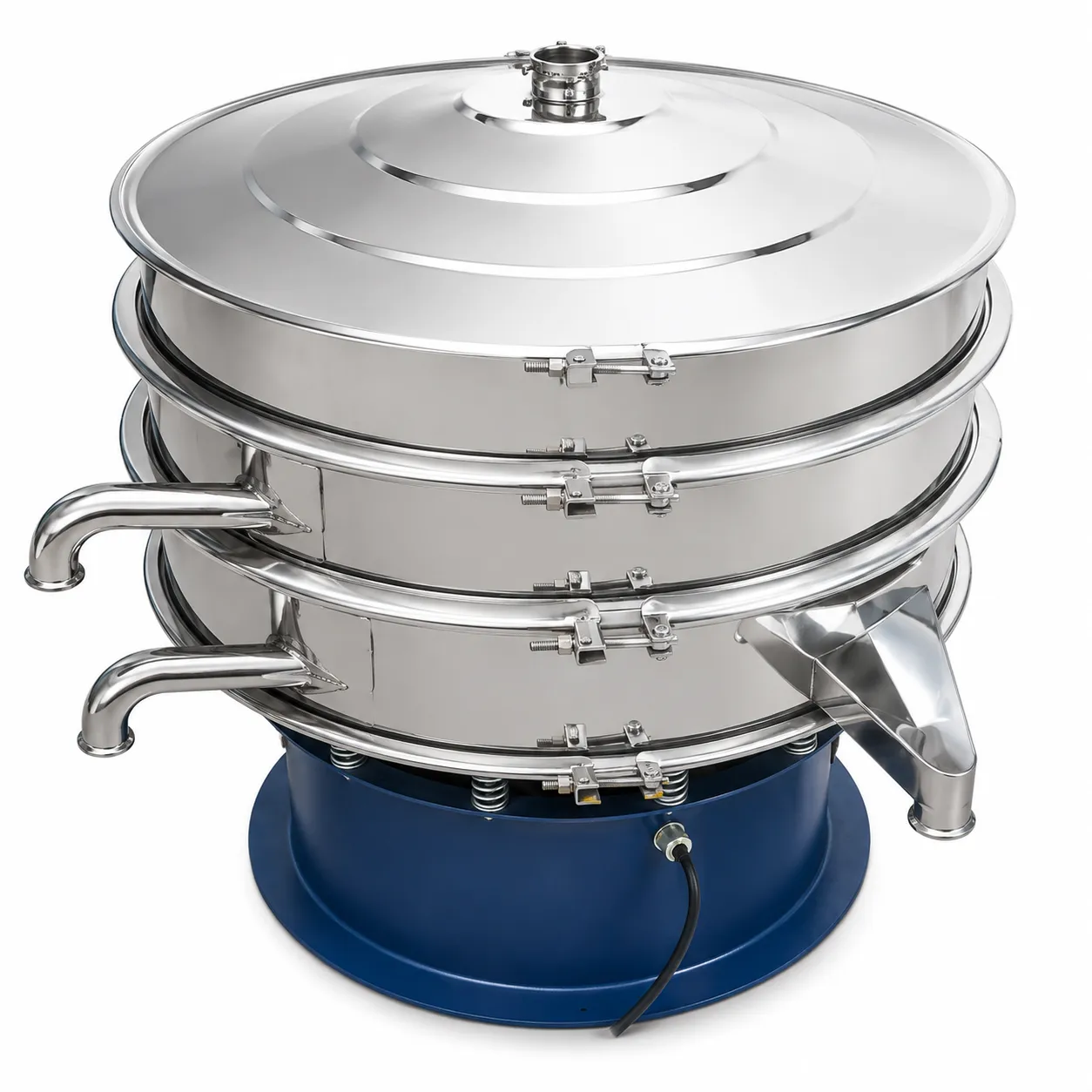
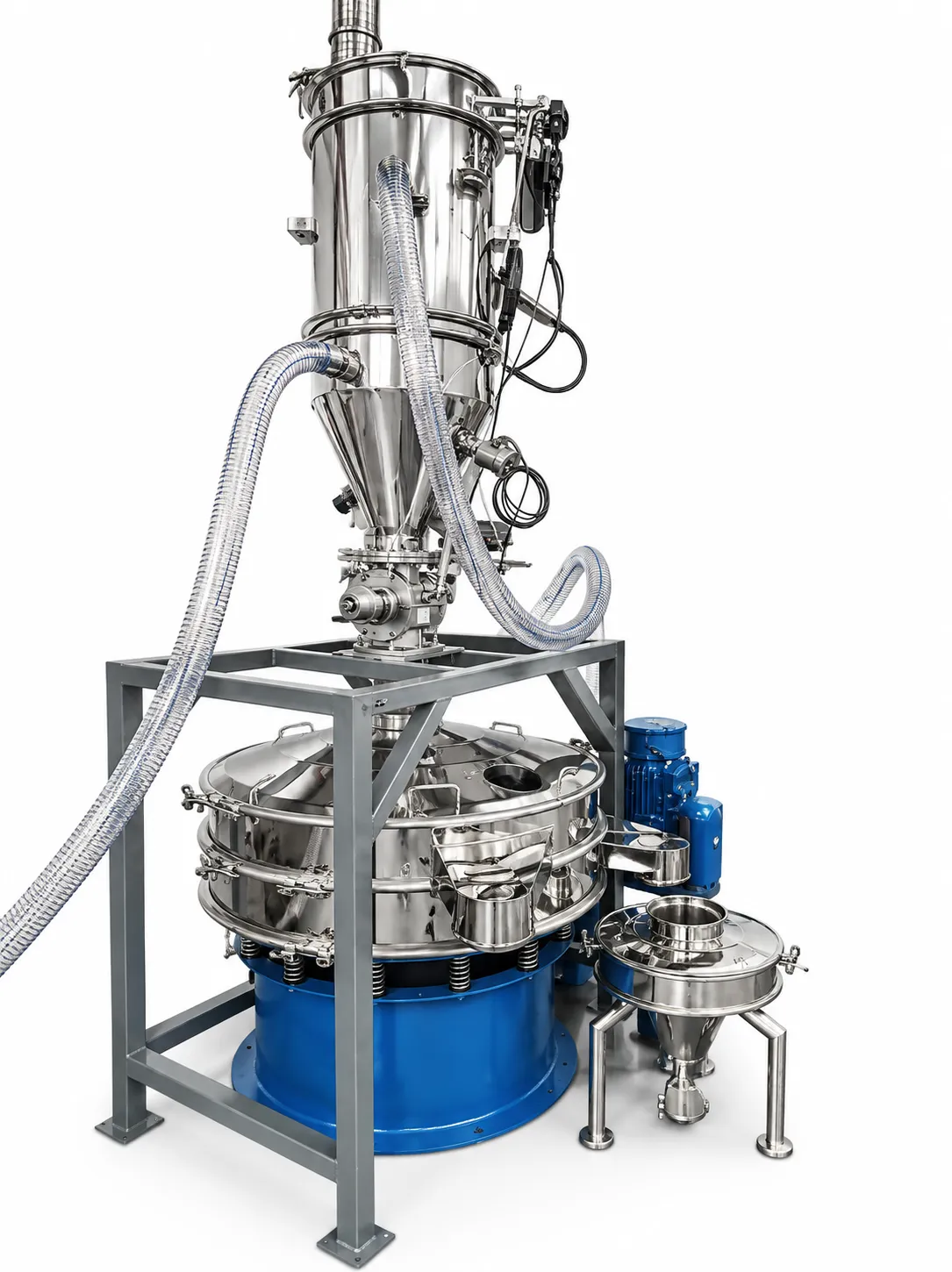
A multi-stage inline vacuum Siever houses 2 or 3 stacked screen stages of decreasing aperture within a single sealed body powder drawn by vacuum passes through each screen stage sequentially, receiving progressive de-lumping and classification in one inline pass. Processing 100–5,000 kg/h, it simultaneously removes large lumps on the coarse top screen (2–5 mm) and oversized particles on the fine bottom screen (150–500 µm) providing dual-stage quality assurance in a single compact inline unit without requiring two separate Siever installations in series.
Vacuum draws powder-laden air from the source through the top inlet into the first (coarsest) screen stage large lumps above the top screen aperture are retained and collected. Powder passing the first screen enters the inter-stage chamber and is drawn through the second (finer) screen secondary oversize is retained and collected separately. Passed product exits through the bottom outlet to the receiving vessel. Each stage has an independent reverse pulse clean nozzle on a staggered timed sequence Stage 1 pulses while Stage 2 sifts, then Stage 2 pulses while Stage 1 recovers maintaining continuous transfer without simultaneous pressure spikes on both stages. Independent reject valve per stage allows separate collection of course and fine reject.
Challenges
Pressure Drop Across Two Screens Reducing Transfer Rate vs. Single Stage
Cumulative pressure drop across two screen stages reduces net vacuum and transfer rate by 20–35%.
Stage-to-Stage Carry-Over of Fine Reject into Stage 2
Fine particles dislodged from Stage 1 by pulsing can bypass Stage 2 at high velocity contaminate passed product.
Independent Reject Management for Each Stage (Two Separate Reject Streams)
Two separate reject outlets require two collection vessels increases system complexity and footprint.
Staggered Pulse Sequence Timing Optimisation for Different Products
Pulse timing valid for one product may cause pressure interference for a denser or more cohesive product.
Screen Change for Lower Stage Requiring Upper Stage Removal
Bottom screen access requires top screen removal longer screen change downtime than single-stage.
Solutions
- Vacuum Pump Sized for 1.5× Combined Stage Pressure Drop: Pump oversized for dual-stage load transfer rate maintained within 90% of single-stage equivalent.
- Inter-Stage Settling Chamber (200 mm Static Zone Between Stages): Static settling zone between stages allows pulse-dislodged fines to settle prevented from entering Stage 2.
- Common Reject Collection Vessel with Dual-Port Inlet (Both Stages to One Vessel): Single reject vessel with two inlet ports collects both stage rejects halves footprint and vessel count.
- Adaptive Pulse Timing PLC Algorithm (Monitors ΔP per Stage, Adjusts Pulse Interval): PLC adjusts pulse timing per stage based on real-time ΔP optimal timing for each product automatically.
- Independent Screen Cassette per Stage (Tool-Free, <3 min per Stage): Each stage has independent cassette lower stage accessible after upper stage cassette removal in <3 min total.
Applications
- Pharmaceutical: Dual-stage API powder inline sieving removes agglomerates (Stage 1, 2 mm) and oversize (Stage 2, 500 µm) in one pass.
- Food & Beverage: Dual-stage flour and starch inline sieving remove insect screen (5 mm) and oversize grains (500 µm) simultaneously.
- Chemical: Dual-classification of specialty powder primary coarse reject and secondary fine oversize in single inline step.
- Nutraceuticals: Two-fraction inline quality assurance of supplement powder dual cut points in single vacuum transfer.
- Cosmetics: Dual-stage mineral powder inline classification primary agglomerate rejection and secondary oversize control.
Models & Capacities
| Type 3 Multi-Stage Inline Vacuum Siever (2–3 Screens): Models & Capacities | |||||||||||
|---|---|---|---|---|---|---|---|---|---|---|---|
| Model | Scale | Transfer Rate [kg/h] | Body Ø [mm] | Stage 1 Aperture [mm] | Stage 2 Aperture [µm–mm] | Stage 3 Aperture [µm] | Stages | Vacuum Level [bar] | Inlet/Outlet Ø [mm] | Body L [mm] | |
| IVS-MS2-LAB | Lab | 50–150 | Ø150 | 2–5 | 150 µm–2 mm | 2 | −0.2 to −0.8 | Ø50 | 480 | ||
| IVS-MS2-PIL | Pilot | 100–400 | Ø200 | 2–5 | 150 µm–2 mm | 2 | −0.2 to −0.8 | Ø65 | 620 | ||
| IVS-MS2-500 | Production | 200–1,000 | Ø280 | 2–5 | 200 µm–2 mm | 2 | −0.2 to −0.8 | Ø80 | 800 | ||
| IVS-MS2-1000 | Production | 400–2,000 | Ø350 | 2–5 | 200 µm–2 mm | 2 | −0.2 to −0.8 | Ø100 | 950 | ||
| IVS-MS2-2000 | Production | 800–3,500 | Ø450 | 3–5 | 250 µm–2 mm | 2 | −0.2 to −0.8 | Ø125 | 1,150 | ||
| IVS-MS3-PIL | Pilot | 100–300 | Ø200 | 5 | 1–2 mm | 200–500 µm | 3 | −0.2 to −0.8 | Ø65 | 820 | |
| IVS-MS3-500 | Production | 200–800 | Ø280 | 5 | 1–2 mm | 200–500 µm | 3 | −0.2 to −0.8 | Ø80 | 1,050 | |
| IVS-MS3-1500 | Production | 500–2,500 | Ø400 | 5 | 1–2 mm | 200–500 µm | 3 | −0.2 to −0.8 | Ø125 | 1,350 | |
| IVS-MS2-5000 | Large Prod | 1,500–5,000 | Ø630 | 3–5 | 300 µm–2 mm | 2 | −0.2 to −0.8 | Ø200 | 1,500 | ||