
Rotary Sieve (Drum Sifter)
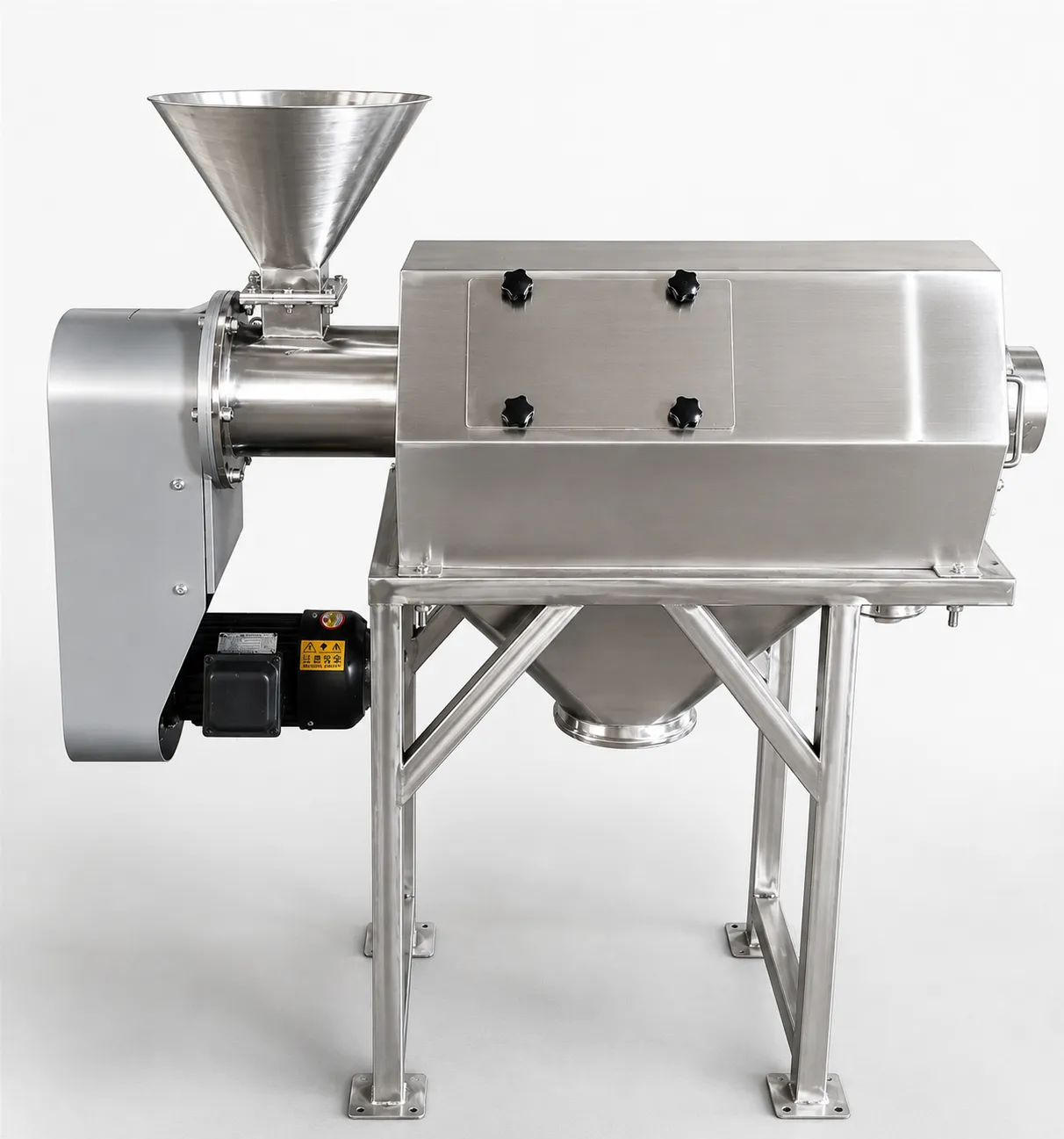
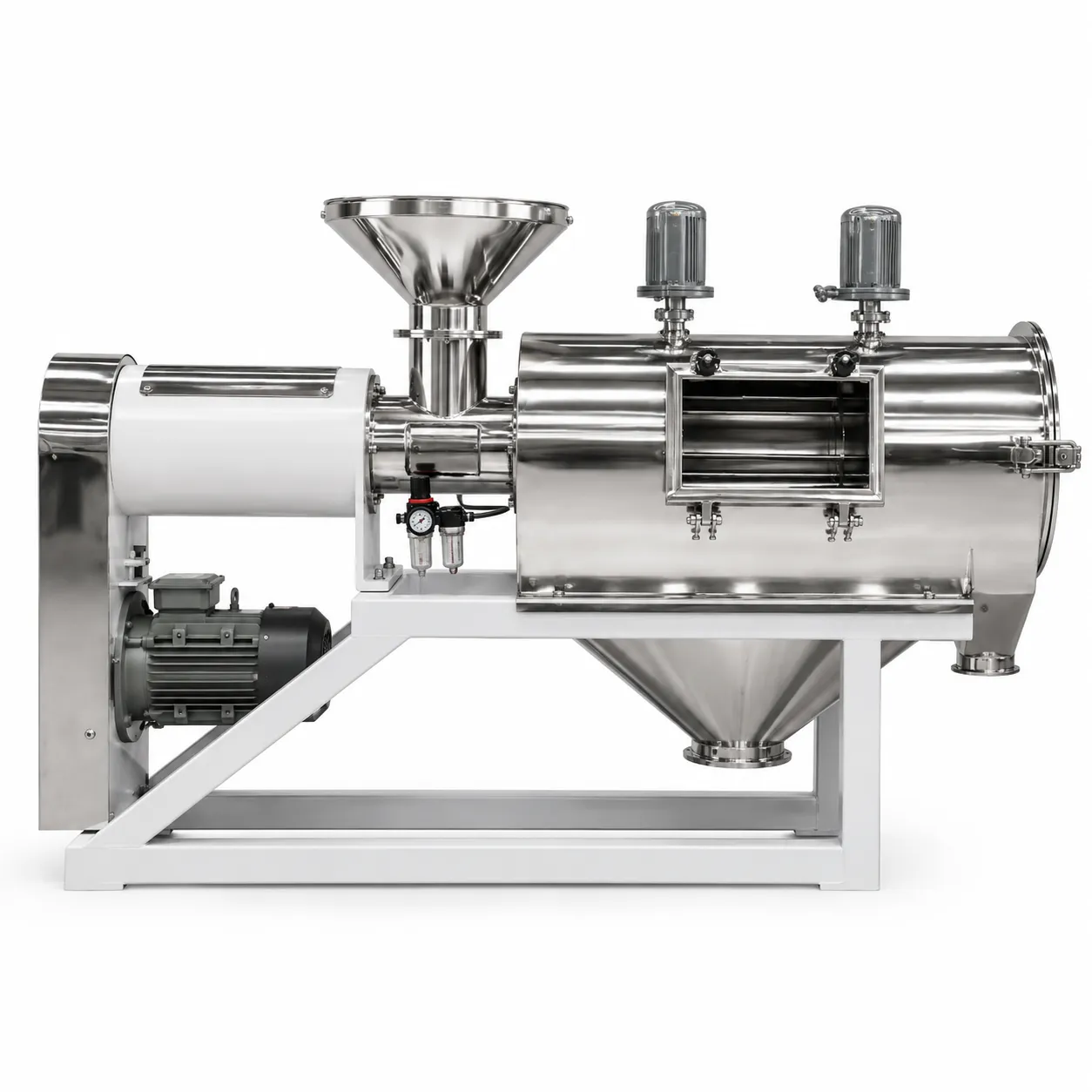
A rotary sieve uses a slowly rotating cylindrical woven-wire or perforated screen drum (5–20 RPM) with an internal helical paddle or spiral flight to advance material axially while particles smaller than the aperture (0.5–25 mm) fall through the drum wall. Processing 100–20,000 kg/h at rates matched to slow rotation, it provides gentle continuous de-lumping and oversize rejection for granular and fibrous materials the standard for sugar dedusting, fertiliser de-lumping, salt de-agglomeration, and food ingredient inline quality control.
A rotary sieve uses a slowly rotating cylindrical woven-wire or perforated screen drum (5–20 RPM) with an internal helical paddle or spiral flight to advance material axially while particles smaller than the aperture (0.5–25 mm) fall through the drum wall. Processing 100–20,000 kg/h at rates matched to slow rotation, it provides gentle continuous de-lumping and oversize rejection for granular and fibrous materials the standard for sugar dedusting, fertiliser de-lumping, salt de-agglomeration, and food ingredient inline quality control.
Feed enters one end of the rotating drum through an axial inlet; the internal helical paddle or spiral flight advances material from feed end to discharge end. Screen aperture in the drum wall passes specification-sized particles radially outward into the collection chute while oversize lumps, agglomerates, or tramp materials advance to the reject discharge at the far end. Drum rotation speed (5–20 RPM) and pitch of internal spiral determine residence time and classification efficiency. External brushes clear external blinding; internal paddle lifters cascade material for continuous re-exposure to the screen wall throughout the full drum length.
Challenges
Screen Blinding with Moist or Fibrous Feed
Moist granules or fibrous materials bridge across drum screen apertures progressively throughput falls.
Low Classification Sharpness vs. Vibrating Screen
Slow drum rotation gives insufficient agitation for sharp cut-size precision in multi-fraction applications.
Drum Bearing and Drive Wear on Trunnion Rollers
Rotating drum weight on trunnion rollers causes progressive wear at contact surface periodic roller replacement.
Tramp Material Damage to Screen Drum
Large metal or stone fragments can punch through screen apertures during rotation contaminate pass fraction
CIP Accessibility of Drum Interior Geometry
Long drum interior with helical paddle geometry complicates full CIP spray coverage shadow zones present.
Solutions
- Lifter Bars Inside Drum + External Cleaning Brushes: Internal lifters cascade sticky material away from screen wall; external brushes clear blinding continuously.
- Pre-Classification by Vibro Sifter for Precision Applications: Vibro sifter used for sharp classification; rotary sieve handles de-lumping and oversize rejection duty.
- Rubber-Tyred Trunnion Rollers (Shore A 60°): Rubber tyre absorbs drum weight shock load; extends roller life and reduces drive vibration transmission.
- Magnetic Grid Inline Before Drum Inlet (12,000 Gauss): Rare-earth magnetic bars capture ferrous tramp metal before drum screen contact screen integrity protected.
- Full-Length Retractable CIP Spray Lance: Retractable spray lance delivers validated coverage to all internal drum surfaces including paddle root zones.
Applications
- Food & Beverage: Sugar dedusting, salt de-lumping, tea leaf grading, dried fruit and vegetable quality control.
- Chemical: Fertiliser granule de-lumping, polymer pellet grading, bulk salt and mineral oversize rejection.
- Pharmaceutical: Bulk granule oversize rejection, excipient de-lumping, high-throughput bulk screening before dispensing.
- Feed & Agriculture: Animal feed ingredient oversize rejection, grain de-awning, mineral supplement particle grading.
- Cosmetics: Bath salt de-lumping, mineral granule quality control sieving at high continuous throughput.
Models & Capacities
| Type 2 Rotary Sieve (Drum Sifter): Models & Capacities | ||||||||
|---|---|---|---|---|---|---|---|---|
| Model | Scale | Throughput [kg/h] | Drum Ø × L [mm] | Screen Aperture [mm] | Drum Speed [RPM] | Drive Motor [kW] | L × W × H [mm] | Weight [kg] |
| RS-LAB | Lab | 50–200 | Ø150×400 | 0.5–10 | 5–20 | 0.18–0.25 | 700×400×600 | 55 |
| RS-PIL | Pilot | 100–500 | Ø300×800 | 0.5–25 | 5–20 | 0.37–0.55 | 1,200×600×800 | 120 |
| RS-500 | Production | 500–2,000 | Ø500×1,200 | 0.5–25 | 5–20 | 0.55–1.1 | 1,800×800×1,100 | 280 |
| RS-800 | Production | 800–4,000 | Ø600×1,500 | 0.5–25 | 5–20 | 0.75–1.5 | 2,200×950×1,300 | 420 |
| RS-1000 | Production | 1,000–5,000 | Ø800×2,000 | 0.5–25 | 5–20 | 1.1–2.2 | 2,600×1,100×1,400 | 580 |
| RS-1500 | Production | 1,500–8,000 | Ø1,000×2,500 | 0.5–25 | 5–15 | 1.5–3.0 | 3,200×1,350×1,600 | 950 |
| RS-2500 | Large Prod | 3,000–12,000 | Ø1,200×3,000 | 0.5–25 | 5–15 | 2.2–5.5 | 4,000×1,600×1,800 | 1,400 |
| RS-3500 | Large Prod | 4,000–16,000 | Ø1,350×3,500 | 1–25 | 5–15 | 4.0–7.5 | 4,800×1,800×2,000 | 2,000 |
| RS-5000 | Large Prod | 6,000–20,000 | Ø1,500×4,000 | 1–25 | 5–15 | 5.5–11 | 5,500×2,000×2,100 | 2,800 |