
Jacketed Paddle Blender (Heating / Cooling)
A jacketed paddle blender combines standard horizontal paddle mixing with a full-length trough jacket and hollow shaft with hollow paddles circulating heating or cooling medium internally. Providing temperature control across the full product contact surface, it enables wax-coating blending, crystallisation during mixing, and temperature-sensitive ingredient processing in food, cosmetic, pharmaceutical, and chemical batch applications.
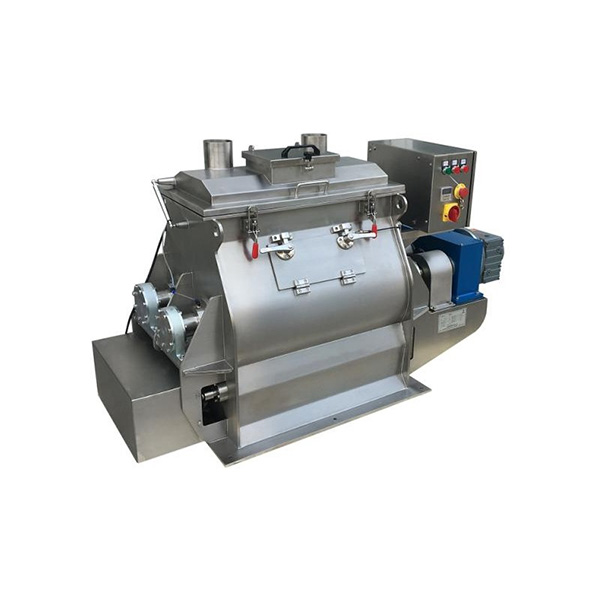
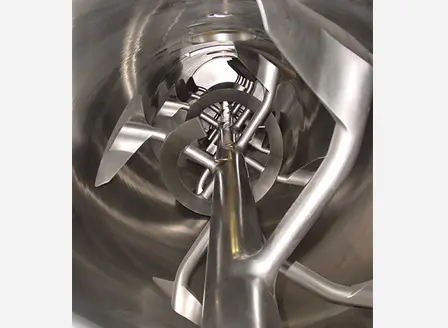
A jacketed paddle blender combines standard horizontal paddle mixing with a full-length trough jacket and hollow shaft with hollow paddles circulating heating or cooling medium internally. Providing temperature control across the full product contact surface, it enables wax-coating blending, crystallisation during mixing, and temperature-sensitive ingredient processing in food, cosmetic, pharmaceutical, and chemical batch applications.
Heating or cooling medium circulates simultaneously through the trough jacket and through the hollow shaft and paddle interiors via rotary unions at each shaft end. This dual heating path across both outer wall and internal paddles maximises heat transfer surface area and minimises radial temperature gradients across the product bed. A PLC-modulated control valve maintains product temperature within ±1°C throughout the blending cycle.
Challenges
Condensate Accumulation in Hollow Paddles
Steam condensate pooling inside hollow paddle cavities causes uneven heat distribution across the paddle surface and risks water hammer during operation.
Jacket Fouling Near Inlet and Outlet Nozzles
Product ingress at jacket nozzle weld areas creates localised hot spots and potential contamination risk between batches.
Temperature Overshoot with Fast Heating Ramps
Rapid jacket temperature increases cause localised overheating of product adjacent to the jacket wall, risking degradation of heat-sensitive ingredients.
Rotary Union Leakage Under Continuous Operation
Rotary unions at hollow shaft ends operating under simultaneous rotation and medium pressure experience progressive seal wear, increasing leakage risk over time.
External Condensation During Cold Processing
Operating the jacket below ambient temperature in humid environments causes surface condensation on the jacket exterior, risking corrosion and drip contamination of the surrounding area.
Solutions
- Steam Trap at Each Hollow Paddle Drain Point: Installing individual steam traps at paddle drain points continuously removes condensate, preventing pooling and eliminating water hammer during steam-heated blending cycles.
- Full-Penetration Welds at Jacket Nozzle Connections: Specifying continuous full-penetration welds at all jacket inlet and outlet nozzle connections eliminates crevices where product residue can accumulate and cause hot spots or contamination.
- PLC Ramp Rate Limiting on Jacket Temperature: Programming a maximum jacket temperature ramp rate in the control system prevents rapid wall temperature increases, protecting heat-sensitive product from localised overheating adjacent to the jacket surface.
- Scheduled Rotary Union Inspection and Seal Replacement: Establishing a preventive maintenance schedule for rotary union seal inspection and replacement at defined operating hours prevents unplanned leakage and maintains medium containment throughout the service interval.
- External Insulation and Vapour Barrier on Cold Jacket: Applying closed-cell insulation with a vapour barrier to the external jacket surface prevents condensation formation during sub-ambient processing, protecting the equipment from corrosion and preventing drip contamination.
Applications
- Food & Beverage: Wax-coated salt and sugar production, fat-coated flavour encapsulation, chocolate powder tempering.
- Chemical: Wax blending, temperature-sensitive specialty chemical, crystallisation-assisted compound.
- Pharmaceutical: Melt-granulation base preparation, temperature-controlled excipient blending, wax-matrix blend.
- Cosmetics: Anhydrous cream base blending, wax-pigment cosmetic blend, temperature-sensitive solid cosmetic.
- Nutraceuticals: Fat-coated vitamin and mineral, lipid-encapsulated probiotic blending at controlled temperature.
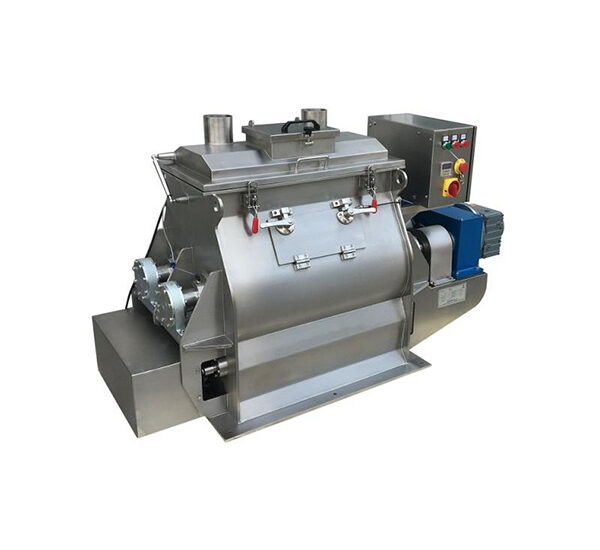
Models & Capacities
| Type 3 — Jacketed Paddle Blender: Models & Capacities | |||||||||||||
|---|---|---|---|---|---|---|---|---|---|---|---|---|---|
| Model | Scale | Net Vol. [L] | Batch Size [kg] | Shaft Speed [RPM] | Motor [kW] | Jacket Area [m²] | Jacket Temp [°C] | Hollow Shaft + Paddle | Trough L [mm] | Trough W [mm] | Overall L [mm] | Overall H [mm] | |
| PB-JK-100 | Pilot | 60 | 18–45 | 20–80 VFD | 1.1 | 0.40 | −20 to 150 | Yes | 900 | 400 | 1,500 | 1,200 | |
| PB-JK-200 | Pilot | 120 | 36–90 | 20–70 VFD | 1.5 | 0.65 | −20 to 150 | Yes | 1,150 | 500 | 1,900 | 1,350 | |
| PB-JK-300 | Pilot | 180 | 54–135 | 15–60 VFD | 2.2 | 0.90 | −20 to 150 | Yes | 1,400 | 600 | 2,250 | 1,500 | |
| PB-JK-500 | Production | 300 | 90–225 | 15–50 VFD | 3.0 | 1.30 | −20 to 150 | Yes | 1,750 | 700 | 2,750 | 1,650 | |
| PB-JK-750 | Production | 450 | 135–340 | 12–45 VFD | 4.0 | 1.80 | −20 to 150 | Yes | 2,100 | 800 | 3,300 | 1,850 | |
| PB-JK-1000 | Production | 600 | 180–450 | 12–40 VFD | 5.5 | 2.30 | −20 to 150 | Yes | 2,400 | 900 | 3,750 | 2,000 | |
| PB-JK-1500 | Production | 900 | 270–675 | 10–35 VFD | 7.5 | 3.10 | −20 to 150 | Yes | 2,900 | 1,050 | 4,500 | 2,250 | |
| PB-JK-2000 | Production | 1,200 | 360–900 | 10–30 VFD | 11 | 3.90 | −20 to 150 | Yes | 3,350 | 1,150 | 5,200 | 2,450 | |
| PB-JK-3000 | Large Prod | 1,800 | 540–1,350 | 8–25 VFD | 15 | 5.50 | −20 to 150 | Yes | 4,100 | 1,350 | 6,300 | 2,750 | |
| PB-JK-5000 | Large Prod | 3,000 | 900–2,250 | 6–20 VFD | 22 | 8.00 | −20 to 150 | Yes | 5,200 | 1,600 | 7,900 | 3,100 | |
| PB-JK-7500 | Large Prod | 4,500 | 1,350–3,375 | 5–16 VFD | 30 | 11.0 | −20 to 150 | Yes | 6,300 | 1,850 | 9,500 | 3,500 | |
| PB-JK-10000 | Large Prod | 6,000 | 1,800–4,500 | 4–14 VFD | 45 | 14.0 | −20 to 150 | Yes | 7,500 | 2,100 | 11,200 | 3,950 | |