
Continuous Paddle Mixer (Flow-Through)
A continuous paddle mixer is a flow-through blending reactor where materials are fed continuously at one trough end, paddles simultaneously advance and blend the material plug along the trough length, and homogeneous product discharges continuously at the far end. The standard continuous mixer for animal feed, fertiliser, cement dry mortar, food, and chemical manufacturing lines requiring uninterrupted production flow.
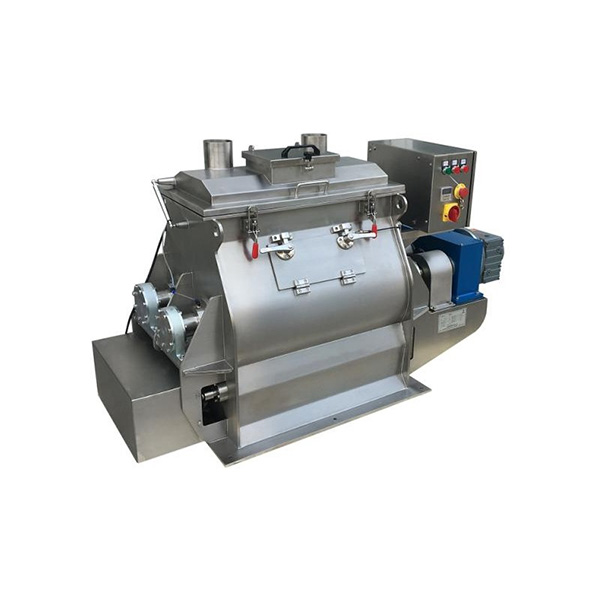
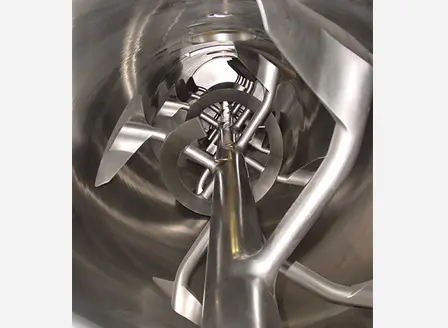
A continuous paddle mixer is a flow-through blending reactor where materials are fed continuously at one trough end, paddles simultaneously advance and blend the material plug along the trough length, and homogeneous product discharges continuously at the far end. The standard continuous mixer for animal feed, fertiliser, cement dry mortar, food, and chemical manufacturing lines requiring uninterrupted production flow.
Gravimetric feeders dose each ingredient continuously into the inlet hopper. Forward-pitched paddles advance the material plug from inlet to outlet in a controlled pattern, with retention time determined by trough volume and volumetric flow rate. Shaft speed and paddle pitch are adjusted to balance axial advancement against radial blending intensity. A weir gate at the discharge end maintains trough fill level and controls retention time independently of throughput.
Challenges
RTD Broadening at High Throughput
High throughput reduces mean retention time, broadening the residence time distribution and reducing blend uniformity at maximum production rates.
Feed Rate Ratio Drift
Individual gravimetric feeder drift accumulates over time, causing blend composition error that cannot be corrected within the short mixer retention time.
Start-Up and Shut-Down Off-Ratio Product
Material in the trough during start-up and flush-out at shut-down is off target composition and must be identified and diverted to prevent non-conforming product reaching the line.
Minor Component Streak-Through
Very low addition rates produce discrete minor-component-rich streaks if feeder discharge frequency is insufficient to distribute the component uniformly across the continuous flow.
Inlet Build-Up from Hygroscopic Feed
Hygroscopic or moist ingredients form adhesive plugs at the inlet zone, progressively restricting throughput and causing compositional variation in the outlet stream.
Solutions
- Weir Gate Sized for Minimum 30-Second Retention: Setting weir gate height and trough volume to maintain a minimum retention time at maximum throughput ensures acceptable residence time distribution across the full production rate range.
- Real-Time Mass Flow Monitoring Per Feeder: Load cell feedback on each feeder with PLC ratio control detects and corrects individual feeder drift within seconds, maintaining blend composition within specification throughout the production run.
- Automated Divert Valves at Start-Up and Shut-Down: Automatically diverting trough contents to a reject vessel during non-steady-state start-up and shut-down phases ensures only specification-compliant product passes to the downstream production line.
- High-Frequency Vibratory Minor Component Feeder: Using a vibratory micro-feeder operating at high pulse frequency distributes the minor component in many small doses per second, eliminating discrete concentration streaks in the continuous outlet stream.
- Back-Pitched Paddles at Inlet Zone: Installing rows of back-pitched paddles at the trough inlet creates a localised back-mixing zone that prevents channelling around hygroscopic lumps and promotes consistent ingredient distribution from the point of entry.
Applications
- Animal Feed: Continuous pelleting line premixer — vitamin, mineral, and additive blending into base meal.
- Fertiliser: Continuous compound fertiliser blending — multi-nutrient ratio blending at 20,000–80,000 kg/h.
- Food & Beverage: Continuous bread premix, biscuit flour blend, seasoning compound — inline with packaging line.
- Chemical: Cement dry mortar blend, construction adhesive compound, continuous specialty premix.
- Pharmaceutical: ICH Q13 continuous blend — inline with direct compression tablet press at 100–5,000 kg/h.
Models & Capacities
| Type 6 — Continuous Paddle Mixer: Models & Capacities | ||||||||||||
|---|---|---|---|---|---|---|---|---|---|---|---|---|
| Model | Scale | Throughput [kg/h] | Shaft Speed [RPM] | Motor [kW] | Retention Time [s] | CV [%] | Trough L [mm] | Trough W [mm] | Trough H [mm] | Overall L [mm] | Overall H [mm] | Weight [kg] |
| PB-CT-LAB | Lab | 10–100 | 30–200 VFD | 0.55 | 30–120 | <5 | 500 | 150 | 150 | 900 | 800 | 55 |
| PB-CT-PIL | Pilot | 50–500 | 25–150 VFD | 0.75 | 30–120 | <5 | 800 | 250 | 220 | 1,300 | 950 | 110 |
| PB-CT-1000 | Production | 200–1,000 | 20–120 VFD | 1.5 | 30–120 | <5 | 1,100 | 350 | 300 | 1,750 | 1,100 | 220 |
| PB-CT-3000 | Production | 500–3,000 | 15–100 VFD | 2.2 | 30–120 | <5 | 1,500 | 480 | 400 | 2,350 | 1,250 | 380 |
| PB-CT-5000 | Production | 1,000–5,000 | 12–80 VFD | 4.0 | 30–120 | <5 | 1,900 | 620 | 500 | 2,950 | 1,400 | 620 |
| PB-CT-10000 | Production | 2,000–10,000 | 10–60 VFD | 5.5 | 30–120 | <5 | 2,500 | 800 | 620 | 3,800 | 1,600 | 980 |
| PB-CT-20000 | Production | 5,000–20,000 | 8–50 VFD | 11 | 30–120 | <5 | 3,300 | 1,050 | 800 | 5,000 | 1,900 | 1,600 |
| PB-CT-40000 | Large Prod | 10,000–40,000 | 6–40 VFD | 18.5 | 30–120 | <5 | 4,500 | 1,350 | 1,050 | 6,700 | 2,250 | 2,800 |
| PB-CT-80000 | Large Prod | 20,000–80,000 | 5–30 VFD | 30 | 30–120 | <5 | 6,000 | 1,700 | 1,300 | 8,800 | 2,650 | 4,800 |
| PB-CT-150000 | Large Prod | 40,000–150,000 | 4–25 VFD | 45 | 30–120 | <5 | 8,500 | 2,200 | 1,700 | 12,000 | 3,200 | 8,500 |