
Double Cone Blender
A double cone blender is a tumble-type batch mixing vessel consisting of two conical sections joined at their widest diameter, rotating about a horizontal axis. Containing no internal agitator, it relies entirely on gravity-driven cascading to blend dry powders and granules. It is the standard choice for blending fragile granules, coated particles, and dry powder formulations where particle integrity must be preserved throughout the blending cycle.
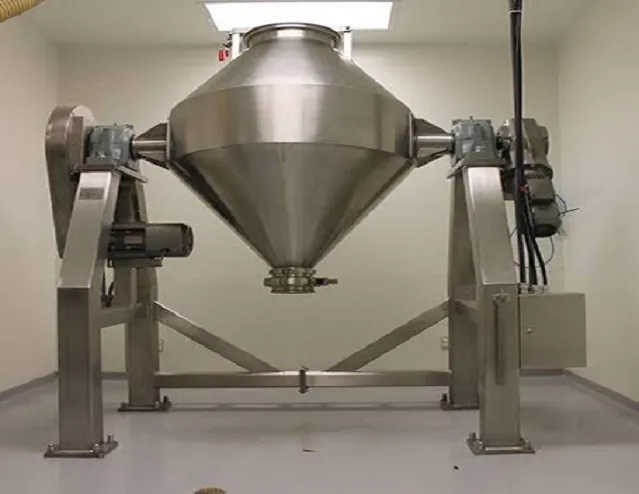
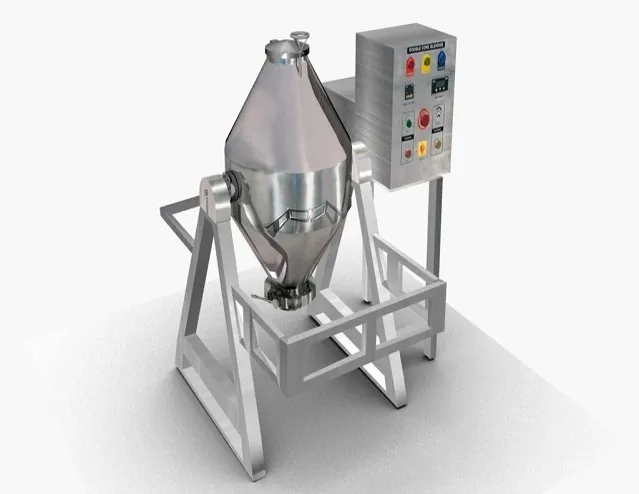
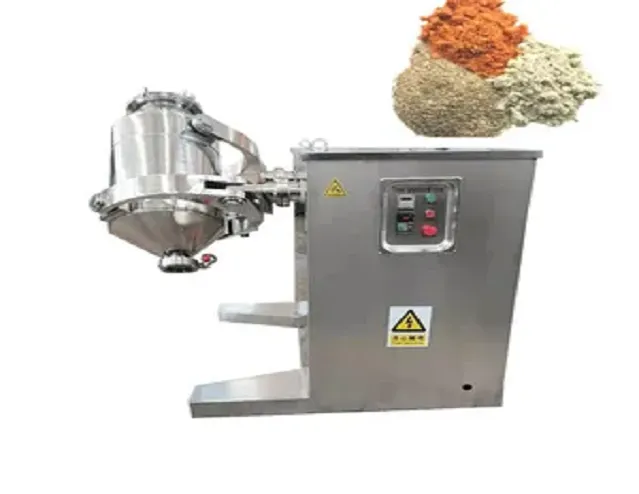
A double cone blender is a tumble-type batch mixing vessel consisting of two conical sections joined at their widest diameter, rotating about a horizontal axis. Containing no internal agitator, it relies entirely on gravity-driven cascading to blend dry powders and granules. It is the standard choice for blending fragile granules, coated particles, and dry powder formulations where particle integrity must be preserved throughout the blending cycle.
As the vessel rotates, material cascades from one cone through the central joining section into the opposing cone, creating bidirectional axial redistribution with each revolution. This repeated gravity-driven transfer progressively homogenises the powder blend. At the end of the cycle, the vessel is positioned apex-down and the discharge valve opened, allowing gravity to empty the batch without mechanical assistance, achieving high batch recovery.
Challenges
Segregation of Dissimilar Particles
Components with different particle sizes or bulk densities migrate toward cone apices during tumbling, creating concentration gradients that worsen toward discharge.
Cohesive Powder Limitation
Poor-flowing powders resist gravity-cascade redistribution, forming agglomerates and stagnant zones that persist through the blending cycle, resulting in poor blend uniformity.
Fill Level Sensitivity
Filling above 60% reduces cascade headspace, converting active cascading to ineffective rolling and significantly extending cycle time.
No Agglomerate Breakup
Without internal agitation, soft agglomerates cannot be broken during blending, requiring pre-milling before charging.
Limited Temperature Control
No integral heating or cooling restricts use to ambient temperature blending without specialist jacket modifications
Solutions
- Intensifier Bar: A fixed internal bar disrupts the cascade each rotation, breaking soft agglomerates and improving redistribution of cohesive powders.
- Fill Level Control at 40–60%: Controlling fill within the validated range maintains adequate cascade headspace, preventing transition to inefficient rolling.
- VFD Pulsed Speed Profiles: Programmed speed variation alters cascade dynamics, disrupting segregation tendencies in blends with differing particle properties.
- Pre-Milling Cohesive Components: Milling or screening cohesive materials before charging eliminates agglomerates that tumble blending cannot break independently.
Applications
- Pharmaceutical: Tablet/capsule final blend, lubricant incorporation, coated granule blending for maximum particle integrity.
- Nutraceuticals & Supplements: Vitamin/mineral blend preparation, pre-blended active homogenisation.
- Food Processing: Powdered flavouring systems, seasoning blends, dry nutritional supplement premixes.
- Chemical: Catalyst support blending, fine chemical premixing with validated cleaning and contamination control.
- Cosmetics: Mineral powder blend, fragile pressed-powder granule blending, pigment-sensitive formulations.
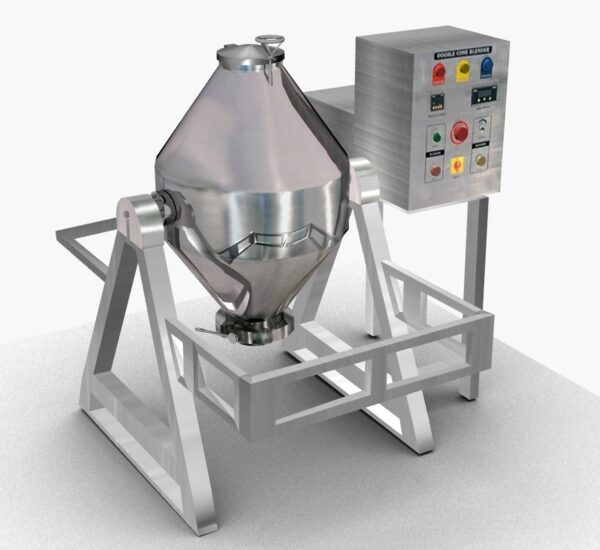
Models & Capacities
| Model | Scale | Gross Vol. [L] | Net Vol. [L] | Batch Size [kg] | Max Ø [mm] | Cone H (each) [mm] | Cylinder H [mm] | Overall H [mm] | Mixing Time [min] | CV [%] | Jacket Area [m²] | Weight [kg] |
|---|---|---|---|---|---|---|---|---|---|---|---|---|
| DCB-002 | Lab | 2 | 1 | 0.3–0.8 | Ø150 | 180 | 120 | 520 | 10–20 | <3 | — | 18 |
| DCB-005 | Lab | 5 | 2.5 | 0.7–2 | Ø300 | 300 | 200 | 800 | 10–20 | <3 | — | 42 |
| DCB-010 | Lab | 10 | 5 | 1.5–4 | Ø380 | 380 | 250 | 980 | 10–20 | <3 | 0.06 | 65 |
| DCB-025 | Lab | 25 | 12 | 4–10 | Ø500 | 480 | 320 | 1,100 | 10–20 | <3 | 0.12 | 110 |
| DCB-050 | Pilot | 50 | 25 | 8–20 | Ø620 | 580 | 380 | 1,280 | 12–22 | <3 | 0.22 | 185 |
| DCB-100 | Pilot | 100 | 50 | 15–40 | Ø750 | 700 | 450 | 1,500 | 12–22 | <3 | 0.38 | 310 |
| DCB-150 | Pilot | 150 | 75 | 22–60 | Ø860 | 800 | 520 | 1,700 | 12–22 | <3 | 0.52 | 450 |
| DCB-250 | Production | 250 | 125 | 38–100 | Ø1,000 | 950 | 600 | 2,000 | 15–25 | <3 | 0.78 | 720 |
| DCB-300 | Production | 300 | 150 | 45–120 | Ø1,080 | 1,020 | 640 | 2,150 | 15–25 | <3 | 0.92 | 880 |
| DCB-500 | Production | 500 | 250 | 75–200 | Ø1,300 | 1,220 | 780 | 2,500 | 15–25 | <3 | 1.35 | 1,400 |
| DCB-750 | Production | 750 | 375 | 115–300 | Ø1,500 | 1,400 | 900 | 2,850 | 15–25 | <3 | 1.85 | 2,000 |
| DCB-1000 | Production | 1,000 | 500 | 150–400 | Ø1,600 | 1,500 | 960 | 3,100 | 15–25 | <3 | 2.30 | 2,800 |
| DCB-1500 | Production | 1,500 | 750 | 225–600 | Ø1,850 | 1,750 | 1,100 | 3,600 | 18–28 | <3 | 3.10 | 4,200 |
| DCB-2000 | Production | 2,000 | 1,000 | 300–800 | Ø2,050 | 1,950 | 1,250 | 4,100 | 18–28 | <3 | 3.90 | 5,800 |
| DCB-3000 | Production | 3,000 | 1,500 | 450–1,200 | Ø2,350 | 2,200 | 1,400 | 4,800 | 18–28 | <3 | 5.50 | 8,500 |
| DCB-5000 | Large Prod | 5,000 | 2,500 | 750–2,000 | Ø2,800 | 2,650 | 1,700 | 5,300 | 20–30 | <3 | 8.00 | 14,000 |
| DCB-7500 | Large Prod | 7,500 | 3,750 | 1,125–3,000 | Ø3,200 | 3,000 | 1,950 | 6,100 | 20–30 | <3 | 11.0 | 22,000 |
| DCB-10000 | Large Prod | 10,000 | 5,000 | 1,500–4,000 | Ø3,500 | 3,300 | 2,100 | 6,600 | 20–30 | <3 | 14.0 | 30,000 |