
Mechanical Steam Trap — Float & Thermostatic (F&T) and Inverted Bucket
A mechanical steam trap uses the density difference between steam and condensate to operate a float or bucket mechanism — condensate is denser and activates the discharge valve; steam is lighter and closes it. The Float & Thermostatic (F&T) trap uses a ball float rising on condensate to open the discharge valve continuously proportional to condensate load; an air vent releases non-condensable gases. The Inverted Bucket trap uses an inverted cup that floats on steam, closing the valve, and sinks when condensate fills it, opening the valve in intermittent cycles.
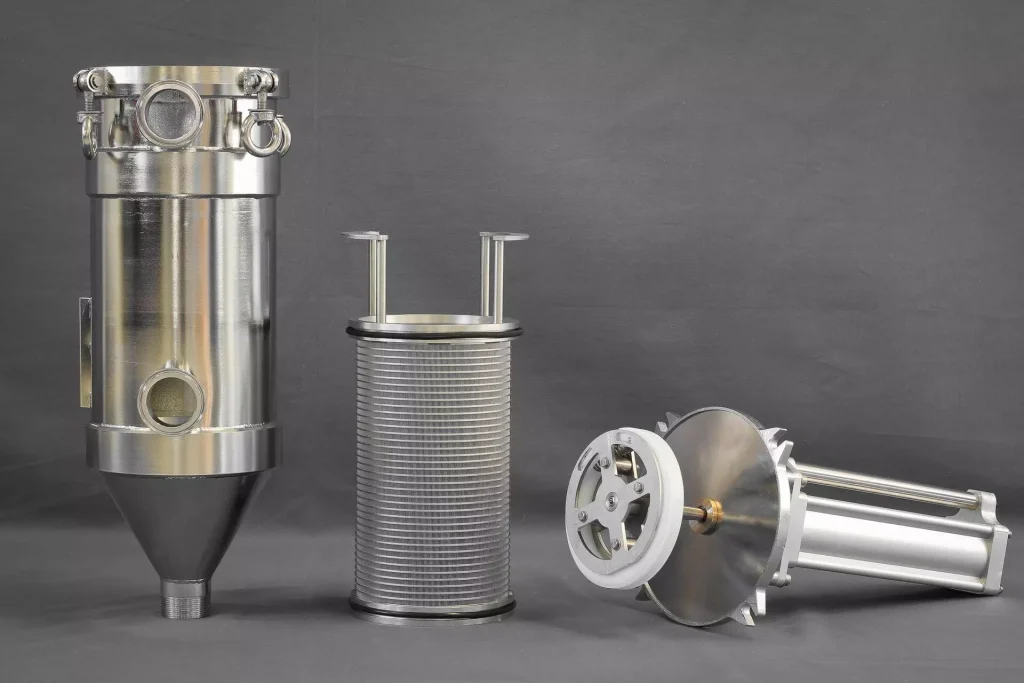
A mechanical steam trap uses the density difference between steam and condensate to operate a float or bucket mechanism — condensate is denser and activates the discharge valve; steam is lighter and closes it. The Float & Thermostatic (F&T) trap uses a ball float rising on condensate to open the discharge valve continuously proportional to condensate load; an air vent releases non-condensable gases. The Inverted Bucket trap uses an inverted cup that floats on steam, closing the valve, and sinks when condensate fills it, opening the valve in intermittent cycles.
F&T: condensate rises in the trap body, lifting the ball float which mechanically opens the discharge valve by a lever linkage — continuous modulating discharge proportional to condensate load; thermostatic air vent in the trap cover discharges non-condensable gases at startup. Inverted Bucket: steam fills the inverted bucket (cup facing down), causing it to float and close the valve; as condensate floods in, the bucket loses buoyancy, sinks, and pulls the valve open — condensate and entrapped air discharge in a pulse; the cycle repeats every 10–60 seconds at steady load.
Challenges
Float Corrosion and Collapse from Dissolved Oxygen in Condensate
Oxygen in condensate corrodes thin-wall ball float — float loses buoyancy; trap fails open (passes steam) or closed.
Bucket Wear from Water Hammer Causing Bucket-to-Seat Collision
Water hammer upstream of inverted bucket trap causes violent bucket oscillation — seat and orifice wear.
Air Binding at Startup on F&T Trap Without Functioning Air Vent
Blocked thermostatic air vent traps air in F&T body — condensate accumulates above air bubble; flooding.
Sub-Cooling Below Saturation in Inverted Bucket (Bucket Locks Shut)
Deep sub-cooled condensate causes bucket to lock shut — condensate backs up in steam main; waterlogging.
Excessive Steam Loss Through Worn Orifice on Failed-Open F&T Trap
Worn seat in F&T allows steam to pass when float is not seating correctly — measurable energy loss.
Solutions
- Stainless Float + Dissolved Oxygen Control (Feedwater O₂ <10 ppb by Deaeration): Stainless float resists corrosion; upstream oxygen removal prevents renewed float attack.
- Inlet Strainer (Y-Type, 40–80 mesh, SS 316L) Before Every Trap: Strainer removes pipeline scale and particles — protects all moving parts from erosion and seat wear.
- Integrated Air Vent (Balanced Pressure Bellows) + Air Vent Test Port on F&T: Balanced pressure bellows air vent on all F&T covers — serviceable without removing trap body; test port confirms function.
- Upstream Pre-Heating (Warm-Up Valve) Before Full-Load Commissioning: Warm-up bypass valve with 10% orifice allows slow warm-up — prevents water hammer and bucket lock.
- Ultrasonic + Temperature Leak Detection Survey (Annual): Portable ultrasonic instrument detects steam blow-through; temperature gun detects failed-closed (cold) traps — annual audit of all traps.
Applications
- Process Heating: Heat exchangers, reboilers, jacketed vessels — F&T preferred for continuous condensate loads; inverted bucket for intermittent.
- HVAC & Space Heating: Fan coil units, unit heaters, radiators — F&T with air vent standard for air-handling coils.
- Pharmaceutical: Clean steam distribution trapping — F&T with SS body and sanitary connections for pure/clean steam service.
- Food & Beverage: Cooking vessel jackets, pasteuriser steam supply trapping — F&T with culinary steam certification.
- Tracing & Freeze Protection: Steam tracing line end traps — inverted bucket handles intermittent loads and outdoor exposure.
Models & Capacities
Type 2A — Mechanical Steam Trap (F&T and Inverted Bucket): Models & Capacities | |||||||||||
Model | Type | Connection DN [mm] | Max Inlet Pressure [bar(g)] | Max Temp [°C] | Condensate Capacity [kg/h] | Min ΔP [bar] | Max ΔP [bar] | Air Vent Integrated | Body Material | Connection Type | Weight [kg] |
FT-015-7 | F&T | DN 15 | 7 | 165 | 60 | 0.07 | 7 | Yes (bellows) | SS 316L | Screwed BSP | 0.5 |
FT-015-14 | F&T | DN 15 | 14 | 198 | 90 | 0.07 | 14 | Yes (bellows) | SS 316L | Screwed BSP | 0.7 |
FT-025-7 | F&T | DN 25 | 7 | 165 | 200 | 0.07 | 7 | Yes (bellows) | SS 316L / CS | Flanged PN16 | 1.5 |
FT-025-14 | F&T | DN 25 | 14 | 198 | 350 | 0.07 | 14 | Yes (bellows) | SS 316L / CS | Flanged PN16 | 1.8 |
FT-040-14 | F&T | DN 40 | 14 | 198 | 800 | 0.07 | 14 | Yes (bellows) | CS / SS 316L | Flanged PN16 | 4.5 |
FT-050-14 | F&T | DN 50 | 14 | 198 | 1,500 | 0.07 | 14 | Yes (bellows) | CS | Flanged PN16 | 8 |
IB-015-14 | Inverted Bucket | DN 15 | 14 | 198 | 90 | 0.07 | 14 | Yes (orifice) | SS 316L | Screwed BSP | 0.8 |
IB-025-14 | Inverted Bucket | DN 25 | 14 | 198 | 350 | 0.1 | 14 | Yes (orifice) | CS / SS | Flanged PN16 | 2.5 |
IB-025-32 | Inverted Bucket | DN 25 | 32 | 235 | 200 | 0.1 | 32 | Yes (orifice) | Alloy steel | Flanged PN40 | 3.5 |
IB-040-32 | Inverted Bucket | DN 40 | 32 | 235 | 600 | 0.1 | 32 | Yes (orifice) | Alloy steel | Flanged PN40 | 7 |