
Self-Cleaning Filter — Scraper / Wiper Type
A scraper-type self-cleaning filter continuously removes collected solids from the filter screen using a rotating or reciprocating scraper blade — solids are mechanically dislodged from the screen surface into a separate reject chamber without interrupting filtration. Processing 1–2,000 m³/h at filtration ratings of 25–2,000 µm and pressures up to 16 bar, it provides uninterrupted clarification of industrial process water, cooling water, irrigation supply, and viscous fluid streams without operator intervention, media replacement, or manual backwash step.
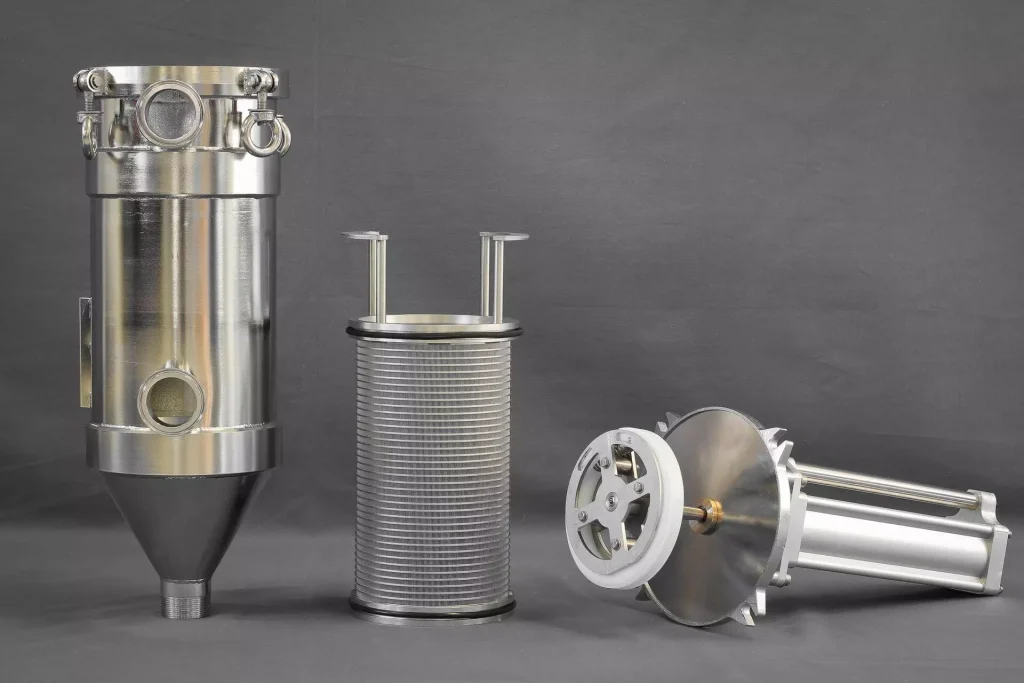
A scraper-type self-cleaning filter continuously removes collected solids from the filter screen using a rotating or reciprocating scraper blade — solids are mechanically dislodged from the screen surface into a separate reject chamber without interrupting filtration. Processing 1–2,000 m³/h at filtration ratings of 25–2,000 µm and pressures up to 16 bar, it provides uninterrupted clarification of industrial process water, cooling water, irrigation supply, and viscous fluid streams without operator intervention, media replacement, or manual backwash step.
Process fluid enters the filter housing and flows outward through the cylindrical filter screen; solids accumulate on the screen inner surface as the differential pressure across the screen rises. When ΔP reaches the setpoint (typically 0.3–0.5 bar), the drive motor rotates the scraper assembly — a close-fitting blade traverses the screen inner surface, detaching accumulated cake into the central reject chamber. Scraped solids exit through a reject valve (continuous trickle or timed flush) while filtration continues uninterrupted at full flow rate through the clean portion of the screen.
Challenges
Screen Blinding by Compressible or Gelatinous Solids
Soft, gelatinous solids deform under scraper pressure — smear into screen apertures rather than being detached.
Scraper Blade Wear Against Abrasive Slurry
Hard mineral particles between scraper blade and screen erode blade edge and screen surface — increases clearance and pass-through.
Reject Flow Containing Excessive Product Loss
Continuous reject discharge removes good product with solids — high product loss if reject-to-feed ratio uncontrolled.
Motor Stall Under High Cake Load at Low Differential Pressure
Thick cake on screen requires high torque — motor may stall if drive undersized for maximum cake thickness scenario.
Screen Damage from Tramp Metal Entering Housing
Large metal pieces jam between scraper and screen — screen rupture or scraper damage.
Solutions
- PTFE-Coated Screen (Ra <0.4 µm) for Gelatinous and Sticky Solids: PTFE screen surface prevents cake adhesion — gelatinous solids detach fully under scraper rather than smearing.
- Hardened Tool Steel Scraper with Stellite 6 Tip (HRC 60): Hard-faced scraper tip resists abrasive wear — maintains design clearance over full service life.
- Reject Volume Control (Timed Valve, Minimum Reject Flow): Timed reject valve opens only at ΔP trigger — minimises product loss while maintaining solids discharge.
- Torque-Limited Drive Motor with Auto-Reverse (3× Rated Torque Safety Margin): Auto-reverse on stall signal allows cake to loosen — re-engages after 3-second pause; trip alarm after 3 cycles.
- Magnetic Bar Screen on Inlet Nozzle (12,000 Gauss): Rare-earth magnetic bar captures ferrous tramp metal before screen — prevents mechanical damage.
Applications
- Water Treatment: Cooling tower makeup, river water intake, industrial process water clarification — continuous unattended operation.
- Food & Beverage: Process water, fruit pulp pre-filtration, brewery and beverage process water clarification.
- Chemical: Cooling water, process water, chemical process stream pre-filtration to protect downstream equipment.
- Pharmaceutical: Raw water and utility water pre-filtration; equipment cooling water — automatic, unattended duty.
- Agriculture: Irrigation drip system protection, fertigation inlet filtration — reduces nozzle blockage.
Models & Capacities
Type 1A — Scraper Self-Cleaning Filter: Models & Capacities | ||||||||||
Model | Scale | Flow Rate [m³/h] | Filter Rating [µm] | Screen Area [m²] | Housing Ø [mm] | Max Pressure [bar] | Motor [kW] | Inlet/Outlet Ø [mm] | Reject Connection | Weight [kg] |
SCF-S-050 | Lab/Pilot | 1–5 | 25–2,000 | 0.02 | Ø100 | 10 | 0.04 | DN 25 | DN 15 | 8 |
SCF-S-100 | Lab/Pilot | 3–15 | 25–2,000 | 0.05 | Ø150 | 10 | 0.06 | DN 32 | DN 20 | 18 |
SCF-S-200 | Pilot | 8–40 | 25–2,000 | 0.10 | Ø200 | 10 | 0.09 | DN 50 | DN 20 | 38 |
SCF-S-300 | Production | 20–100 | 50–2,000 | 0.20 | Ø300 | 10 | 0.12 | DN 80 | DN 25 | 75 |
SCF-S-400 | Production | 50–250 | 50–2,000 | 0.40 | Ø400 | 10 | 0.18 | DN 100 | DN 32 | 145 |
SCF-S-500 | Production | 100–500 | 50–2,000 | 0.65 | Ø500 | 16 | 0.25 | DN 150 | DN 40 | 265 |
SCF-S-600 | Large Prod | 200–800 | 50–2,000 | 0.90 | Ø600 | 16 | 0.37 | DN 200 | DN 40 | 420 |
SCF-S-800 | Large Prod | 400–1,500 | 100–2,000 | 1.50 | Ø800 | 16 | 0.55 | DN 250 | DN 50 | 780 |
SCF-S-1000 | Large Prod | 700–2,500 | 100–2,000 | 2.30 | Ø1,000 | 16 | 0.75 | DN 300 | DN 65 | 1,350 |