
Self-Cleaning Filter — Automatic Backwash Type
An automatic backwash self-cleaning filter reverses a small portion of clean filtrate back through discrete segments of the filter screen — the reversed flow dislodges accumulated solids from the screen upstream face and flushes them through a reject outlet, restoring screen permeability without interrupting forward filtration flow through the remaining screen area. Processing 2–5,000 m³/h at 10–800 µm and pressures up to 16 bar, it achieves >99% uptime on continuous duty for cooling water, municipal water, and process water clarification.
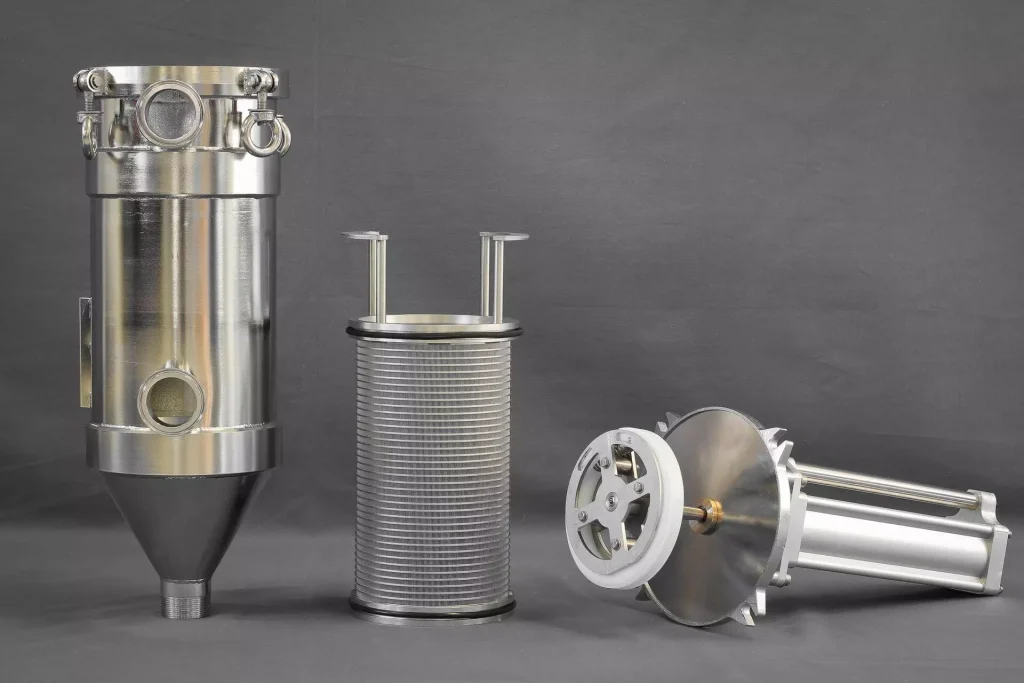
The filter screen is divided into multiple segments (8–24 sectors); a rotating backwash arm driven by the differential pressure across the screen (no external power for hydraulically driven models) sequentially covers each segment in turn. When the arm aligns with a segment, it creates a low-pressure zone that draws clean filtrate backward through that segment — dislodging cake into the reject channel. The arm completes a full rotation in 10–60 seconds, cleaning each segment in sequence while the others continue forward filtration. Most models initiate backwash on ΔP alarm (0.3–0.5 bar) and can also run on timed interval.
Challenges
Insufficient Backwash Pressure Differential for Viscous Fluid Cleaning
Hydraulic backwash arm relies on ΔP generated by normal flow — insufficient ΔP at high viscosity to drive effective backwash.
Screen Blinding from Fibrous or Biofouling Material (Grows Through Screen)
Fibrous material and biofilm grow through screen apertures from feed side — not removed by reverse flow alone.
Backwash Arm Seal Wear Causing Cross-Flow Between Segments
Arm-to-screen seal must maintain close tolerance — wear allows forward flow to short-circuit into backwash reject stream.
Reject Water Volume Loss (5–15% of Feed Flow During Backwash):
Continuous backwash operation loses 5–15% of feed as reject — significant at high-cost water or concentrated product.
High-Solids Blinding Faster Than Backwash Can Clear (>5,000 mg/L TSS)
Very high inlet solids loading blinds screen faster than sequential backwash can recover — net screen area declines progressively.
Solutions
- Motorised Backwash Arm Drive (Independent Motor, Not Pressure-Dependent): Motor-driven arm maintains cleaning at any viscosity — independent of inlet/outlet differential pressure.
- Chemical Dosing Port on Backwash Line (Biocide, Descaler): Chemical inject on backwash water removes biofilm and scale — restores screen fully without disassembly.
- Precision-Machined PTFE Arm Seal (Replaceable Cartridge, ±0.05 mm Tolerance): PTFE cartridge seal maintains arm-to-screen clearance — replaceable in <30 min; controls cross-flow leakage.
- Pulse Backwash (High-Intensity 2-Second Burst Every 60 Seconds): Pulse valve amplifies backwash flow momentarily — dislodges compacted cake that continuous low-flow backwash cannot remove.
- Dual-Screen Configuration (A/B Alternating, 200% of Required Area): Second screen online while first backwashes — 100% rated flow maintained regardless of backwash frequency.
Applications
- Municipal Water: Drinking water pre-treatment, irrigation district distribution, desalination pre-filtration — large-volume continuous duty.
- Industrial Cooling: Cooling tower make-up water, heat exchanger protection, chiller condenser water pre-filtration.
- Power Generation: Condenser cooling water intake, boiler feedwater pre-filtration — continuous unattended 24/7.
- Mining: Process water clarification, tailings pond reclaim water filtration — high TSS inlet loads.
- Aquaculture: Recirculating aquaculture system (RAS) solids removal — continuous low-maintenance duty.
Models & Capacities
Type 1B — Automatic Backwash Self-Cleaning Filter: Models & Capacities | |||||||||||
Model | Scale | Flow Rate [m³/h] | Filter Rating [µm] | Screen Segments | Housing Ø [mm] | Max Pressure [bar] | Drive Type | Motor [kW] | Inlet/Outlet Ø [mm] | Reject Ø [mm] | Weight [kg] |
SCF-BW-100 | Pilot | 2–10 | 10–800 | 8 | Ø150 | 10 | Hydraulic | — | DN 40 | DN 20 | 22 |
SCF-BW-200 | Pilot | 5–30 | 10–800 | 8 | Ø200 | 10 | Hydraulic | — | DN 50 | DN 25 | 48 |
SCF-BW-300 | Production | 15–80 | 10–800 | 12 | Ø300 | 10 | Motorised | 0.09 | DN 80 | DN 32 | 110 |
SCF-BW-400 | Production | 40–200 | 10–800 | 12 | Ø400 | 10 | Motorised | 0.12 | DN 100 | DN 40 | 210 |
SCF-BW-600 | Production | 100–500 | 25–800 | 16 | Ø600 | 16 | Motorised | 0.18 | DN 200 | DN 50 | 480 |
SCF-BW-800 | Production | 250–1,000 | 25–800 | 16 | Ø800 | 16 | Motorised | 0.25 | DN 250 | DN 65 | 900 |
SCF-BW-1000 | Large Prod | 500–2,000 | 50–800 | 20 | Ø1,000 | 16 | Motorised | 0.37 | DN 300 | DN 80 | 1,650 |
SCF-BW-1200 | Large Prod | 1,000–3,500 | 50–800 | 24 | Ø1,200 | 16 | Motorised | 0.55 | DN 400 | DN 100 | 2,800 |
SCF-BW-1500 | Large Prod | 2,000–5,000 | 100–800 | 24 | Ø1,500 | 16 | Motorised | 0.75 | DN 500 | DN 100 | 4,500 |