
Dual-Shaft Planetary + High-Speed Disperser Mixer
A dual-shaft planetary mixer integrates an independently driven high-speed disperser shaft concentric within the planetary stirrer orbit, providing simultaneous bulk mixing and high-shear dispersion in the same bowl without intermediate transfer or tool change. The planetary stirrer handles bulk circulation while the disperser breaks down agglomerates and achieves fine particle dispersion. Widely used in paint, cosmetic, and adhesive manufacturing.
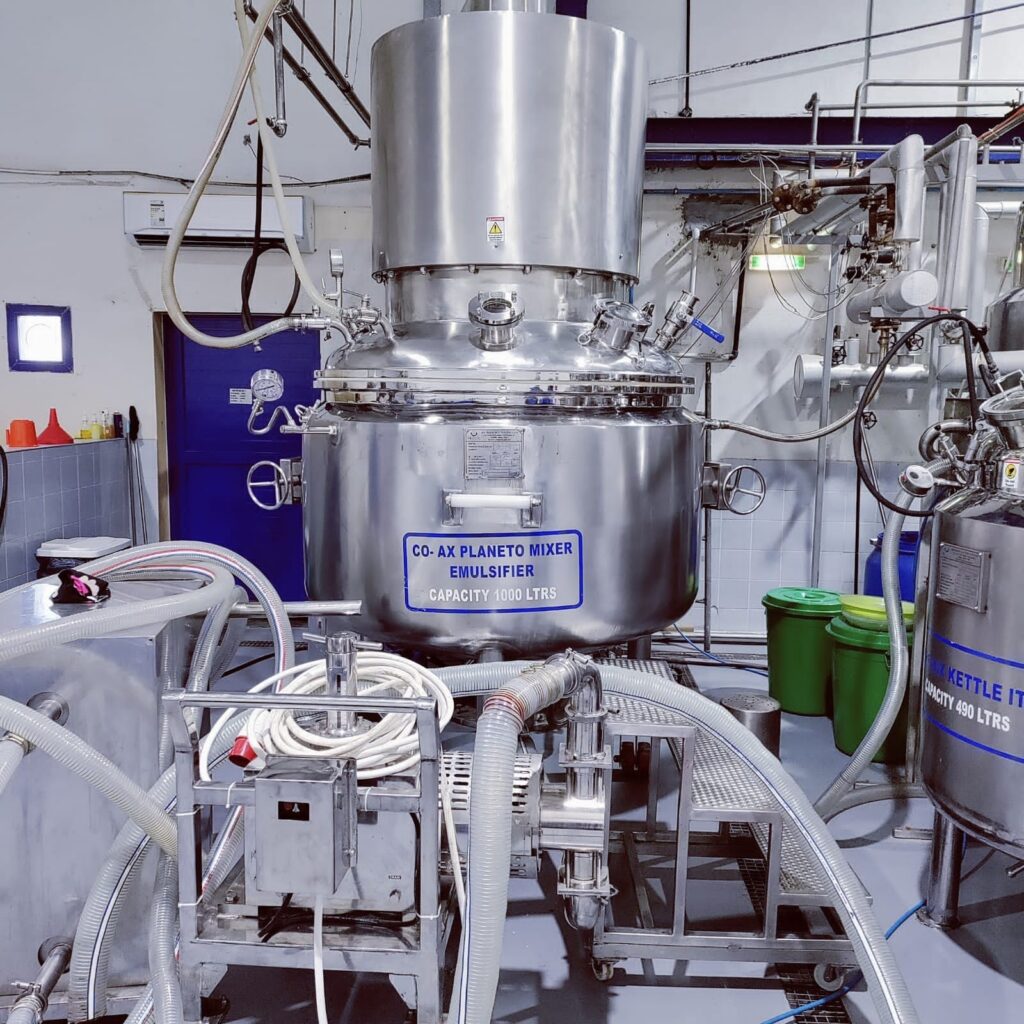
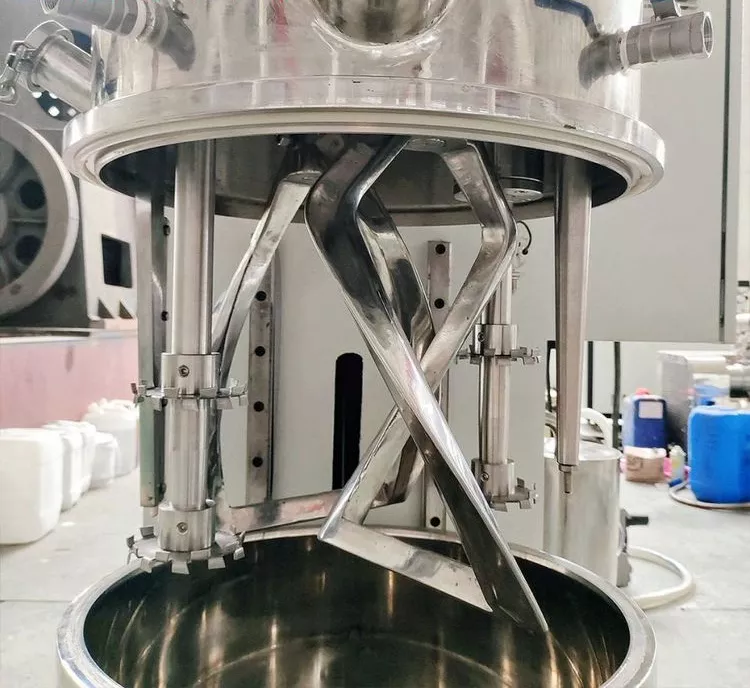
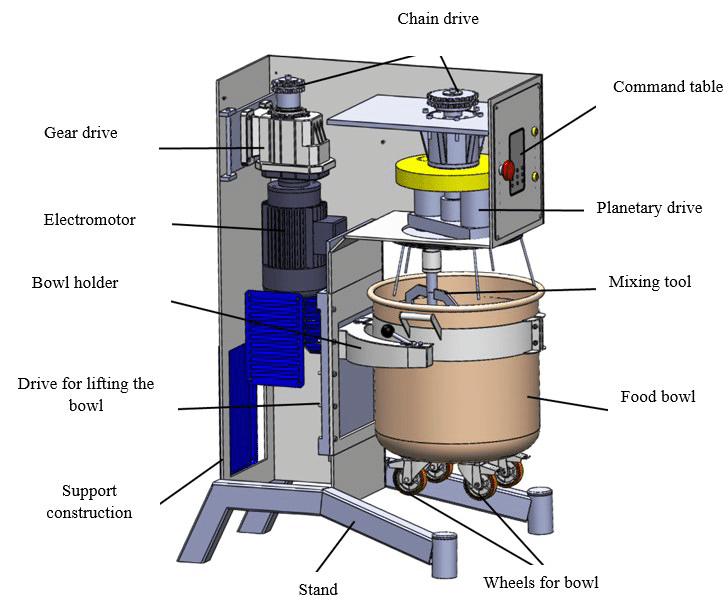
A dual-shaft planetary mixer integrates an independently driven high-speed disperser shaft concentric within the planetary stirrer orbit, providing simultaneous bulk mixing and high-shear dispersion in the same bowl without intermediate transfer or tool change. The planetary stirrer handles bulk circulation while the disperser breaks down agglomerates and achieves fine particle dispersion. Widely used in paint, cosmetic, and adhesive manufacturing.
The planetary stirrer orbits and rotates at low speed, circulating the bulk product and continuously presenting fresh material to the central high-speed disperser. The disperser shaft operates independently through a coaxial bearing assembly, with a Cowles or sawtooth disc generating localised high shear at its periphery. Both drives are independently controlled by variable frequency drives and programmed by PLC recipe, allowing the disperser to run at maximum shear during pigment incorporation and reduce speed during finishing phases.
Challenges
Disperser Aeration at Low Viscosity
Below a minimum viscosity threshold, the disperser disc entrains air into the product rather than dispersing it effectively, compromising product quality.
Shaft Vibration at High Disperser Speed
A long concentric disperser shaft running at high speed can develop dynamic eccentricity, accelerating bearing wear and reducing shaft service life.
Localised Overheating Around Disperser Zone
High shear at the disperser disc generates localised heat that can exceed the bulk bowl temperature, risking thermal degradation of heat-sensitive ingredients near the disc.
Agglomerate Recombination Between Passes
Partially broken agglomerates can reaggregate before the planetary stirrer returns them to the disperser zone if circulation rate is too slow relative to disperser speed.
Cleaning the Coaxial Shaft Annulus
The annular space between the planetary and disperser shafts is difficult to access during cleaning, creating residue accumulation risk particularly in GMP and food-grade applications.
Solutions
- Viscosity Interlock -- Disperser Starts Only Above 500 cP (Viscometer Probe): Inline viscosity probe confirms minimum product viscosity before
- Minimum Viscosity Interlock: An inline viscosity probe confirms the product has reached a minimum viscosity threshold before the disperser is permitted to ramp to high speed, preventing aeration during low-viscosity phases.
- Intermediate Guide Bearing on Disperser Shaft: A support bearing positioned along the disperser shaft reduces dynamic deflection at high speed, allowing smooth operation and extending bearing service life.
- Independent Cooling Circuit for Lower Bowl Section: A separately controlled jacket circuit in the lower bowl section compensates for localised shear heating around the disperser zone, protecting temperature-sensitive formulations.
- PLC-Matched Planetary-to-Disperser Speed Ratio: The control system calculates the required circulation rate and adjusts planetary speed to ensure agglomerates are returned to the disperser zone frequently enough to prevent re-agglomeration.
- Annular Flush Port at Coaxial Bearing Base: A dedicated CIP flush port at the base of the coaxial bearing housing allows cleaning fluid to be injected through the annular gap, flushing residue from bottom to top and ensuring full cleaning coverage.
Applications
- Paints & Coatings: Pigment dispersion, high-build paint, varnish, ink -- simultaneous macro-mixing and micro-dispersion.
- Cosmetics: Foundation, tinted moisturiser, eye shadow base -- pigment dispersion below 25 um without phase separation.
- Adhesives: Structural adhesive, UV-cure resin, epoxy paste -- filler dispersion with simultaneous bulk mixing.
- Pharmaceutical: API suspension, tablet coating colour dispersion, topical product -- dual-function GMP processing.
- Chemical: Specialty coating, potting compound, resin composite -- dispersion and mixing in single vessel.
Models & Capacities
Type D — Dual-Shaft Planetary + High-Speed Disperser: Models & Capacities | ||||||||||||
Model | Net Vol. [L] | Planetary RPM | Disperser RPM | Planetary Motor [kW] | Disperser Motor [kW] | Disperser Disc Tip Speed [m/s] | Visc. Max [cP] | Op. Temp [deg C] | Bowl Dia [mm] | Bowl H [mm] | Overall Dimensions [mm] | |
|
|
|
|
|
|
|
|
|
|
| L |
|
PM-D-005 | 5 | 40-300 | 500-3,000 | 0.55 | 0.37 | 5-15 | 200,000 | -5 to 120 | Dia350 | 390 | 600 |
|
PM-D-020 | 20 | 30-200 | 500-3,000 | 1.1 | 0.75 | 5-18 | 200,000 | -5 to 120 | Dia550 | 580 | 900 |
|
PM-D-050 | 50 | 20-150 | 500-3,000 | 2.2 | 1.5 | 5-18 | 300,000 | -5 to 120 | Dia750 | 740 | 1,200 |
|
PM-D-100 | 100 | 15-120 | 500-2,500 | 4.0 | 3.0 | 8-20 | 300,000 | -5 to 120 | Dia950 | 950 | 1,600 |
|
PM-D-200 | 200 | 15-100 | 300-2,500 | 7.5 | 5.5 | 8-20 | 400,000 | -5 to 120 | Dia1200 | 1,200 | 2,000 |
|
PM-D-300 | 300 | 10-80 | 300-2,000 | 11 | 7.5 | 8-20 | 400,000 | -5 to 120 | Dia1450 | 1,430 | 2,400 |
|
PM-D-500 | 500 | 10-70 | 200-2,000 | 18.5 | 11 | 10-20 | 400,000 | -5 to 120 | Dia1650 | 1,680 | 2,800 |
|
PM-D-1000 | 1,000 | 10-60 | 200-1,500 | 30 | 18.5 | 10-20 | 400,000 | -5 to 120 | Dia2050 | 2,080 | 3,500 |
|
PM-D-2000 | 2,000 | 10-50 | 150-1,200 | 45 | 30 | 8-18 | 400,000 | -5 to 120 | Dia2650 | 2,280 | 4,200 |
|