
Vortex Mixer
A vortex mixer drives an eccentric cup head at 500–3,200 RPM, transmitting inertial forces through the vessel wall to create a high-speed liquid vortex. Designed primarily for small volume samples up to 50 mL, it achieves rapid homogenisation in seconds without shaft penetration or direct contact with the sample. It is the standard mixing instrument in analytical, biological, and pharmaceutical laboratories for tube-scale sample preparation.
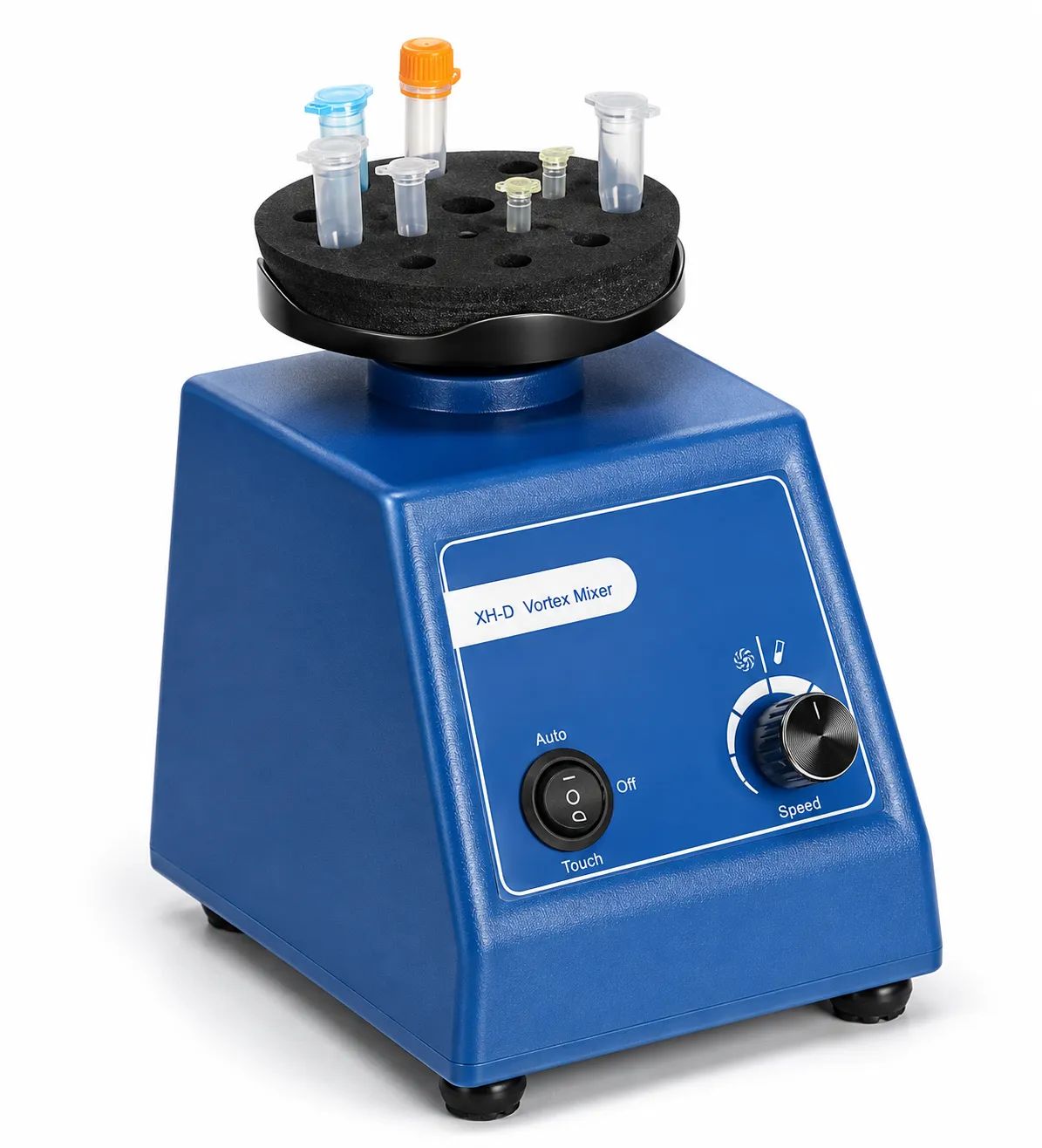
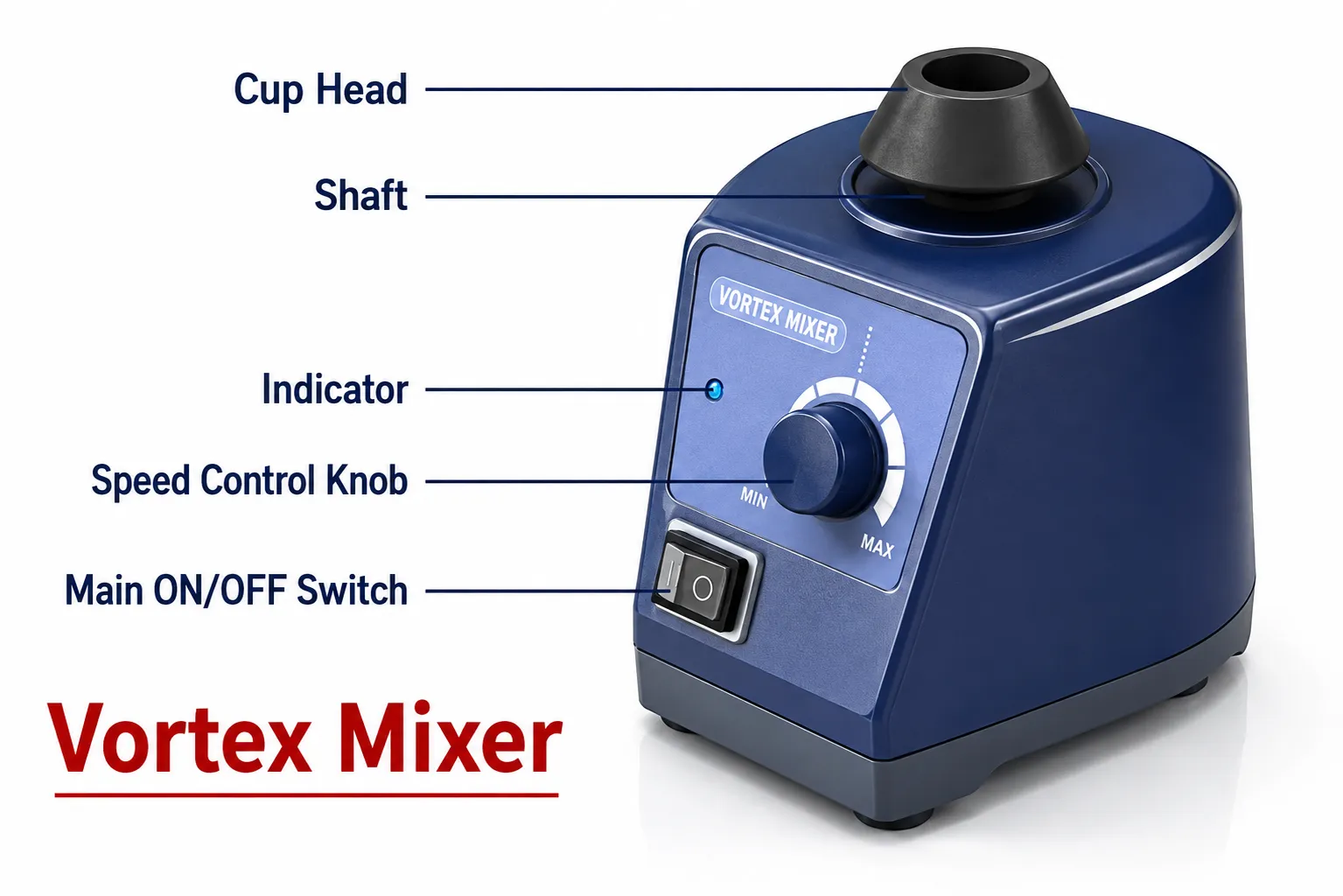
A vortex mixer drives an eccentric cup head at 500–3,200 RPM, transmitting inertial forces through the vessel wall to create a high-speed liquid vortex. Designed primarily for small volume samples up to 50 mL, it achieves rapid homogenisation in seconds without shaft penetration or direct contact with the sample. It is the standard mixing instrument in analytical, biological, and pharmaceutical laboratories for tube-scale sample preparation.
The motor drives an eccentric orbital oscillation at the cup surface. When a vessel is pressed against the cup, the inertial forces establish a rotating liquid vortex inside the tube, with the funnel depth proportional to speed and inversely related to sample viscosity. At maximum speed the liquid surface tilts steeply, maximising circulation within the tube. Touch mode activates mixing only while the tube is pressed against the cup; continuous mode runs at fixed speed without operator contact. Multi-tube platform attachments allow simultaneous vortexing of several vessels.
Challenges
Foam Generation in Protein and Surfactant Samples
The high liquid-air interface generated during vortexing causes persistent foam in samples containing proteins, detergents, or surfactants, introducing air into the sample and interfering with downstream analytical measurements such as absorbance readings or protein assays.
Aerosol and Containment Risk with Biological Samples
Vortexing open tubes or tubes with loose caps generates aerosol droplets, creating a biological containment hazard when working with infectious, toxic, or volatile samples.
Viscosity Limitation
Above approximately 50–100 cP, the liquid mass resists the eccentric orbital forcing sufficiently to suppress vortex formation, making the mixer ineffective for viscous samples such as glycerol-rich buffers or concentrated polymer solutions.
Sample Heating During Prolonged Mixing
Continuous high-speed operation transfers frictional energy into the sample, raising temperature by several degrees over a few minutes, which can denature thermally sensitive enzymes, oligonucleotides, or unstable reagents.
Incomplete Mixing of Dried or Pelleted Residues
Dried residues or cell pellets at the tube cap or shoulder can remain outside the vortex funnel and fail to resuspend completely, particularly in samples that have been centrifuged or lyophilised.
Solutions
- Pulsed Mode Operation: Using short alternating on and off cycles rather than continuous running limits cumulative heat input and reduces sustained foam generation, protecting thermally sensitive samples while still achieving homogenisation.
- Sealed Tube Operation with Cap Integrity Check: Ensuring all tubes are securely capped before vortexing eliminates aerosol generation. For biological samples, operating within a containment enclosure adds an additional layer of protection.
- Pre-Cooling the Sample or Using a Chilled Adapter: Pre-cooling samples on ice before vortexing or using a chilled platform adapter helps maintain sample temperature within acceptable limits during mixing, protecting labile biological molecules.
- Pre-Wetting Dried Residues Before Vortexing: Adding a small volume of solvent and allowing it to soak into dried residues before vortexing, or briefly inverting the tube to wet the cap region, improves complete resuspension of difficult samples.
- Switching to an Appropriate Technique for Viscous Samples: Recognising that vortex mixing is not suited to viscous samples and transferring to an overhead stirrer, roller mixer, or tube rotator for samples exceeding the practical viscosity range of the vortex mixer.
Applications
- Molecular Biology: Cell pellet resuspension after centrifugation, homogenisation of DNA and RNA extraction samples, and preparation of PCR reagent mixes prior to amplification.
- Clinical Diagnostics: Homogenisation of blood and urine samples before analysis, reconstitution of lyophilised diagnostic reagents, and preparation of samples for immunoassay platforms.
- Pharmaceutical Development: Dissolution of reference standards for HPLC analysis, preparation of micro-scale formulation samples, and homogenisation of suspension samples before potency testing.
- Biochemistry: Rapid reconstitution of lyophilised proteins and enzymes, mixing of enzyme-substrate solutions at assay initiation, and integration of buffer components at small scale.
- Analytical Chemistry: Mixing of solvent systems for sample preparation, dissolution of small solid samples in extraction tubes, and homogenisation of indicator additions to reaction vessels at micro-scale.
Models & Capacities
Standard Single-Tube Vortex Mixer — Models & Capacities (0.5 µL Nano to 500 mL Large Volume) | |||||||||
Orbital Radius [mm] | Operation Mode | Max Viscosity [cP] | Timer [s / min] | Control | Motor Power [W] | Platform Ø [mm] | Overall W×D×H [mm] | Weight [kg] |
|
3 | Touch only | <50 | — | Speed knob | 5 | Ø20 | 80×65×100 | 0.3 |
|
3 | Touch / continuous | <50 | — | Speed knob | 8 | Ø25 | 90×75×110 | 0.4 |
|
4 | Touch / continuous | <50 | — | Speed knob | 10 | Ø30 | 100×85×120 | 0.5 |
|
4 | Touch / cont. / timer | <50 | 1–999 s | Digital LED | 15 | Ø30 | 110×90×130 | 0.7 |
|
4 | Continuous | <50 | — | On/Off only | 10 | Ø30 | 90×75×115 | 0.4 |
|
4 | Touch / cont. / pulse | <100 | 1 s–99 min | Digital PID | 20 | Ø35 | 120×100×140 | 1.0 |
|
5 | Touch / cont. / pulse | <100 | 1 s–99 min | Touchscreen | 25 | Ø40 | 130×110×150 | 1.2 |
|
5 | All modes + program | <150 | 1 s–24 h | Touchscreen + PC | 30 | Ø40 | 140×115×155 | 1.5 |
|
6 | Touch / continuous | <200 | — | Speed knob | 30 | Ø60 | 160×130×180 | 1.8 |
|
6 | Touch / continuous | <200 | 1 s–99 min | Digital | 40 | Ø80 | 185×155×200 | 2.5 |
|
6 | Touch / continuous | <300 | 1 s–99 min | Digital | 60 | Ø100 | 210×180×220 | 3.5 |
|