
Rotary Mixer Tube Rotator
A rotary mixer rotates sample tubes through continuous 360° end-over-end inversion at 4–30 RPM. Each inversion drives gravity-alternated flow within the tube, gently shuttling liquid between base and cap without mechanical shear, vortex, or foam generation. Used for 0.2–50 mL samples, it is the standard instrument for gentle long-duration mixing of biological samples where shear-sensitive components must remain intact.
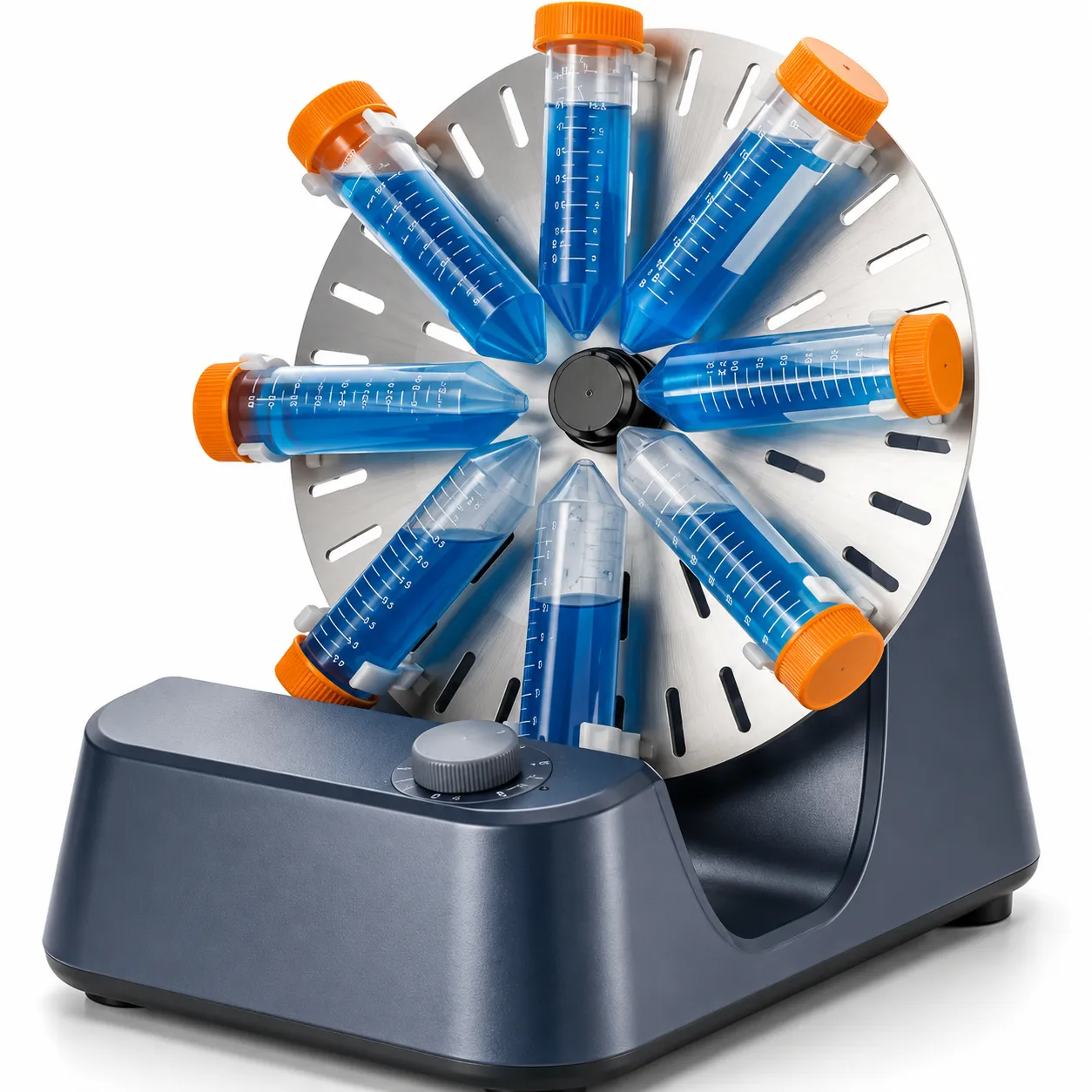
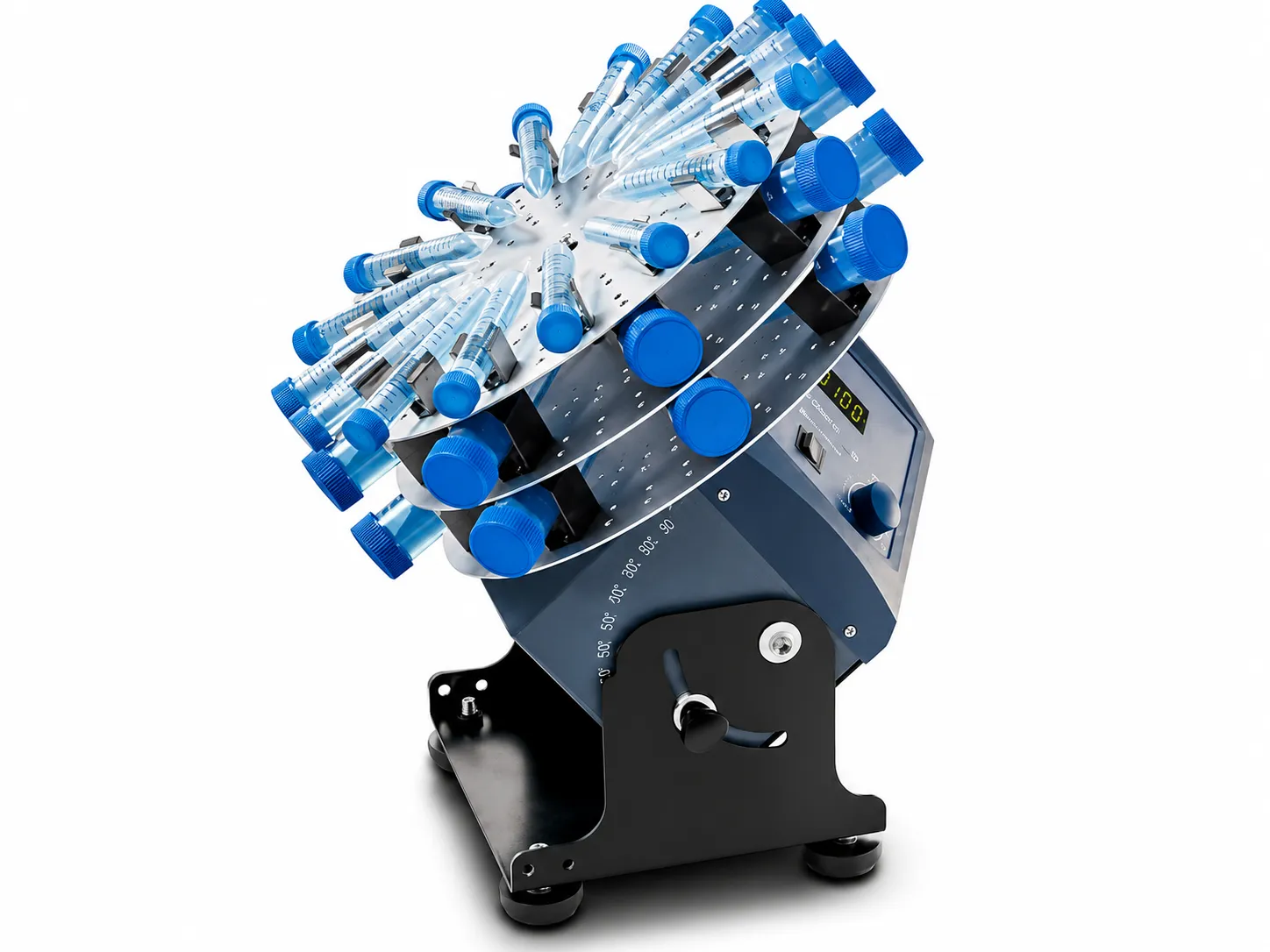
A rotary mixer rotates sample tubes through continuous 360° end-over-end inversion at 4–30 RPM. Each inversion drives gravity-alternated flow within the tube, gently shuttling liquid between base and cap without mechanical shear, vortex, or foam generation. Used for 0.2–50 mL samples, it is the standard instrument for gentle long-duration mixing of biological samples where shear-sensitive components must remain intact.
The drive wheel rotates at a set speed, carrying tubes through a full 360° arc. At each inversion, gravity causes the liquid to flow from one end of the tube to the other, resuspending settled particles and gently homogenising the contents. Tubes must be adequately filled to sustain smooth end-to-end flow rather than splashing. Symmetric loading across the wheel prevents vibration during rotation.
Challenges
High-Density Particle Re-Sedimentation
Dense particles settle faster than the inversion cycle can resuspend them, leading to incomplete mixing between inversions.
Fill Volume Sensitivity
Insufficient fill volume creates excess headspace, causing splashing and foam generation rather than smooth end-to-end flow.
Slow Homogenisation
Gravity-driven laminar flow takes significantly longer to achieve homogenisation compared to vortex or mechanical stirring.
Rotational Imbalance from Unequal Loading
Asymmetric tube loading causes vibration, accelerating bearing wear and reducing mixing consistency.
Limited Temperature Control
Standard models operate at ambient temperature only, restricting use in applications requiring precise thermal conditions during mixing.
Solutions
- Tilted Rotation Axis: Angling the rotation axis introduces a lateral gravity component that generates secondary flow within the tube, improving resuspension of denser particles between inversions.
- Validated Fill Volume Protocol: Maintaining fill volume between 75–95% of tube capacity ensures consistent end-to-end sweeping across all tube formats and sample types.
- Speed Adjustment for Particle Type: Increasing inversion frequency for denser or faster-settling particles reduces the time between resuspension events, maintaining suspension throughout the mixing period.
- Counterbalance Dummy Tubes: Placing water-filled tubes of equivalent mass in empty wheel positions maintains rotational balance during partial loads.
- Incubator-Compatible Models: Low-profile designs with motors rated for operation at 4°C and 37°C allow rotary mixing to be performed within temperature-controlled environments.
Applications
- Haematology and Blood Banking (Whole Blood, Platelet Concentrates): Continuous gentle inversion maintains platelet suspension homogeneity during storage and processing, the standard method for platelet concentrate handling.
- Bead-Based Immunoprecipitation and Magnetic Bead Separation: End-over-end rotation ensures consistent bead-sample contact during antibody binding and magnetic separation protocols in molecular biology workflows.
- Cell-Antibody Conjugation and Cell Suspension Maintenance: Gentle rotation maintains viable cell suspensions and promotes uniform antibody binding during labelling protocols without shear-induced cell damage.
- Affinity Resin Equilibration and Protein Purification: Slow continuous inversion ensures complete equilibration of affinity resin with binding buffer and uniform sample contact during batch purification steps.
- Pharmaceutical Reference Standard Dissolution and Protein Formulation Mixing: Gentle long-duration mixing of reference standards and protein formulations where shear-induced aggregation or degradation must be avoided during sample preparation.
Models & Capacities
Standard Rotary Wheel Mixer — Models & Capacities (8 to 48 Positions, Micro-tube to 50 mL) | ||||||||||||
Tube Positions | Tube Formats Accepted | Working Vol. [mL] | Rotation Mode | Speed Range [RPM] | Tilt Angle [°] | Timer | Motor [W] | Incubator Compatible | Overall W×D×H [mm] | Weight [kg] |
| |
8 | 0.5–15 mL | 0.2–15 | 360° end-over-end | 10 | 0 | No timer | 5 | Yes (4–37°C) | 155×120×155 | 0.8 |
| |
16 | 0.5–50 mL | 0.2–50 | 360° end-over-end | 10 | 0 | No timer | 8 | Yes (4–37°C) | 175×140×175 | 1.2 |
| |
24 | 0.5–50 mL | 0.2–50 | 360° end-over-end | 10 | 0 | No timer | 10 | Yes (4–37°C) | 200×165×200 | 1.8 |
| |
8 | 0.2–15 mL | 0.2–15 | 360° end-over-end | 4–30 | 0 | No timer | 8 | Yes (4–37°C) | 165×130×165 | 1.0 |
| |
16 | 0.2–50 mL | 0.2–50 | 360° end-over-end | 4–30 | 0 | No timer | 10 | Yes (4–37°C) | 185×150×185 | 1.5 |
| |
24 | 0.2–50 mL | 0.2–50 | 360° end-over-end | 4–30 | 0 | No timer | 12 | Yes (4–37°C) | 210×175×210 | 2.2 |
| |
48 | 0.5–50 mL | 0.5–50 | 360° end-over-end | 4–25 | 0 | No timer | 20 | Yes (4–37°C) | 280×240×280 | 4.5 |
| |
16 | 0.2–50 mL | 0.2–50 | 360° end-over-end | 1–80 | 0 | 1 s–99 h | 15 | Yes (4–37°C) | 200×160×200 | 1.8 |
| |
24 | 0.2–50 mL | 0.2–50 | 360° end-over-end | 1–80 | 0 | 1 s–99 h | 20 | Yes (4–37°C) | 220×180×220 | 2.5 |
| |
48 | 0.2–50 mL | 0.2–50 | 360° end-over-end | 1–80 | 0 | 1 s–99 h | 30 | Yes (4–37°C) | 295×250×295 | 5.0 |
| |
16 | 0.2–50 mL | 0.2–50 | 360° end-over-end | 4–30 | 0–45 adj. | No timer | 15 | Yes (4–37°C) | 210×175×220 | 2.0 |
| |
24 | 0.2–50 mL | 0.2–50 | 360° end-over-end | 1–80 | 0–45 adj. | 1 s–99 h | 20 | Yes (4–37°C) | 230×195×240 | 3.0 |
| |