
Orbital Shaker
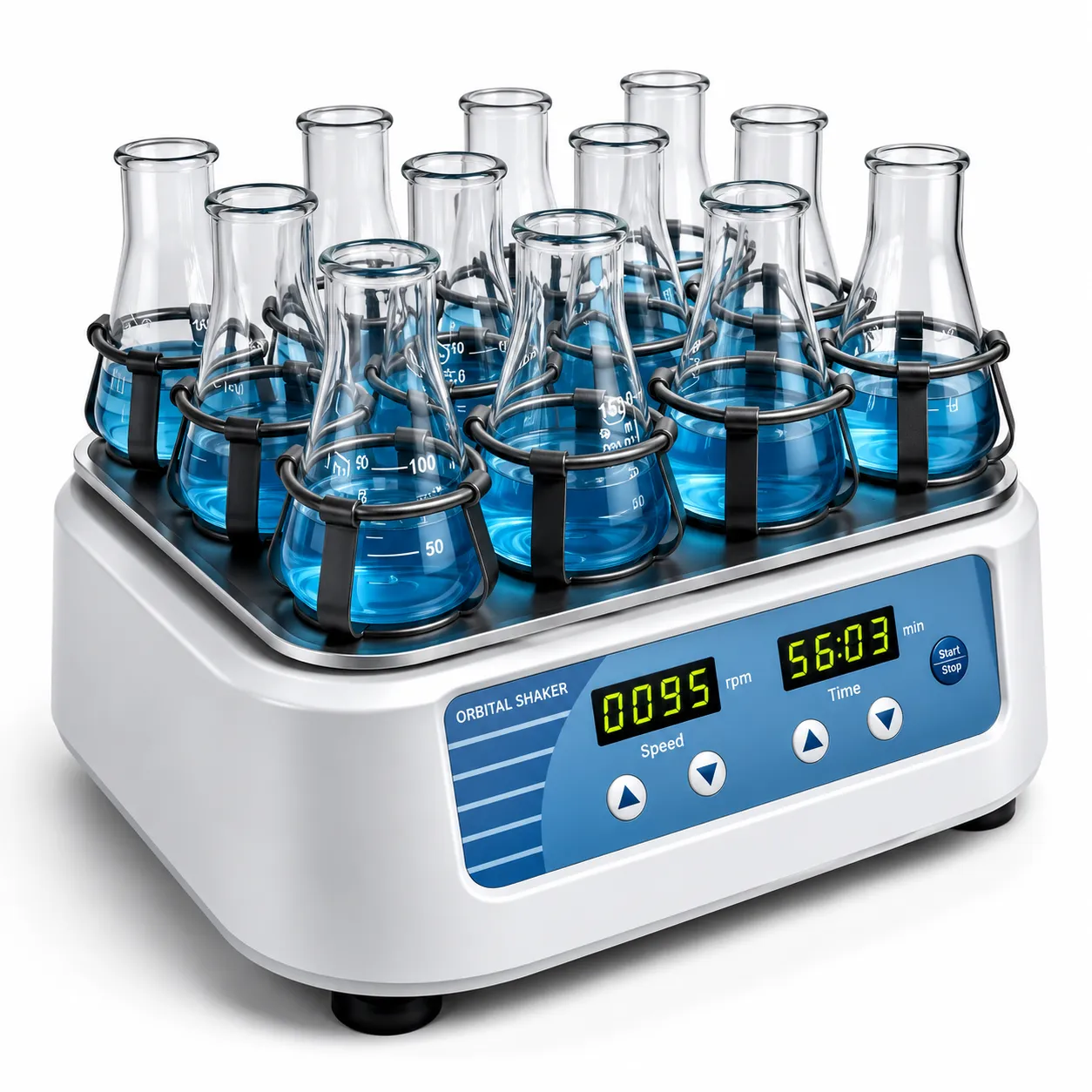
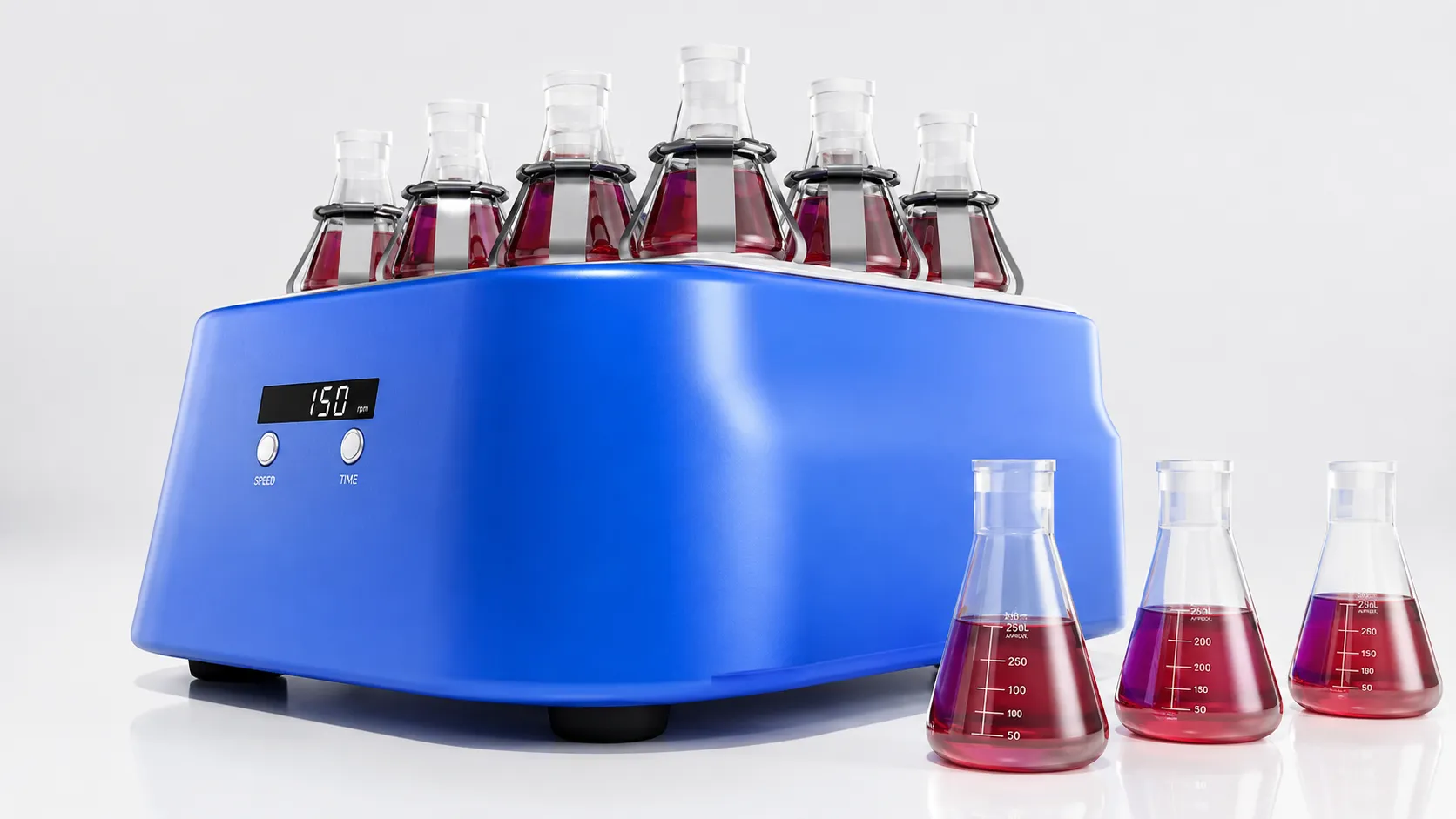
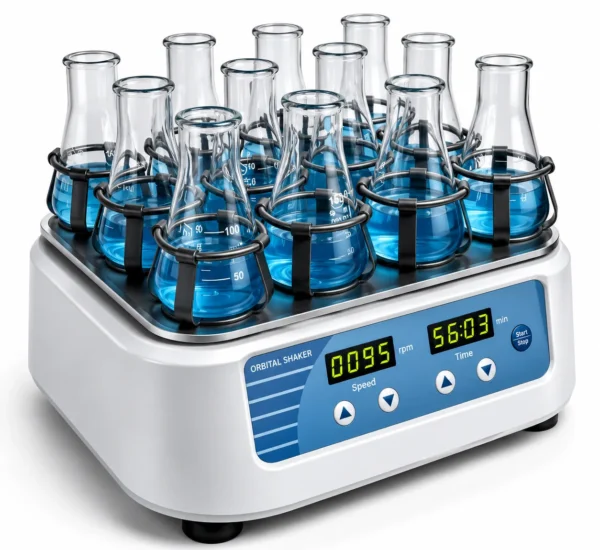
An orbital shaker drives a flat platform in circular orbital motion at 20–500 RPM with a fixed orbital radius, generating wave-like liquid flow in all clamped vessels simultaneously. Used across microplates, tubes, and Erlenmeyer flasks, it is the standard instrument for aerobic microbial cultivation and parallel sample processing where gentle to moderate mixing is required across multiple vessels simultaneously.
Challenges
Limited Oxygen Transfer Rate
Orbital shakers provide significantly lower oxygen transfer than stirred bioreactors, restricting cultivation to organisms or processes with moderate oxygen demand. High-density cultures quickly become oxygen-limited in shake flask format.
Evaporation During Extended High-Temperature Runs
Prolonged shaking at elevated temperatures causes significant evaporation from loosely capped vessels, altering media osmolality, pH, and nutrient concentration, which directly affects biological culture outcomes.
Flask Slippage at High Speed
Improperly secured or heavily loaded flasks can slip from clamps at high orbital speeds, causing spills, contamination, and potential loss of biological material.
Non-Uniform Mixing Across Microplate Wells
A single fixed orbital radius generates different mixing intensities in peripheral versus central wells of a microplate, creating well-to-well variability in oxygen transfer and mixing that compromises parallel screening data.
Phase Separation in Two-Phase Systems
At higher speeds, density-mismatched liquid systems such as organic-aqueous extraction mixtures can undergo radial separation rather than homogenisation, reducing extraction efficiency.
Solutions
- Baffled Erlenmeyer Flasks: Using flasks with two to four internal baffles disrupts symmetric toroidal flow, significantly increasing oxygen transfer rate at the same orbital speed compared to unbaffled flasks, extending the cultivation range to higher oxygen-demanding organisms.
- Gas-Permeable Membrane Closures: Replacing loose caps with PTFE or breathable membrane closures prevents evaporation during extended runs while maintaining adequate oxygen and carbon dioxide exchange, protecting media composition throughout long cultivation periods.
- Torque-Verified Spring-Loaded Flask Clamps: Clamps that maintain consistent clamping force independent of flask size and fill weight prevent slippage at all operating speeds, reducing contamination risk and protecting operator safety.
- Orbital Radius Matched to Vessel Size: Selecting an orbital radius proportional to the vessel diameter maximises wave amplitude and oxygen transfer for the specific vessel geometry in use.
- Microplate-Specific Sub-Platforms with Reduced Orbital Radius: Using a sub-platform with a smaller orbital radius matched to microplate well dimensions improves mixing uniformity across all wells, reducing well-to-well variability in oxygen transfer during parallel screening experiments.
Applications
- Aerobic Microbial Cultivation (E. coli, Bacillus, Saccharomyces): Shake flask screening of growth conditions, media composition, and inoculum preparation prior to stirred bioreactor scale-up.
- Mammalian Cell Suspension Culture (CHO, HEK293): Expansion of suspension-adapted cell lines in baffled flasks or disposable tubes for upstream bioprocess development and viral vector production.
- Enzyme and Secondary Metabolite Production Screening: Parallel cultivation of fungal and bacterial strains in multiple flasks to screen fermentation conditions for enzyme titres and secondary metabolite yields.
- Pharmaceutical Solubility and Dissolution Screening: Parallel agitation of drug compound suspensions in buffered media to assess solubility and dissolution rate across multiple pH conditions simultaneously.
- Liquid-Liquid Extraction Optimisation: Extended agitation of organic-aqueous extraction systems to determine equilibrium partition coefficients and optimise solvent selection in natural product and API extraction processes.
- Biodegradation and Environmental Bioassays: Long-duration agitation of soil or water samples with microbial inocula to assess biodegradation kinetics of pollutants under defined and reproducible mixing conditions.
Models & Capacities
Standard Benchtop Orbital Shaker — Models & Capacities (Compact 200×200 mm to XXL 750×550 mm Platform) | ||||||||
Max Load [kg] | Max Flask Size [L] | Max Flasks | Timer [s – h] | Motor [W] | Noise [dB(A)] | Overall W×D×H [mm] | Weight [kg] |
|
2 | 0.25 | 4 × 250 mL | 1 s–99 h | 20 | <50 | 280×260×130 | 3.5 |
|
4 | 0.5 | 4 × 500 mL | 1 s–99 h | 40 | <52 | 380×340×145 | 5.5 |
|
6 | 1 | 6 × 1 L | 1 s–99 h | 60 | <54 | 460×360×160 | 7.0 |
|
8 | 2 | 4 × 2 L | 1 s–99 h | 60 | <54 | 460×360×160 | 7.5 |
|
12 | 2 | 8 × 2 L | 1 s–99 h | 80 | <55 | 530×460×175 | 10 |
|
15 | 5 | 4 × 5 L | 1 s–99 h | 80 | <55 | 530×460×175 | 11 |
|
20 | 5 | 8 × 5 L | 1 s–99 h | 120 | <58 | 680×530×185 | 18 |
|
30 | 5 | 12 × 5 L | 1 s–99 h | 150 | <58 | 830×630×195 | 26 |
|
15 | 2 | 8 × 2 L | 1 s–999 h | 100 | <55 | 530×460×185 | 14 |
|
20 | 5 | 8 × 5 L | 1 s–999 h | 150 | <58 | 680×530×200 | 22 |
|
30 | 5 | 12 × 5 L | 1 s–999 h | 180 | <58 | 830×630×205 | 35 |
|