
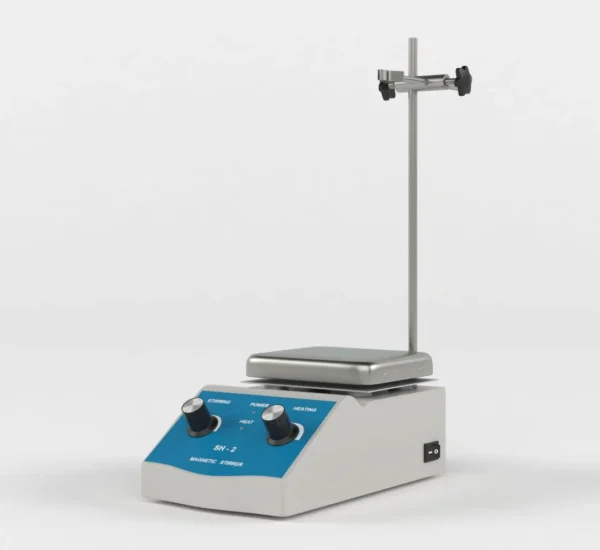
Magnetic Stirrer Hotplate Stirrer
A magnetic stirrer drives a PTFE-encapsulated stir bar via a rotating magnet beneath the base plate, coupling torque through the vessel wall without shaft penetration. Combined hotplate models integrate resistance heating for simultaneous temperature control. Processing 1 mL to 5 L at viscosities up to approximately 1,000 cP, it provides simple, contamination-free stirring for dissolution studies, chemical reactions, and analytical sample preparation.
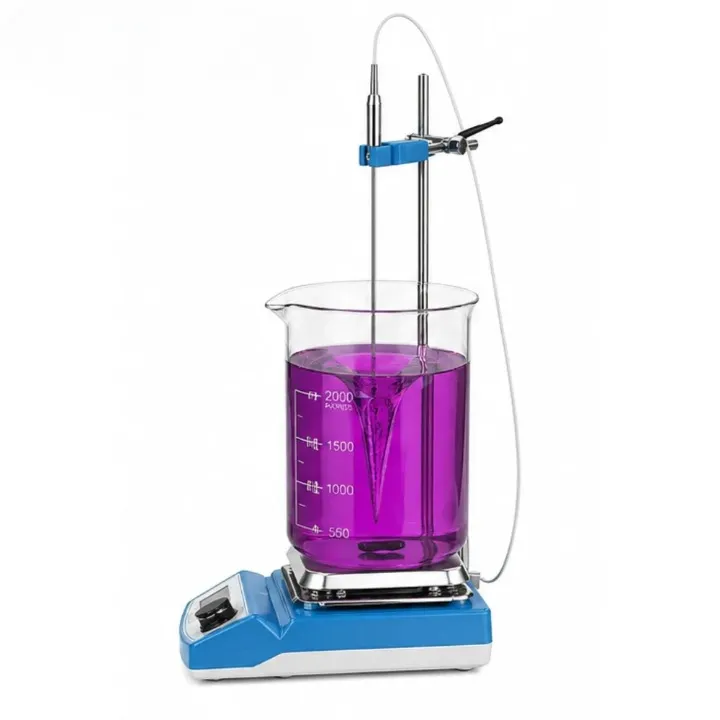
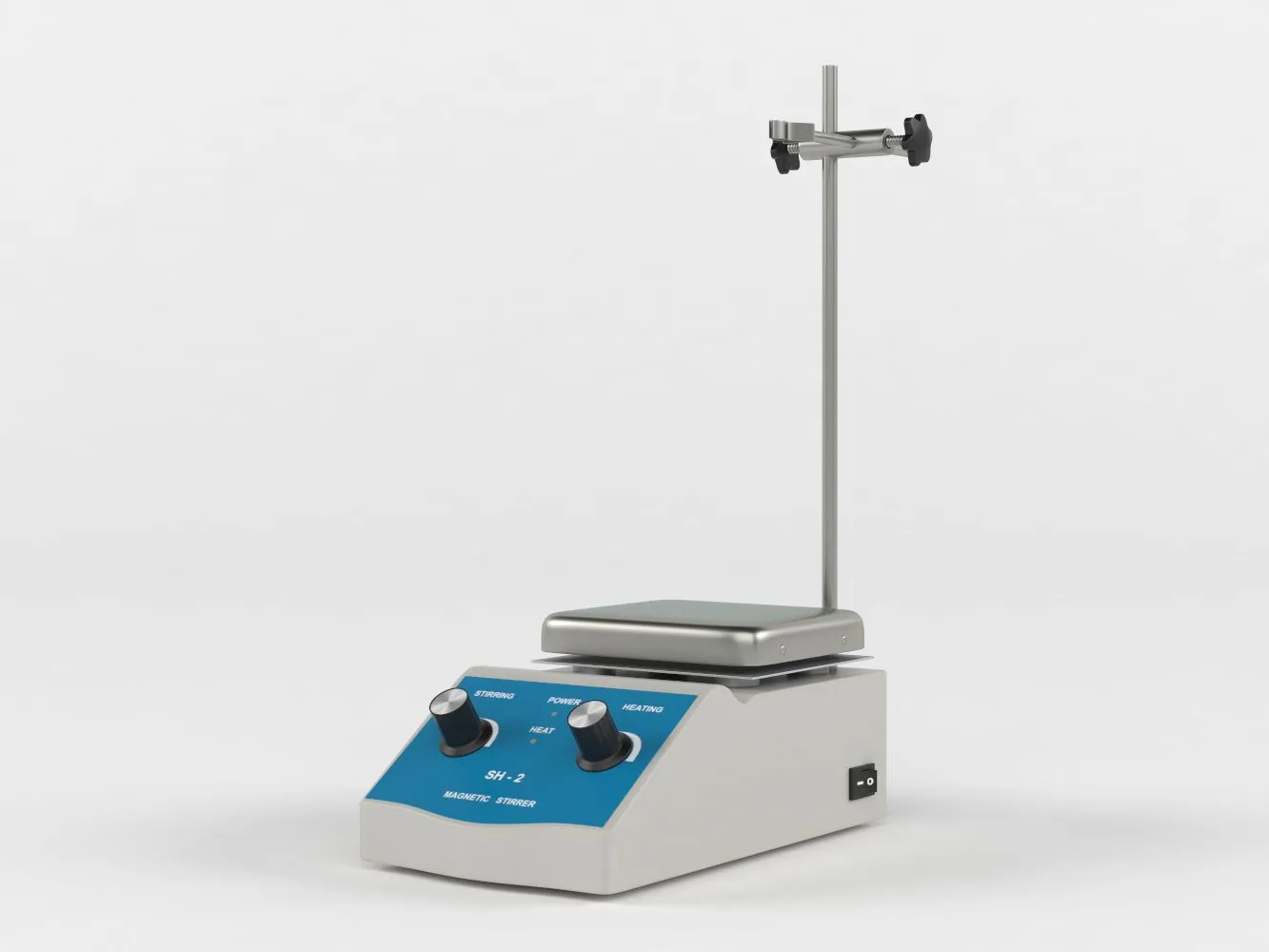
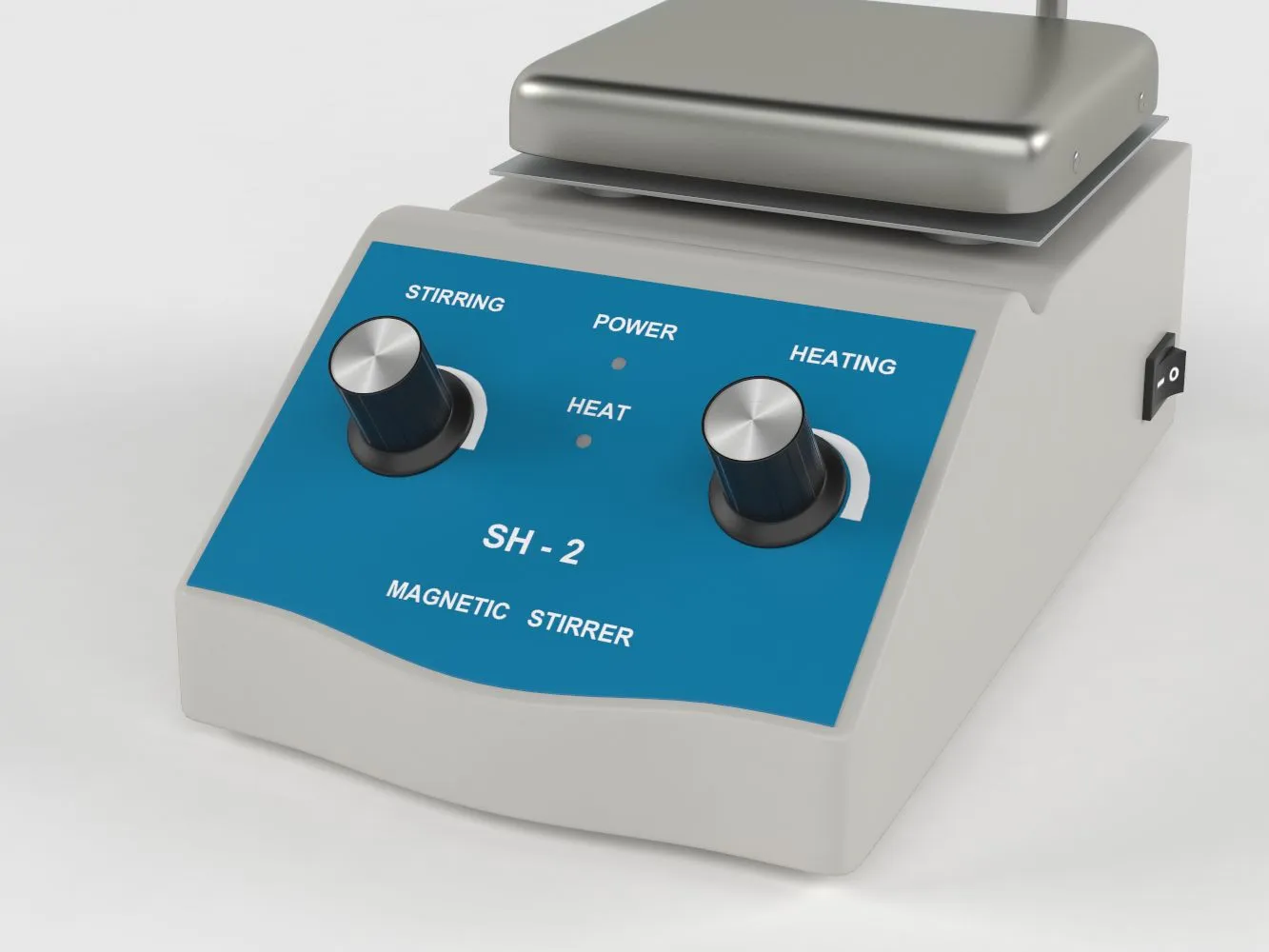
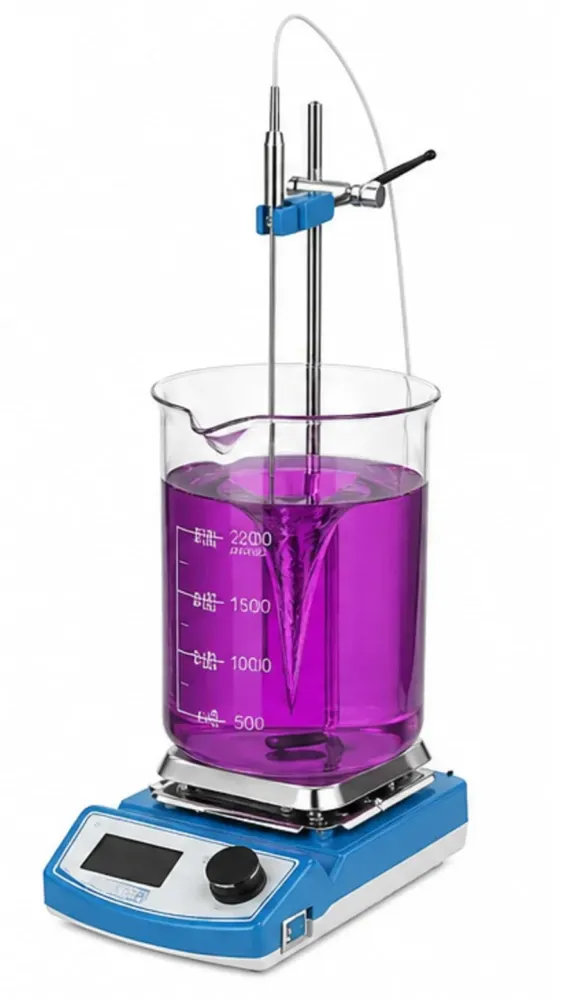
A magnetic stirrer drives a PTFE-encapsulated stir bar via a rotating magnet beneath the base plate, coupling torque through the vessel wall without shaft penetration. Combined hotplate models integrate resistance heating for simultaneous temperature control. Processing 1 mL to 5 L at viscosities up to approximately 1,000 cP, it provides simple, contamination-free stirring for dissolution studies, chemical reactions, and analytical sample preparation.
The drive magnet rotates at a set speed, inducing synchronous stir bar rotation that generates liquid circulation within the vessel. Hotplate models use resistance heating with PID control maintaining plate temperature at setpoint; an external probe placed directly in the liquid provides more accurate bulk temperature measurement and reduces the lag between plate and liquid temperature. Different stir bar shapes generate different flow patterns within the vessel.
Challenges
Stir Bar Decoupling at High Viscosity or Speed
When fluid resistance exceeds the magnetic coupling torque, the stir bar loses synchrony with the drive magnet, spinning erratically or stopping entirely, giving a false impression of active mixing.
Inadequate Mixing in Tall or Large Vessels
Magnetic stirrers generate primarily bottom-level circulation; in vessels taller than approximately twice the vessel diameter, upper liquid layers receive little mixing.
Hotplate Temperature Overshoot
Without a probe directly in the liquid, the plate temperature can significantly overshoot the target, risking thermal degradation of heat-sensitive samples.
Stir Bar Retrieval and Cross-Contamination
In multi-product laboratory environments, stir bars are frequently misplaced, damaged, or inadequately cleaned between uses, creating cross-contamination risk.
Ineffective Solid Suspension
Denser solid particles settle faster than the toroidal flow can lift them, leaving undissolved solids resting beneath or beside the stir bar rather than suspended in the bulk.
Solutions
- Operate Below 60-70% of Maximum Speed: Maintaining speed well below maximum preserves coupling torque margin, preventing decoupling particularly as viscosity increases during dissolution or reaction.
- External Temperature Probe Directly in Liquid: Always connecting PID control to a probe immersed in the liquid rather than relying on plate temperature sensing eliminates overshoot and accurately represents bulk temperature.
- Dedicated Colour-Coded Stir Bars per Product: Assigning specific stir bars to specific products or processes and inspecting PTFE coating integrity before each use reduces cross-contamination and contamination from damaged coatings.
- Switching to Overhead Stirrer for Tall Vessels or Solid Suspension: Recognising the inherent limitation of magnetic stirrers and transferring to an overhead mechanical stirrer when vessel geometry or solids loading exceeds the practical capability of magnetic coupling.
- Using Appropriate Stir Bar Shape for the Application: Selecting cross-shaped or oval bars for general dissolution, and larger egg-shaped bars for higher viscosity media, improves circulation and extends the practical operating range.
Applications
- Chemical Synthesis: Routine reaction stirring, reflux operations, dissolution studies in flasks and beakers.
- Analytical Chemistry: Standard solution preparation, titration vessel stirring, sample dissolution for spectroscopy.
- Pharmaceutical Development: Solubility/dissolution rate studies, pH adjustment with heating, buffer preparation.
- Biology & Biochemistry: Buffer and media preparation, enzyme assay stirring, small-scale culture maintenance.
- Food Science: Small-scale emulsion preparation, hydrocolloid solubility studies, thermal treatment of liquid samples.
Models & Capacities
Standard Hotplate Magnetic Stirrer — Models & Capacities (Micro 1 mL to Pilot 50 L) | |||||||||||||
Model | Scale | Working Vol. [mL – L] | Plate / Bath Size [mm] | Speed Range [RPM] | Heating Power [W] | Max Plate Temp [°C] | Temp Accuracy | Temp Sensor | Max Viscosity [cP] | Display / Control | Overall W×D×H [mm] | Weight [kg] |
|
MS-HP-MICRO | Micro/Lab | 1–50 mL | 80×80 | 200–2,000 | 10 | 200 | ±2°C (plate) | Pt 1000 | <200 | Analogue knob | 110×110×75 | 0.6 |
|
MS-HP-MINI | Lab | 1–100 mL | 100×100 | 100–2,000 | 15 | 320 | ±1°C (plate) | Pt 1000 | <500 | Analogue knob | 130×130×85 | 0.8 |
|
MS-HP-100 | Lab | 20–250 mL | 120×120 | 50–1,800 | 20 | 340 | ±1°C (plate) | Pt 1000 | <500 | Analogue knob | 155×155×90 | 1.0 |
|
MS-HP-500A | Lab | 50 mL–500 mL | 130×130 | 50–1,600 | 30 | 350 | ±1°C (plate) | Pt 1000 | <1,000 | Analogue | 160×160×95 | 1.2 |
|
MS-HP-1L-A | Lab | 50 mL–1 L | 140×140 | 50–1,500 | 50 | 360 | ±1°C (plate) | Pt 1000 | <2,000 | Analogue | 175×175×100 | 1.5 |
|
MS-HP-1L-D | Lab | 50 mL–1 L | 140×140 | 50–1,500 | 50 | 360 | ±0.5°C (probe) | Pt 100 ext. | <2,000 | Digital LED | 175×175×105 | 1.8 |
|
MS-HP-2L | Lab | 100 mL–2 L | 155×155 | 50–1,500 | 100 | 380 | ±0.5°C (probe) | Pt 100 ext. | <5,000 | Digital LED | 200×200×110 | 2.2 |
|
MS-HP-3L | Lab/Pilot | 250 mL–3 L | 170×170 | 50–1,400 | 150 | 380 | ±0.5°C (probe) | Pt 100 ext. | <8,000 | Digital LED | 215×215×115 | 2.8 |
|
MS-HP-5L | Lab/Pilot | 250 mL–5 L | 180×180 | 50–1,200 | 200 | 400 | ±0.5°C (probe) | Pt 100 ext. | <10,000 | Digital LED | 230×230×120 | 3.2 |
|
MS-HP-10L | Lab/Pilot | 1–10 L | 220×220 | 30–1,000 | 300 | 380 | ±0.5°C (probe) | Pt 100 ext. | <15,000 | Digital | 275×275×130 | 4.5 |
|
MS-HP-20L | Pilot | 5–20 L | 280×280 | 20–800 | 450 | 350 | ±1°C (probe) | Pt 100 ext. | <20,000 | Digital PID | 340×340×145 | 7.0 |
|
MS-HP-50L | Pilot | 10–50 L | 380×380 | 10–600 | 800 | 320 | ±1°C (probe) | Pt 100 ext. | <20,000 | Digital PID | 450×450×160 | 12 |
|