
High-Speed Disperser Dissolver
A high-speed disperser drives a serrated Cowles-type disc impeller at 500–5,000 RPM, generating an intense radial discharge jet creating a doughnut-shaped recirculation pattern with localised high shear at the disc tooth tips. Processing 100 mL to 50 L at viscosities up to 50,000 cP, it is the standard instrument for pigment dispersion and powder incorporation in paint, ink, and adhesive formulation.
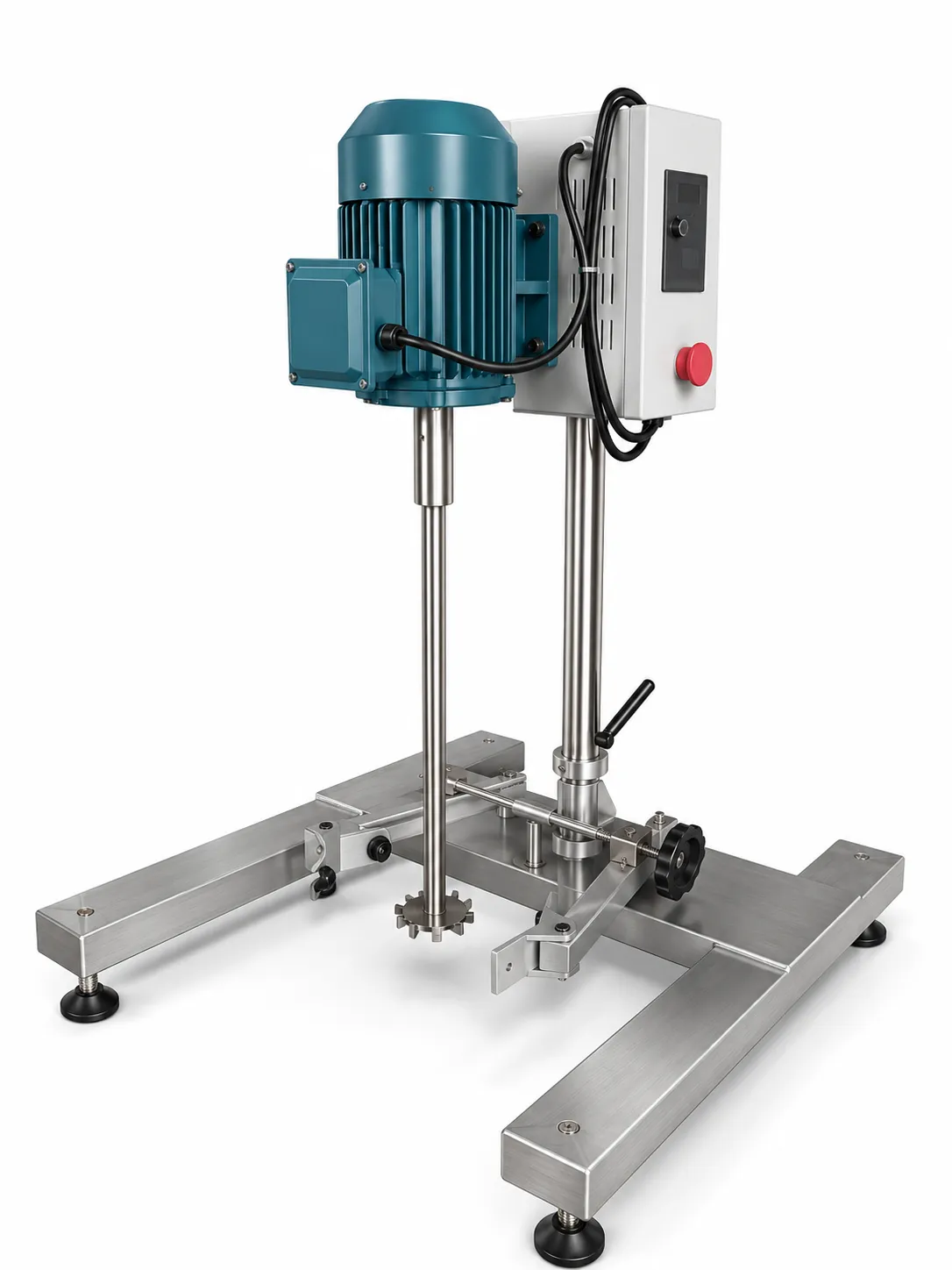
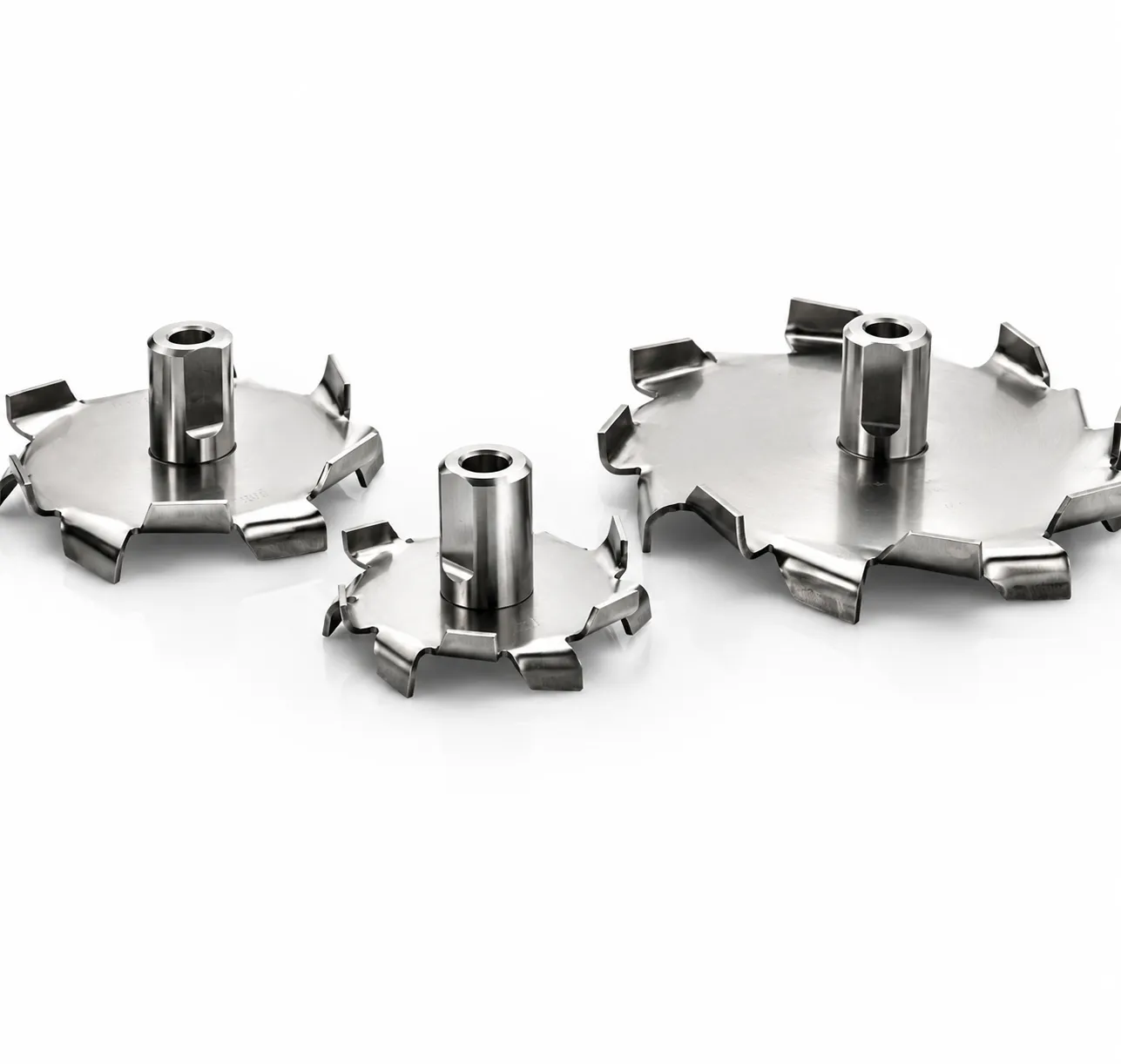
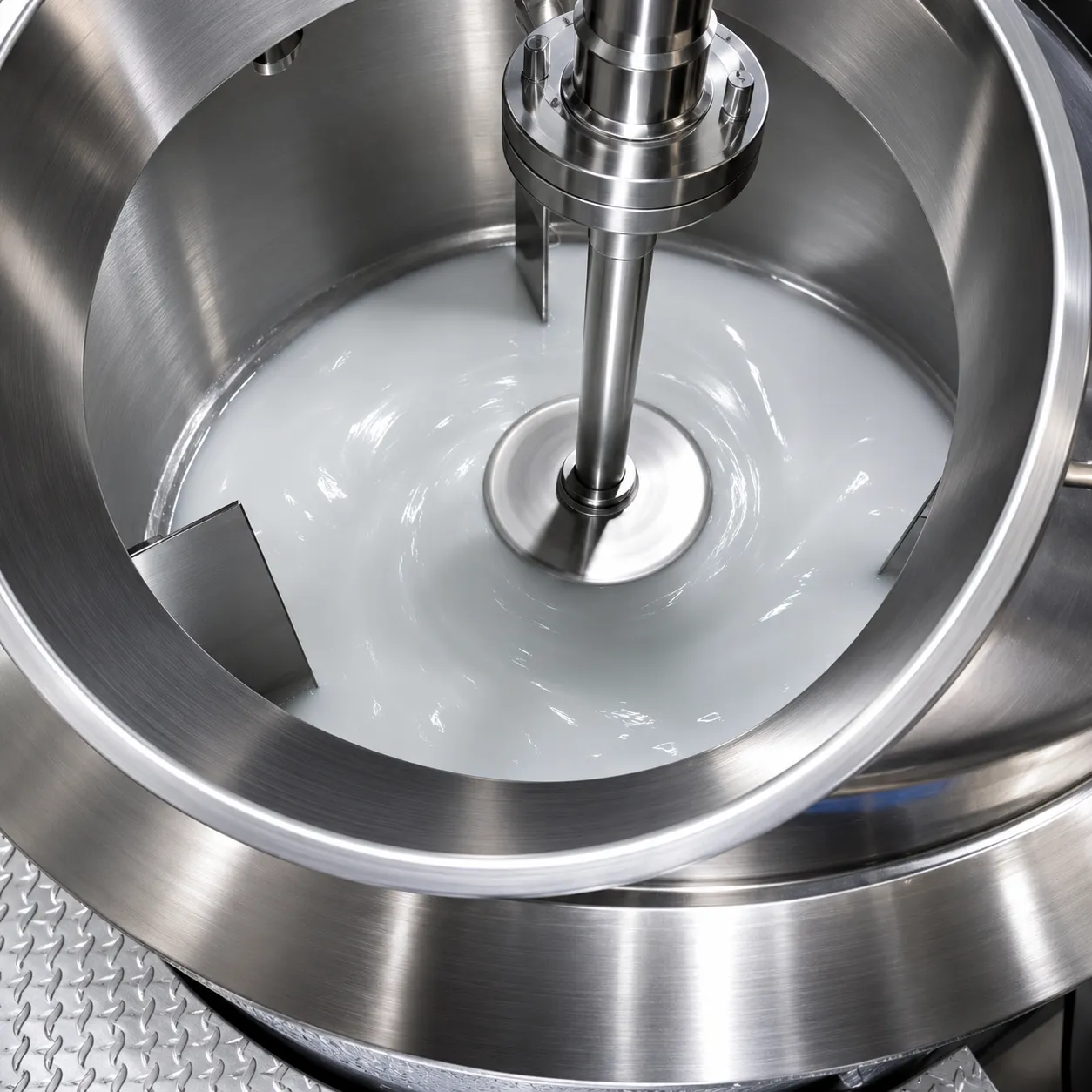
A high-speed disperser drives a serrated Cowles-type disc impeller at 500–5,000 RPM, generating an intense radial discharge jet creating a doughnut-shaped recirculation pattern with localised high shear at the disc tooth tips. Processing 100 mL to 50 L at viscosities up to 50,000 cP, it is the standard instrument for pigment dispersion and powder incorporation in paint, ink, and adhesive formulation.
Liquid is charged first; solids are added incrementally at low speed to prevent dusting and uncontrolled agglomeration. At process speed, the disc generates a high-velocity radial jet that splits into upward and downward recirculation loops. The ascending loop draws surface powder into the suction zone; the descending loop carries wetted particles into the high-shear zone below the disc, progressively wetting and deagglomerating the solid phase.
Challenges
Vortex Formation and Air Entrainment
At higher speeds in unbaffled vessels, a deep surface vortex draws headspace air into the dispersion, introducing bubbles that create pinholes and surface defects in applied coatings and films.
Disc Tooth Wear from Abrasive Pigments
Repeated processing of hard abrasive pigments such as titanium dioxide and calcium carbonate progressively erodes disc tooth geometry, reducing shear intensity and dispersion efficiency over time.
Shaft Vibration at Certain Operating Speeds
In low-viscosity systems, the shaft can develop vibration at speeds approaching its natural frequency, causing mechanical stress and potentially reducing equipment service life.
Batch Overheating During Sustained High-Speed Operation
Prolonged high-power operation generates heat within the batch, risking degradation of thermally sensitive resins, emulsion stability, and reactive adhesive formulations.
Loss of Dispersion Pattern Below Minimum Tip Speed
Below the minimum effective tip speed, the characteristic doughnut recirculation pattern collapses and the disc merely stirs the batch without generating the shear needed for effective pigment dispersion.
Solutions
- Eccentric Disc Positioning or Baffled Vessel: Offsetting the disperser shaft from the vessel centreline or using a baffled vessel suppresses vortex formation without sacrificing the high-shear radial discharge pattern essential for effective dispersion.
- Hardened or Coated Disc Selection: Specifying tungsten carbide or ceramic-coated Cowles discs for abrasive pigment applications significantly extends disc service life and maintains consistent tooth geometry and shear performance over time.
- Critical Speed Identification and Speed Range Restriction: Identifying the shaft critical speed during equipment setup and programming the variable frequency drive to avoid sustained operation near resonance reduces vibration risk and protects shaft integrity.
- Jacketed Vessel with Temperature-Controlled Cooling: Circulating cooling water through the vessel jacket during high-power operation maintains batch temperature within an acceptable range, protecting thermally sensitive resin systems and emulsions.
- Tip Speed as Primary Scale-Up Parameter: Maintaining constant disc tip speed rather than RPM or power per volume when transferring between vessel scales ensures equivalent shear rate and dispersion kinetics at production scale.
Applications
- Paint Mill-Base Preparation (Alkyd, Acrylic, Epoxy Systems): Dispersion of titanium dioxide, carbon black, and organic pigments into resin vehicles during mill-base preparation prior to let-down, the standard first-stage operation in architectural and industrial paint production.
- Printing Ink Pigment Dispersion (Offset, Flexographic, Gravure): Incorporation and deagglomeration of organic pigments and carbon black into ink vehicles for offset, flexographic, and gravure printing ink manufacturing.
- Adhesive and Sealant Filler Incorporation: Dispersion of mineral fillers, fumed silica, and rheology modifiers into polyurethane, silicone, and epoxy adhesive bases during formulation and production.
- Cosmetic Pigment Dispersion (Foundations, Colour Cosmetics): Dispersion of iron oxides, ultramarines, and mineral pigments into oil and emulsion bases during colour cosmetic and foundation formulation development and production.
- Sunscreen Active Incorporation: Dispersion and deagglomeration of mineral UV filters including zinc oxide and titanium dioxide into cosmetic emulsion and anhydrous sunscreen bases at both laboratory and production scale.
Models & Capacities
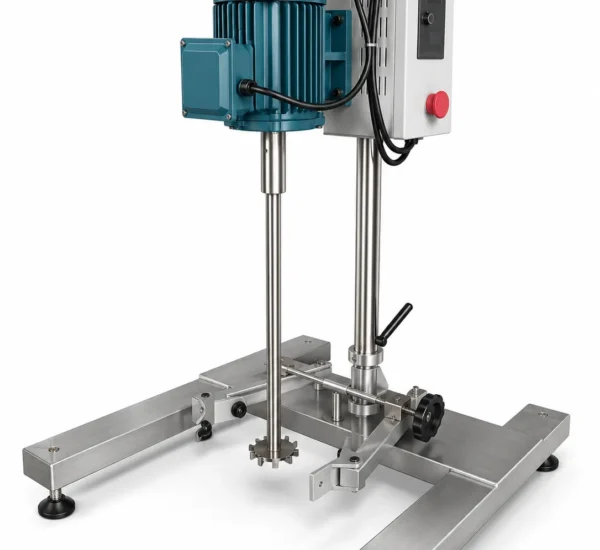
Standard Single-Shaft High-Speed Disperser — Models & Capacities (100 mL Lab to 50,000 L Large Production) |
| ||||||||||||||
Model | Scale | Working Vol. [L] | Disc Ø [mm] | Speed Range [RPM] | Tip Speed [m/s] | Motor [kW] | Max Viscosity [cP] | Hegman Fineness [µm] | Shaft L [mm] | Jacket Option | Lift Travel [mm] | Weight [kg] |
| ||
HSD-LAB-020 | Lab | 0.1–0.5 | Ø20 | 500–10,000 VFD | 5–33 | 0.04 | <2,000 | 5–80 | 150 | No | 100 | 1.5 | |||
HSD-LAB-060 | Lab | 0.2–2 | Ø60 | 500–6,000 VFD | 5–19 | 0.12 | <5,000 | 10–100 | 250 | No | 150 | 3.5 | |||
HSD-LAB-100 | Lab | 0.5–5 | Ø100 | 300–5,000 VFD | 5–26 | 0.37 | <10,000 | 10–150 | 350 | Optional | 200 | 8.0 | |||
HSD-LAB-150 | Lab | 1–15 | Ø150 | 200–4,000 VFD | 5–31 | 0.75 | <15,000 | 10–150 | 450 | Optional | 250 | 15 | |||
HSD-PIL-200 | Pilot | 5–50 | Ø200 | 150–3,500 VFD | 5–37 | 1.5 | <20,000 | 10–200 | 550 | Yes | 350 | 38 | |||
HSD-PIL-250 | Pilot | 10–100 | Ø250 | 100–3,000 VFD | 5–39 | 2.2 | <25,000 | 10–200 | 650 | Yes | 400 | 65 | |||
HSD-PIL-300 | Pilot | 20–150 | Ø300 | 80–2,500 VFD | 5–39 | 3.0 | <30,000 | 10–200 | 750 | Yes | 500 | 110 | |||
HSD-P-400 | Production | 50–500 | Ø400 | 60–2,000 VFD | 5–42 | 5.5 | <35,000 | 10–250 | 900 | Yes | 650 | 220 | |||
HSD-P-500 | Production | 100–1,000 | Ø500 | 50–1,800 VFD | 5–47 | 7.5 | <40,000 | 15–300 | 1,050 | Yes | 800 | 380 | |||
HSD-P-600 | Production | 200–2,000 | Ø600 | 40–1,500 VFD | 5–47 | 11 | <45,000 | 15–300 | 1,200 | Yes | 950 | 620 | |||
HSD-P-750 | Production | 400–5,000 | Ø750 | 30–1,200 VFD | 5–47 | 15 | <50,000 | 20–350 | 1,400 | Yes | 1,150 | 1,050 | |||
HSD-LP-900 | Large Prod | 800–10,000 | Ø900 | 25–1,000 VFD | 5–47 | 22 | <50,000 | 20–400 | 1,700 | Yes | 1,400 | 1,800 | |||
HSD-LP-1200 | Large Prod | 2,000–20,000 | Ø1,200 | 18–750 VFD | 5–47 | 37 | <50,000 | 20–500 | 2,100 | Yes | 1,800 | 3,500 | |||
HSD-LP-1500 | Large Prod | 5,000–50,000 | Ø1,500 | 15–600 VFD | 5–47 | 55 | <50,000 | 25–500 | 2,600 | Yes | 2,200 | 7,000 | |||