
Bottom Entry Homogenizer
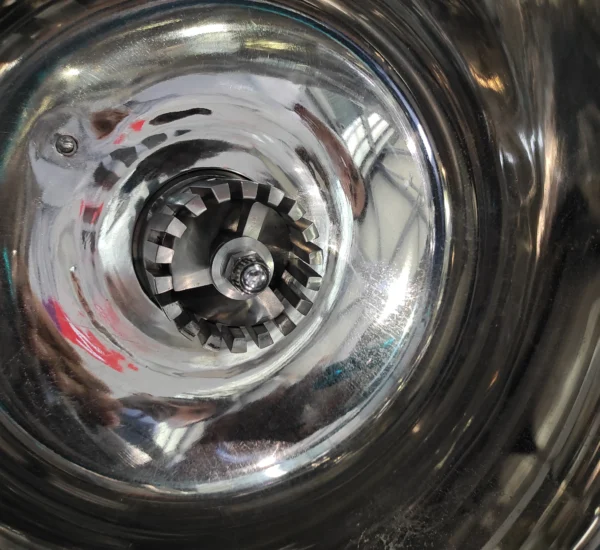
A standard bottom entry homogenizer mounts a rotor-stator workhead at the vessel base through a mechanical seal, drawing material upward by centrifugal suction. It eliminates bottom dead zones and particle settling without requiring supplementary bottom agitation. The standard configuration for pharmaceutical, cosmetic, food, and chemical batch emulsification and dispersion in jacketed production vessels.
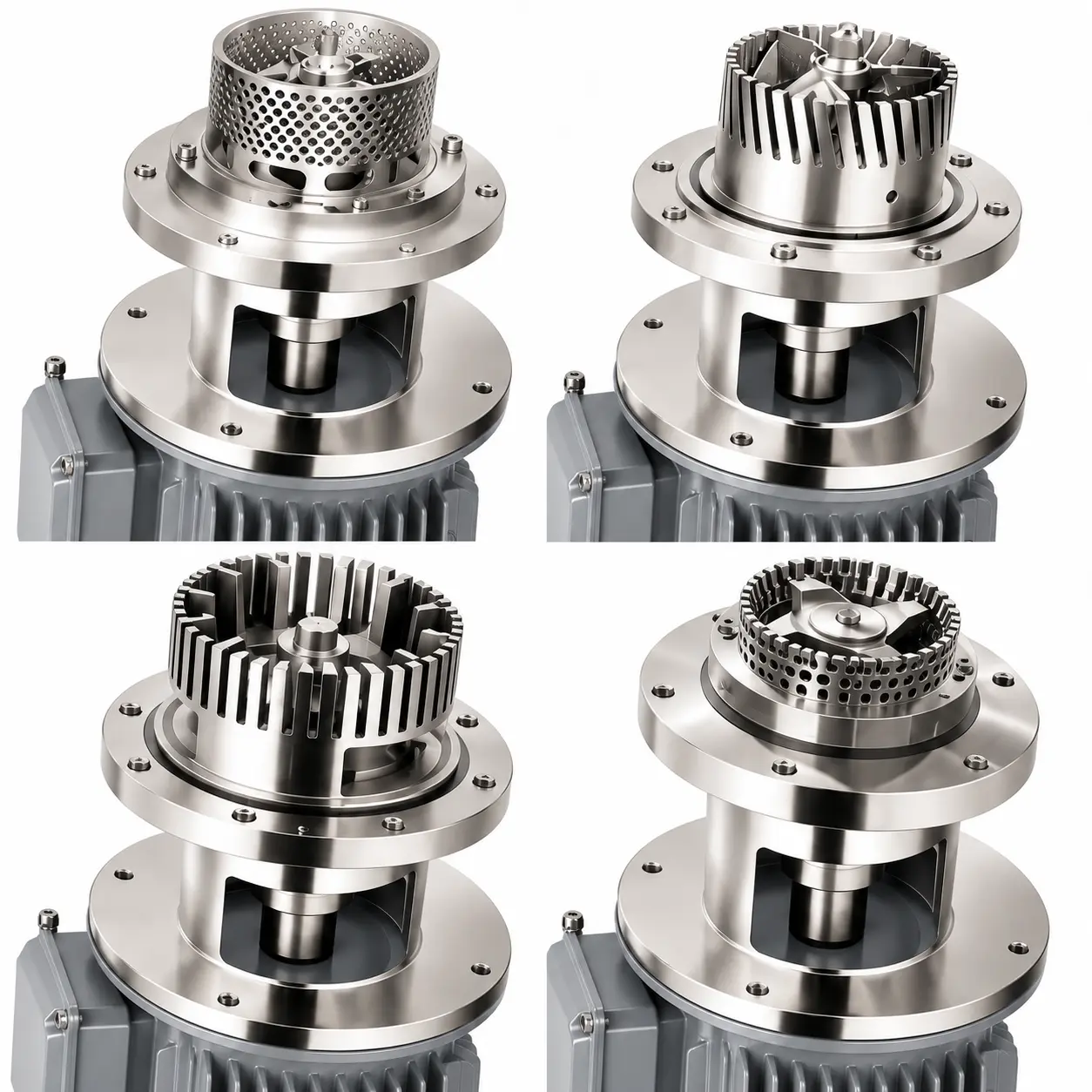
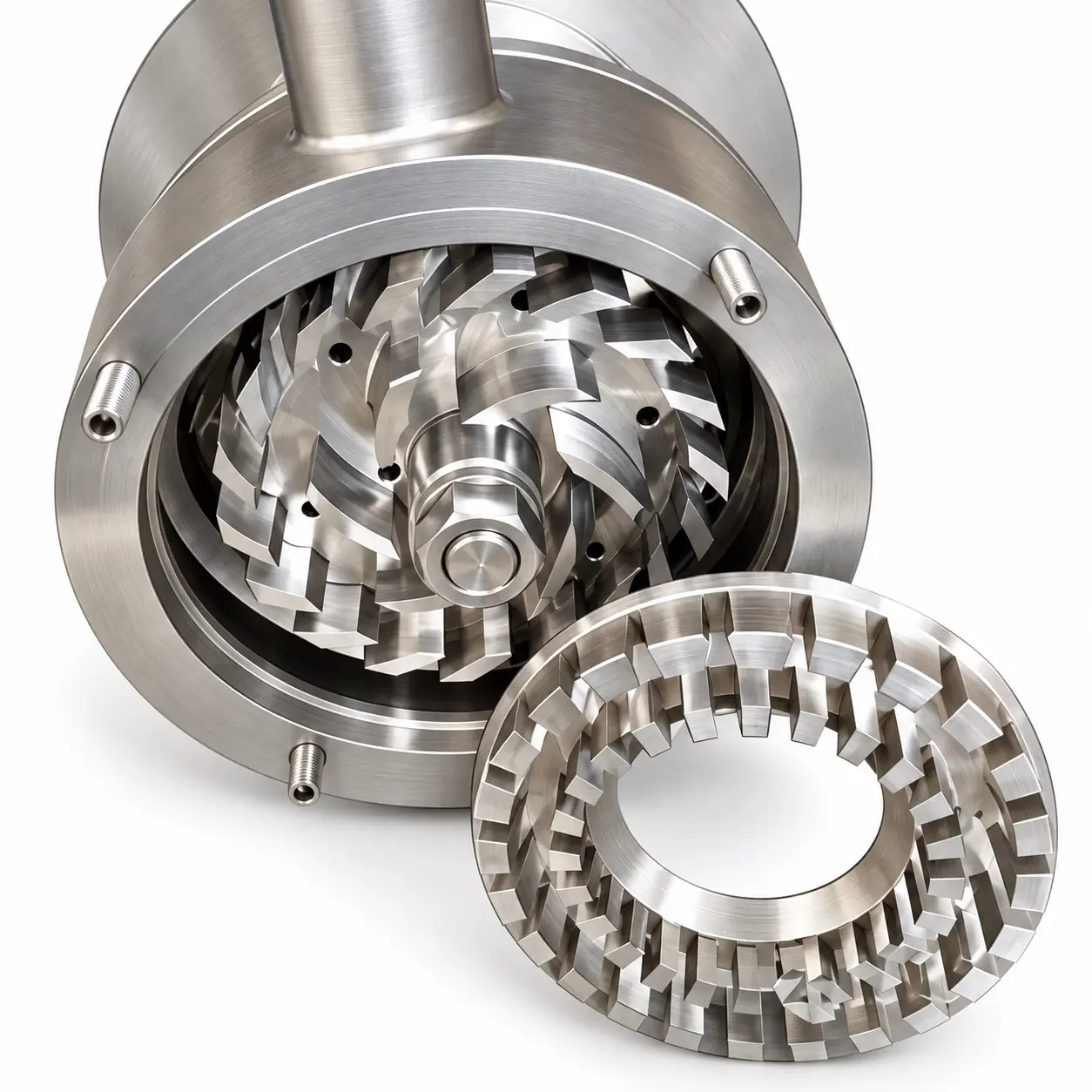
Material is drawn into the bottom-mounted workhead by the spinning rotor, subjected to intense shear in the rotor-stator gap, and expelled radially. The expelled product creates upward axial circulation loops through the full vessel height, continuously returning material to the workhead. All batch material passes repeatedly through the high-shear zone without supplementary agitation for bottom circulation.
Challenges
Mechanical Seal Wear in Submerged Continuous Operation
The bottom-mounted seal operates fully submerged under continuous high-speed rotation, making it susceptible to accelerated wear from abrasive particles, aggressive process fluids, and repeated thermal cycling between batches.
Maintenance Requires Vessel Drainage
Accessing the workhead or seal for inspection and replacement requires complete vessel drainage, significantly increasing maintenance downtime compared to top entry designs where the homogenizer lifts clear of the vessel.
Air Ingestion During Low-Fill Start-Up
When liquid level is low during early batch charging, the workhead can draw air rather than liquid, causing foam and product aeration before adequate liquid depth is established above the workhead.
Viscosity Limitation Above 50,000 cP
Centrifugal suction becomes insufficient to draw highly viscous material into the workhead at adequate flow rate, reducing processing efficiency and extending batch time without supplementary agitation.
Heat Accumulation During Sustained Processing
Continuous high-shear operation transfers energy into the batch as heat. Without adequate jacket cooling, temperature rise compromises thermally sensitive emulsions and biological formulations over long processing cycles.
Solutions
- Hard-Face Mechanical Seal with Cooling Water Flush: Silicon carbide or tungsten carbide seal faces combined with a dedicated cooling water flush circuit reduce wear rate and extend service life in continuous submerged operation with abrasive or chemically aggressive process fluids.
- CIP-Compatible Bottom Flange Mounting: Designing the bottom flange for validated in-place cleaning without workhead removal allows full cleaning between batches without vessel drainage, significantly reducing changeover downtime in multi-product facilities.
- Minimum Fill Level Interlock: Preventing homogenizer start-up below a defined minimum liquid level above the workhead eliminates air ingestion during batch charging and protects the mechanical seal from dry-running damage at low fill conditions.
- Combining with Top-Mounted Slow-Speed Agitator: Pairing the bottom homogenizer with a top-mounted anchor or paddle agitator provides forced downward circulation of viscous material toward the workhead, extending the effective viscosity range beyond what the homogenizer alone can handle.
- Active Jacket Cooling Throughout Processing: Maintaining controlled cooling water flow through the vessel jacket during the full homogenisation cycle removes workhead-generated heat, keeping batch temperature within acceptable limits for heat-sensitive formulations.
Applications
- Pharmaceutical Suspension and Sterile Emulsion Manufacturing: Batch dispersion and emulsification of active pharmaceutical ingredients within GMP-rated jacketed vessels, with bottom entry ensuring complete batch turnover and no settled API accumulation at the vessel base.
- Cosmetic Cream and Lotion Production: Primary emulsification of oil and water phases in cream and lotion manufacturing, where bottom entry ensures complete incorporation of dense wax and oil phase components that would otherwise settle during processing.
- Food Sauce, Dressing, and Beverage Emulsification: Batch homogenisation of oil-in-water food emulsions where settled ingredients at the vessel base must be continuously drawn into the shear zone throughout the full batch cycle.
- Dairy Yogurt Base and Flavoured Milk Processing: Homogenisation of dairy-based products in hygienic stainless steel vessels, ensuring complete fat globule size reduction and uniform ingredient distribution throughout the batch without settled-particle risk.
- Chemical Resin and Polymer Emulsion Processing: Batch dispersion of resin systems and polymer emulsions where dense fillers or pigments would settle to the vessel base in a top entry configuration, leaving unprocessed material.
Product Catalogue & Technical Datasheet
Model | Scale | Power (HP / kW) | Speed (RPM) | Flow Rate (L/h) | Particle Size (µm) | Viscosity Max (cP) | Tip Speed (m/s) | Shear Rate (s⁻¹) | Op. Temp (°C) | Op. Pressure (bar) |
BEH-LAB-01 | Lab | 0.5 / 0.37 | 1,500–3,000 | 10–50 | <1–20 | 20,000 | 5–15 | 10³–10⁴ | 0–150 | Atm to 6 |
BEH-LAB-05 | Lab / Pilot | 1.0 / 0.75 | 1,500–3,000 | 50–200 | <1–20 | 50,000 | 8–20 | 10³–10⁵ | 0–150 | Atm to 6 |
BEH-PIL-10 | Pilot | 5 / 3.7 | 1,500–3,000 | 200–1,000 | <1–15 | 80,000 | 10–22 | 10³–10⁵ | 0–150 | Atm to 10 |
BEH-PIL-20 | Pilot | 10 / 7.5 | 1,500–3,000 | 500–2,000 | <1–10 | 100,000 | 12–25 | 10⁴–10⁵ | 0–150 | Atm to 10 |
BEH-100 | Production | 20 / 15 | 1,500–3,000 | 1,000–5,000 | <1–10 | 100,000 | 12–25 | 10⁴–10⁵ | 0–150 | Atm to 10 |
BEH-300 | Production | 40 / 30 | 1,500–3,000 | 2,000–10,000 | <1–5 | 100,000 | 15–25 | 10⁴–10⁵ | 0–150 | Atm to 10 |
BEH-600 | Production | 60 / 45 | 1,500–3,000 | 5,000–20,000 | <1–5 | 100,000 | 15–25 | 10⁴–10⁵ | 0–150 | Atm to 10 |
BEH-HP-100 | Large Prod. | 100 / 75 | 1,500–3,000 | 10,000–40,000 | <1–3 | 100,000 | 18–25 | 10⁴–10⁵ | 0–150 | Atm to 10 |