
Bead Mill Bead Beater
A bead mill agitates sample suspension with grinding beads through high-frequency oscillation in tube format or rotating impeller in stirred chamber format, generating compressive and shear forces at particle-bead contact points. Processing 0.1 mL to 5 L, it fractures solid particles, disrupts cell walls, and deagglomerates aggregates. It is the most reliable method for disrupting tough cell walls resistant to chemical or enzymatic lysis.
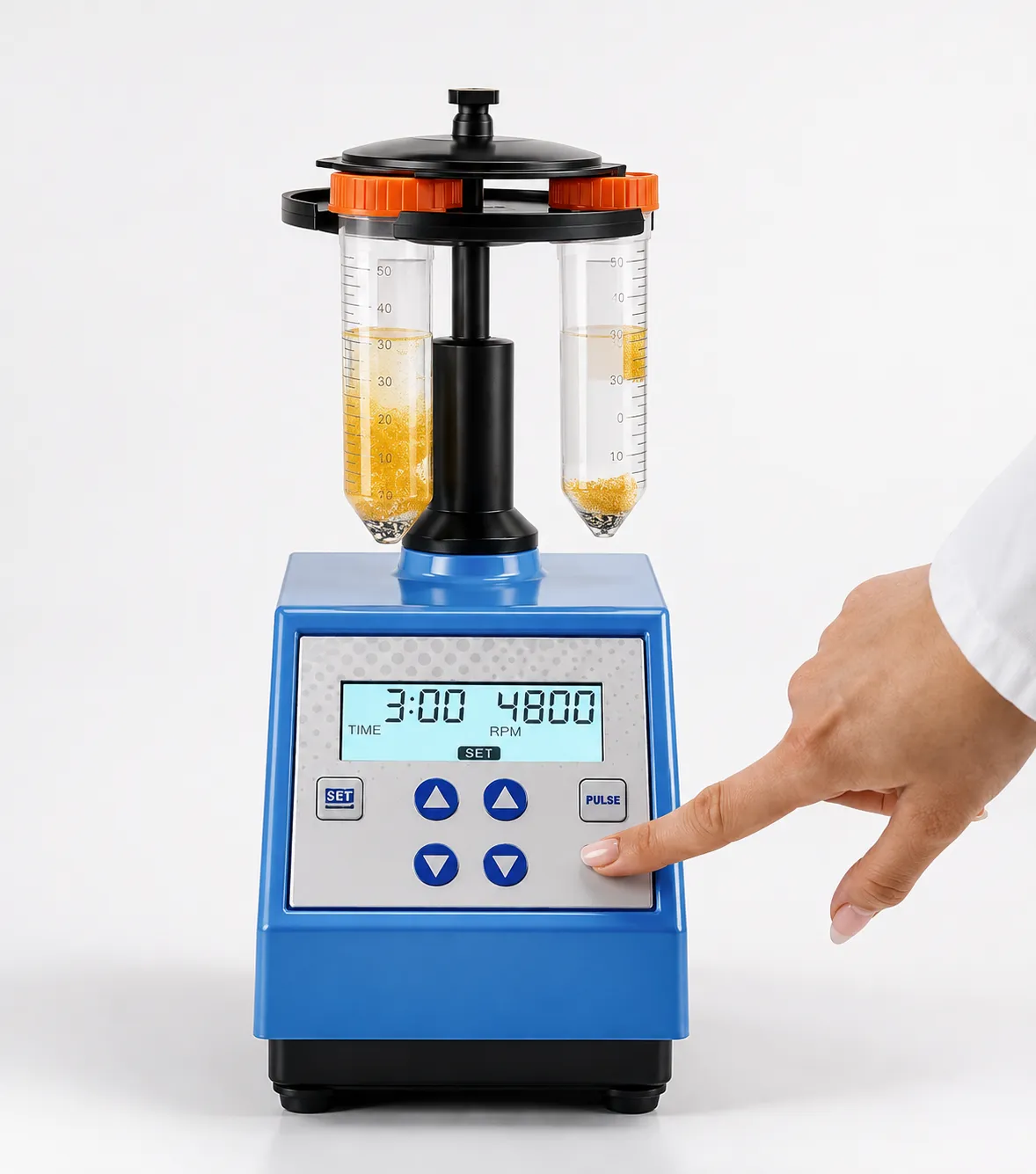
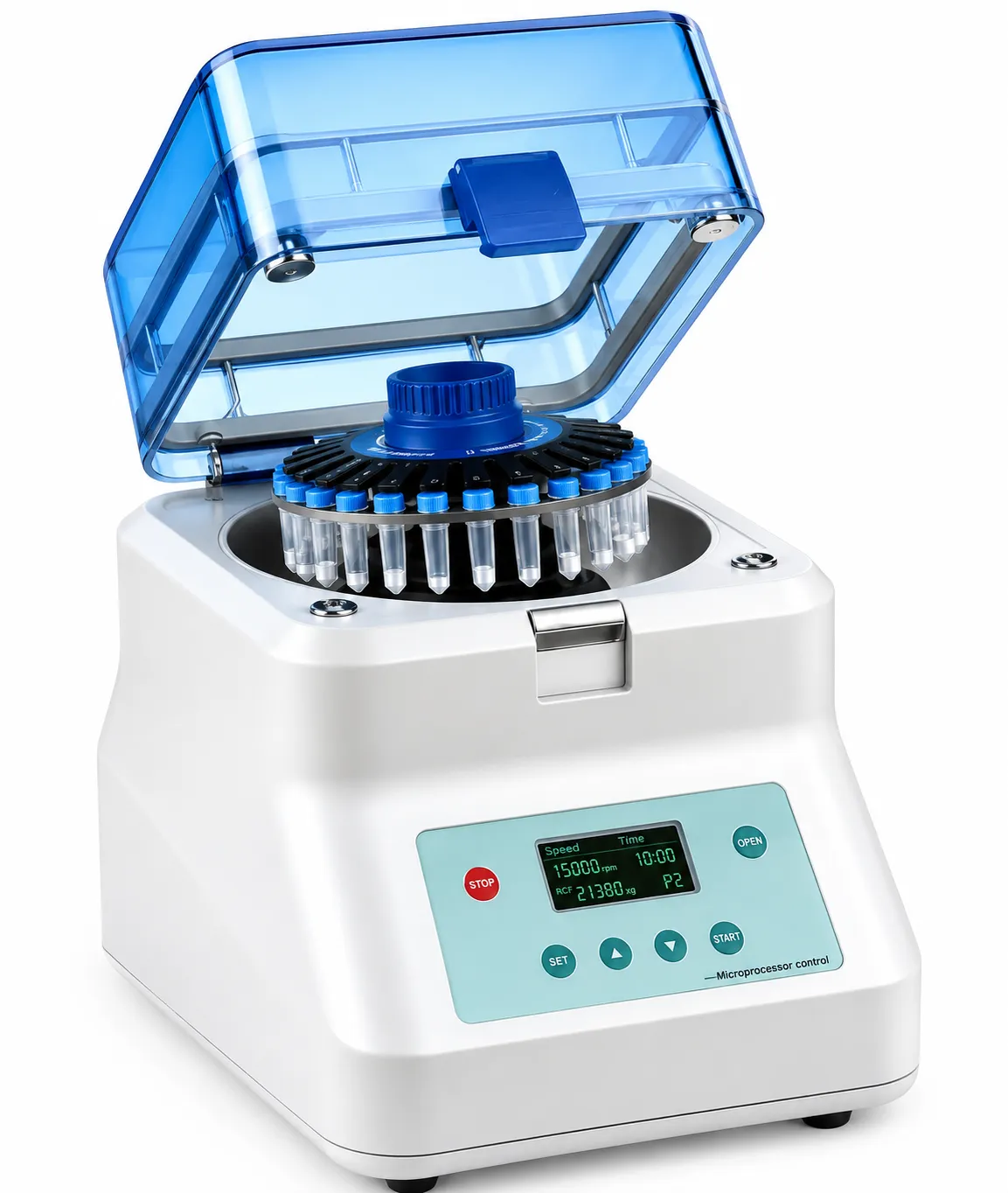
A bead mill agitates sample suspension with grinding beads through high-frequency oscillation in tube format or rotating impeller in stirred chamber format, generating compressive and shear forces at particle-bead contact points. Processing 0.1 mL to 5 L, it fractures solid particles, disrupts cell walls, and deagglomerates aggregates. It is the most reliable method for disrupting tough cell walls resistant to chemical or enzymatic lysis.
In tube-format instruments, high-frequency oscillation accelerates beads, creating stress fields throughout the tube volume. Stirred chamber mills rotate an impeller driving beads radially, concentrating kinetic energy at the chamber wall for fine grinding. Smaller beads provide more collision events per unit time, optimal for cell lysis. Larger, denser beads deliver higher energy per collision, suited to crystalline particle fracture and hard material grinding.
Challenges
Rapid Sample Heating
High power density generates significant heat within seconds, causing protein denaturation, enzyme inactivation, and nucleic acid degradation in biological samples processed without active cooling.
Bead Erosion and Sample Contamination
All bead materials release micro-fragments during grinding, introducing trace elemental contamination into the processed sample, which is particularly problematic for downstream analytical measurements and pharmaceutical applications.
Bead Separation After Processing
Sub-0.5 mm beads are difficult to separate from the processed sample by simple decanting, requiring additional centrifugation or filtration steps that extend processing time and risk sample loss.
Non-Uniform Energy Distribution in Tube Format
Variation in bead packing density across the tube volume creates regions of higher and lower energy input, resulting in inconsistent disruption or particle size reduction across the sample.
Aerosol Release on Opening Processed Tubes
Opening tubes immediately after processing releases pressurised aerosol containing viable biological agents or fine pharmaceutical particles, creating containment and safety risks.
Solutions
- Pre-Cooling and Pulsed Processing: Pre-cooling samples and beads on ice or in liquid nitrogen before processing, combined with short alternating processing and rest intervals, limits cumulative heat input and protects thermally sensitive biological molecules.
- Yttria-Stabilised Zirconia Beads: Specifying high-purity yttria-stabilised zirconia beads minimises bead erosion and reduces elemental contamination to trace levels, making them the preferred choice for biological and pharmaceutical applications.
- Integrated Bead Retention Screen: Using instruments with a built-in slotted screen sized just below the minimum bead diameter allows single-step bead-sample separation immediately after processing without additional centrifugation.
- Narrow Bead Size Distribution: Specifying beads with a tight size distribution ensures consistent energy delivery throughout the sample volume, improving reproducibility of cell disruption and particle size reduction between runs.
- Sealed Screw-Cap Tube Processing with Post-Run Centrifugation: Keeping tubes sealed until cooled and briefly centrifuging before opening eliminates aerosol release and improves sample recovery from tube walls and bead surfaces.
Applications
- Bacterial and Yeast Cell Disruption for Protein and Nucleic Acid Extraction: Mechanical disruption of gram-positive bacteria, yeast, and fungal cells with thick or rigid cell walls that resist chemical and enzymatic lysis, enabling extraction of intracellular proteins, DNA, RNA, and metabolites.
- Plant and Seed Tissue Grinding for Molecular Biology: Disruption of plant leaf, root, and seed tissue for DNA, RNA, and protein extraction in genomics, proteomics, and metabolomics workflows where tissue toughness prevents chemical lysis alone.
- Pharmaceutical API Nanosuspension Production: Wet grinding of poorly water-soluble drug particles to sub-micron size in stirred bead mill format to produce nanosuspensions with improved dissolution rate and bioavailability.
- Microalgae Cell Disruption for Lipid and Protein Extraction: Disruption of microalgae cell walls for intracellular lipid and protein recovery in biofuel research and nutraceutical ingredient extraction processes.
- Pigment and Nanoparticle Deagglomeration: Breakup of soft agglomerates in pigment dispersions and nanoparticle suspensions to achieve target particle size distribution in materials science and coating formulation applications.
Models & Capacities
Tube-Format Oscillating Bead Beater — Models & Capacities (0.05 mL Micro to 200 mL Pilot) | ||||||||||
Motion Type | Frequency [Hz] / Speed | Bead Size [mm] | Processing Time [s] | Temp Rise [°C/min] | Tube Format | Tubes (simultaneous) | Pulsed Mode | Motor [W] | Weight [kg] |
|
Oscillation | 50 Hz | 0.1–2 | 10–60 | 20–40 | 0.5–2 mL screw-cap | 1 | Yes | 20 | 0.3 |
|
Oscillation | 50 Hz | 0.1–3 | 10–60 | 20–40 | 0.5–2 mL screw-cap | 1 | Yes | 30 | 0.4 |
|
Oscillation | 50 Hz | 0.1–3 | 15–90 | 15–35 | 1.5–5 mL tube | 1 | Yes | 40 | 0.5 |
|
High-speed vortex | 3,200 RPM | 0.1–2 | 10–60 | 15–30 | 0.5–2 mL | 1 | Yes | 50 | 0.6 |
|
High-speed vortex | 2,800 RPM | 0.1–3 | 15–90 | 15–30 | 2–15 mL | 1 | Yes | 80 | 0.8 |
|
Mixer-mill (ball) | 30 Hz | 0.2–30 | 10–120 | 10–25 | 2 mL stainless vial | 2 | Yes | 100 | 4.5 |
|
Mixer-mill (ball) | 25 Hz | 1–50 | 30–180 | 8–20 | 5–50 mL vial | 2 | Yes | 200 | 8.0 |
|
Mixer-mill (ball) | 20 Hz | 5–100 | 30–300 | 5–15 | 50–200 mL jar | 2 | Yes | 500 | 18 |
|