
Crimp Sanitary Hose Assembly
A crimp sanitary hose is a flexible reinforced hose assembly with stainless steel Tri-Clamp or BSP end fittings permanently secured by a mechanically crimped ferrule — the crimp deforms the SS ferrule uniformly around the hose outer braid, creating a permanent, leak-proof, zero dead-leg connection. Manufactured in bore diameters of DN 10–100 in silicone, PTFE-lined, EPDM, and multi-layer composite construction, it provides flexible, validated-clean, CIP/SIP-compatible connections between fixed process equipment and mobile or flexible-mounted points in food, pharmaceutical, dairy, and cosmetic manufacturing — FDA 21 CFR 177/178, EC 1935/2004, and 3-A compliant.
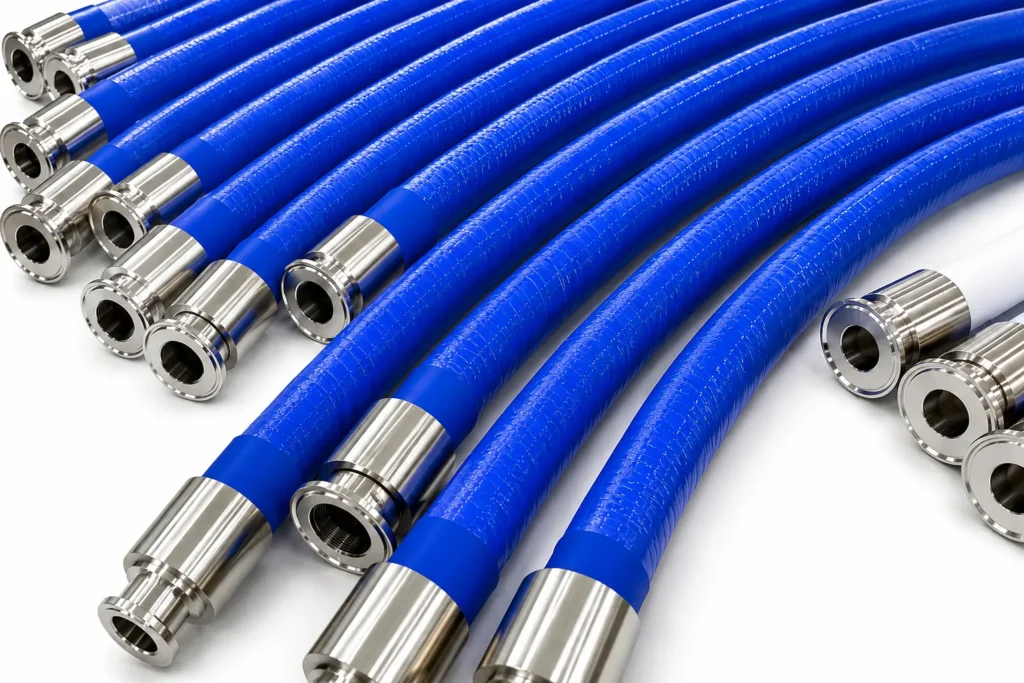
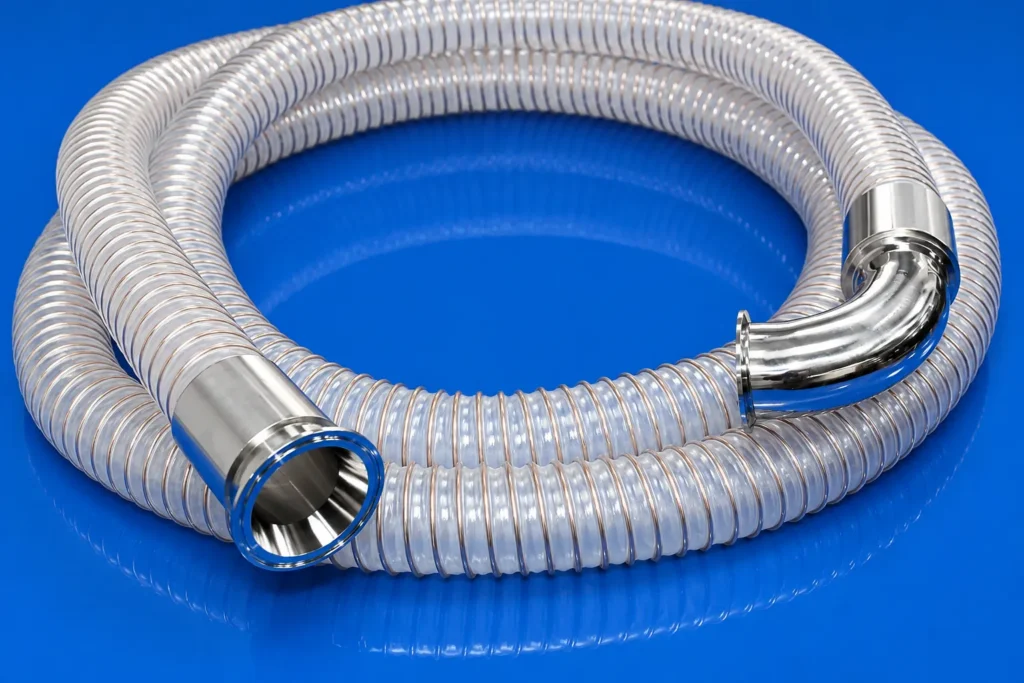
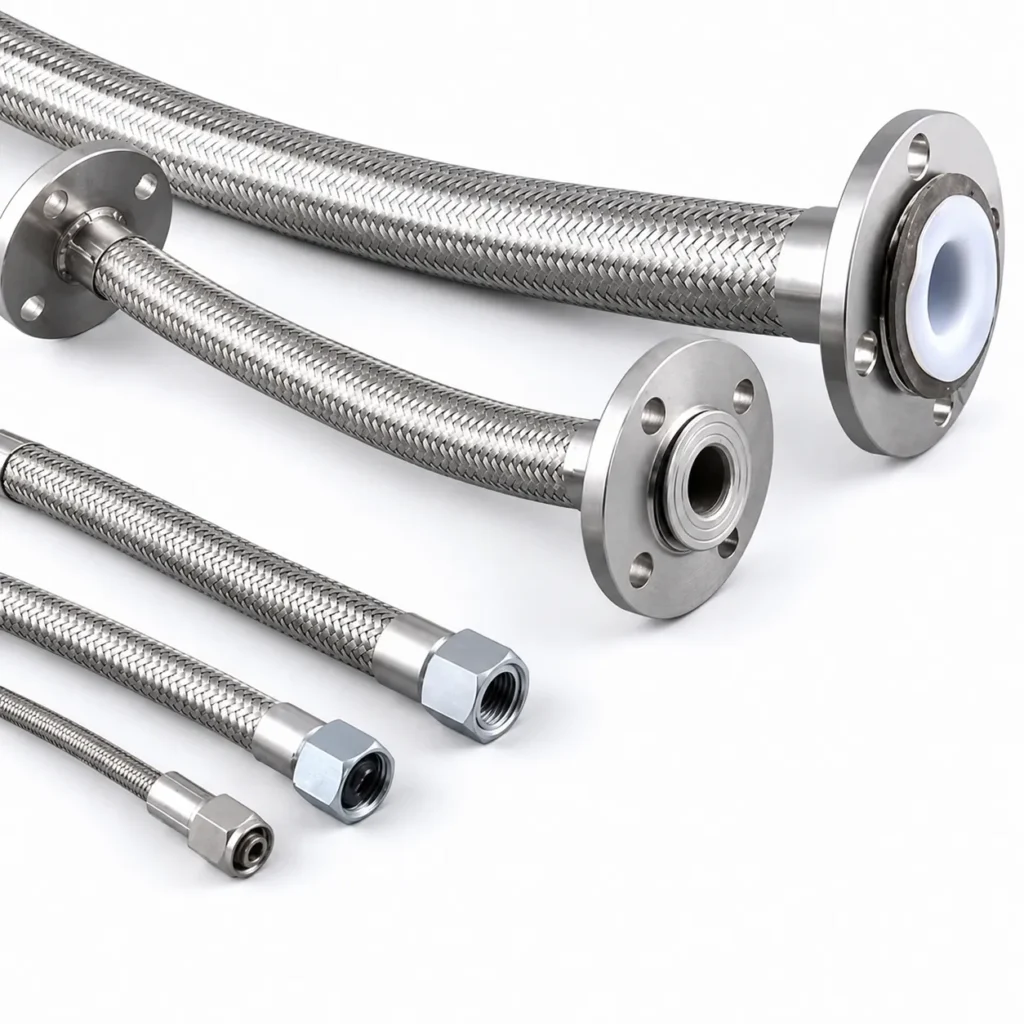
A crimp sanitary hose is a flexible reinforced hose assembly with stainless steel Tri-Clamp or BSP end fittings permanently secured by a mechanically crimped ferrule — the crimp deforms the SS ferrule uniformly around the hose outer braid, creating a permanent, leak-proof, zero dead-leg connection. Manufactured in bore diameters of DN 10–100 in silicone, PTFE-lined, EPDM, and multi-layer composite construction, it provides flexible, validated-clean, CIP/SIP-compatible connections between fixed process equipment and mobile or flexible-mounted points in food, pharmaceutical, dairy, and cosmetic manufacturing — FDA 21 CFR 177/178, EC 1935/2004, and 3-A compliant.
The hose tube is slid over a machined SS 316L stem fitting; a pre-sized SS ferrule is positioned over the hose outer braid at the stem; a hydraulic crimping tool compresses the ferrule inward by 10–20% of its outer diameter — permanently locking it to the braid and stem. The crimp exerts radial compression across the full 360° ferrule circumference with a defined crimp OD (specified per hose/fitting combination, ±0.1 mm) — calibrated by a crimp gauge per production lot. CIP flow passes through the full bore without restriction; smooth bore surface (Ra <1.6 µm silicone; Ra <0.4 µm PTFE) meets hygienic design requirements.
Challenges
Crimp Ferrule OD Drift During Crimping Tool Wear
Worn tool produces ferrule OD above specification — under-compression allows hose pullout under surge pressure.
Silicone Hose Permeation by Aromatic Solvents and Chlorinated Compounds
Silicone tube is permeable to organic solvents — toluene, MEK, and chlorinated solvents permeate bore over time.
Hose Kinking at Tight Bend Radius (<1.5× OD) Causing Flow Restriction
Over-bending collapses the hose cross-section — flow rate drops and product accumulates at the kink.
PTFE Liner De-Lamination from Outer Reinforcement at High-Temperature Cycling
Differential thermal expansion between PTFE and braid causes liner blistering in repeated SIP cycles.
Microbial Harbouring at Crimp-to-Hose Interface on Aged Assemblies
Micro-gap between ferrule and outer braid may not drain fully if silicone swells with age.
Solutions
- Crimp OD Verification Every 50 Crimps (Calibrated Go/No-Go Gauge per Hose OD): Mandatory crimp gauge check — ferrule OD within ±0.1 mm of specification throughout production run.
- PTFE-Lined Hose for Solvent Service (Full-Bore PTFE ID with SS Braid): PTFE inner tube provides complete solvent barrier — zero permeation regardless of organic solvent type.
- Minimum Bend Radius Label on Every Assembly (1.5× OD Colour-Coded Tag): Prevents field installation at angles causing kink-induced flow restriction — visual colour-coded tag.
- Chemically Bonded PTFE Liner (Cannot De-Laminate): Bonded liner specified for >50 SIP cycles or 130°C continuous service — no slip-fit liner used.
- Annual Assembly Inspection Protocol (Pressure Test + Crimp OD Re-Measurement): Annual 1.5× rated pressure test and crimp OD check — failure triggers immediate replacement.
Applications
- Pharmaceutical: Product transfer, WFI distribution, CIP/SIP circuit flexible connections — GMP-validated, pressure-tested.
- Dairy & Food: Milk, cream, beverage, juice flexible transfer — 3-A compliant, CIP/SIP validated.
- Biotechnology: Bioreactor connections, sterile transfer, aseptic process flexible links.
- Cosmetics & Personal Care: Raw material transfer, filling machine flexible connections, SLES and surfactant handling.
- Chemical: PTFE-lined hose for solvent, acid, alkali flexible transfer connections.
Models — Hose Types, Sizes & Pressure Ratings
Crimp Sanitary Hose — Types, Sizes & Pressure Ratings (DN 10 to DN 100) | ||||||||||
Hose Type | Bore Material | DN [mm] | Bore ID [mm] | OD [mm] | Working Pressure [bar] | Vacuum [bar abs.] | Temp Range [°C] | Min Bend Radius [mm] | End Fitting Standard | FDA / EC Compliance |
Silicone Standard | Silicone tube + SS braid | DN 10 | 10 | 20 | 10 | Full vac. | −60 to +180 | 30 | Tri-Clamp / BSP | FDA 21 CFR 177.2600; EC 1935/2004 |
Silicone Standard | Silicone tube + SS braid | DN 15 | 15 | 26 | 10 | Full vac. | −60 to +180 | 39 | Tri-Clamp / BSP | FDA 21 CFR 177.2600; EC 1935/2004 |
Silicone Standard | Silicone tube + SS braid | DN 25 | 25 | 40 | 10 | Full vac. | −60 to +180 | 60 | Tri-Clamp / BSP | FDA 21 CFR 177.2600; EC 1935/2004 |
Silicone Standard | Silicone tube + SS braid | DN 40 | 40 | 58 | 8 | Full vac. | −60 to +180 | 87 | Tri-Clamp / BSP | FDA 21 CFR 177.2600; EC 1935/2004 |
Silicone Standard | Silicone tube + SS braid | DN 50 | 50 | 72 | 8 | Full vac. | −60 to +180 | 108 | Tri-Clamp / BSP | FDA 21 CFR 177.2600; EC 1935/2004 |
Silicone Standard | Silicone tube + SS braid | DN 65 | 65 | 90 | 6 | Full vac. | −60 to +180 | 135 | Tri-Clamp / BSP | FDA 21 CFR 177.2600; EC 1935/2004 |
Silicone Standard | Silicone tube + SS braid | DN 80 | 80 | 108 | 6 | Full vac. | −60 to +180 | 162 | Tri-Clamp / BSP | FDA 21 CFR 177.2600; EC 1935/2004 |
Silicone Standard | Silicone tube + SS braid | DN 100 | 100 | 130 | 4 | Full vac. | −60 to +180 | 195 | Tri-Clamp / Flange | FDA 21 CFR 177.2600; EC 1935/2004 |
PTFE-Lined | PTFE liner + SS braid | DN 10 | 10 | 22 | 16 | Full vac. | −60 to +200 | 45 | Tri-Clamp / BSP | FDA 21 CFR 177.1550; USP Class VI |
PTFE-Lined | PTFE liner + SS braid | DN 15 | 15 | 28 | 16 | Full vac. | −60 to +200 | 52 | Tri-Clamp / BSP | FDA 21 CFR 177.1550; USP Class VI |
PTFE-Lined | PTFE liner + SS braid | DN 25 | 25 | 44 | 16 | Full vac. | −60 to +200 | 78 | Tri-Clamp / BSP | FDA 21 CFR 177.1550; USP Class VI |
PTFE-Lined | PTFE liner + SS braid | DN 40 | 40 | 60 | 12 | Full vac. | −60 to +200 | 108 | Tri-Clamp / BSP | FDA 21 CFR 177.1550; USP Class VI |
PTFE-Lined | PTFE liner + SS braid | DN 50 | 50 | 75 | 12 | Full vac. | −60 to +200 | 135 | Tri-Clamp / BSP | FDA 21 CFR 177.1550; USP Class VI |
PTFE-Lined | PTFE liner + SS braid | DN 65 | 65 | 95 | 10 | Full vac. | −60 to +200 | 170 | Tri-Clamp / Flange | FDA 21 CFR 177.1550; USP Class VI |
EPDM Sanitary | EPDM tube + SS braid | DN 15 | 15 | 26 | 10 | Full vac. | −40 to +130 | 52 | Tri-Clamp / BSP | FDA 21 CFR 177.2600; 3-A compliant |
EPDM Sanitary | EPDM tube + SS braid | DN 25 | 25 | 40 | 10 | Full vac. | −40 to +130 | 75 | Tri-Clamp / BSP | FDA 21 CFR 177.2600; 3-A compliant |
EPDM Sanitary | EPDM tube + SS braid | DN 50 | 50 | 72 | 8 | Full vac. | −40 to +130 | 120 | Tri-Clamp / BSP | FDA 21 CFR 177.2600; 3-A compliant |
Multi-Layer Composite | PTFE/EPDM + SS double braid | DN 25 | 25 | 46 | 25 | Full vac. | −60 to +210 | 90 | Tri-Clamp / Flange | FDA 21 CFR 177.1550; USP Class VI |
Multi-Layer Composite | PTFE/EPDM + SS double braid | DN 40 | 40 | 64 | 25 | Full vac. | −60 to +210 | 135 | Tri-Clamp / Flange | FDA 21 CFR 177.1550; USP Class VI |
Multi-Layer Composite | PTFE/EPDM + SS double braid | DN 50 | 50 | 80 | 20 | Full vac. | −60 to +210 | 150 | Tri-Clamp / Flange | FDA 21 CFR 177.1550; USP Class VI |