
Roller Tube Peristaltic Pump
A roller tube peristaltic pump uses 2–6 rollers rotating around a circular path to progressively compress a flexible tube (silicone, Norprene, Viton) creating discrete fluid slugs that advance from inlet to outlet with each roller pass. Operating at 0.001–20 m³/h across 1–30,000 cP and suction lifts up to 8 m, it provides self-priming, reversible, and precisely metered flow with zero product-mechanism contact ideal for laboratory, pharmaceutical dosing, and bioprocess transfer.
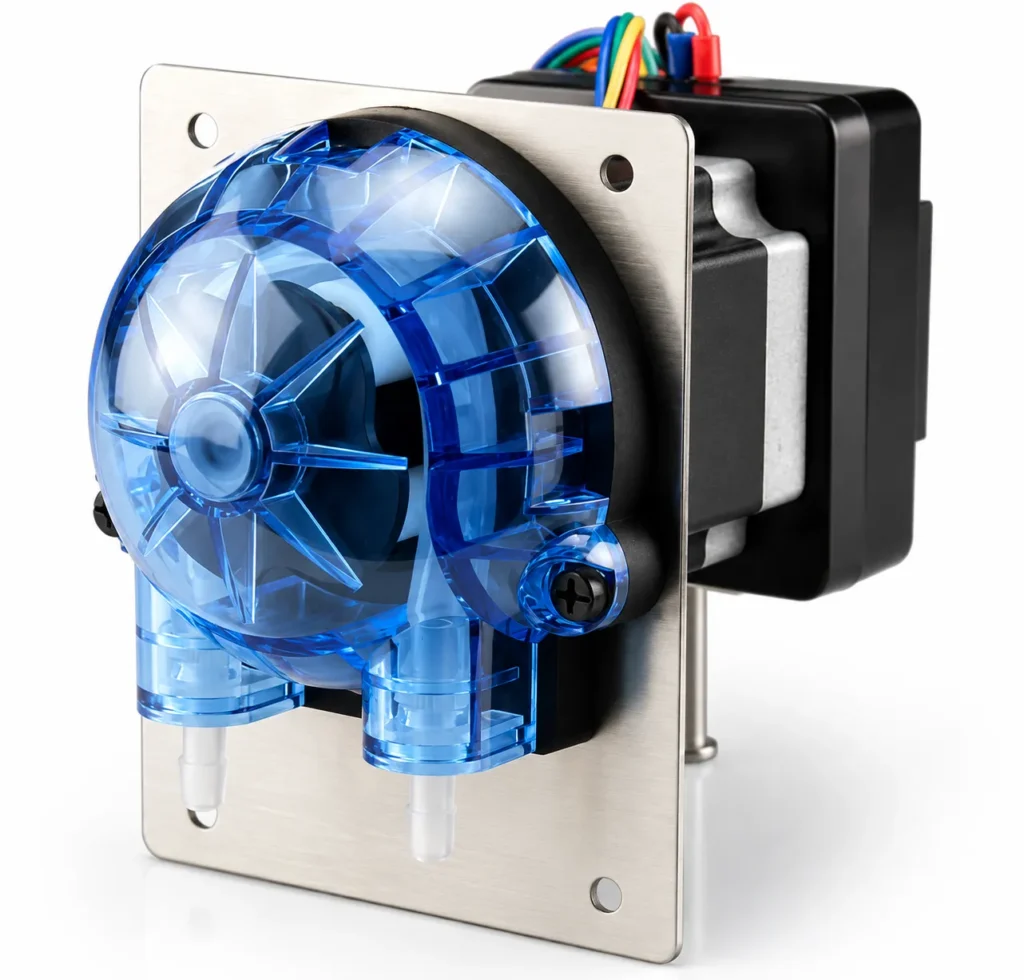
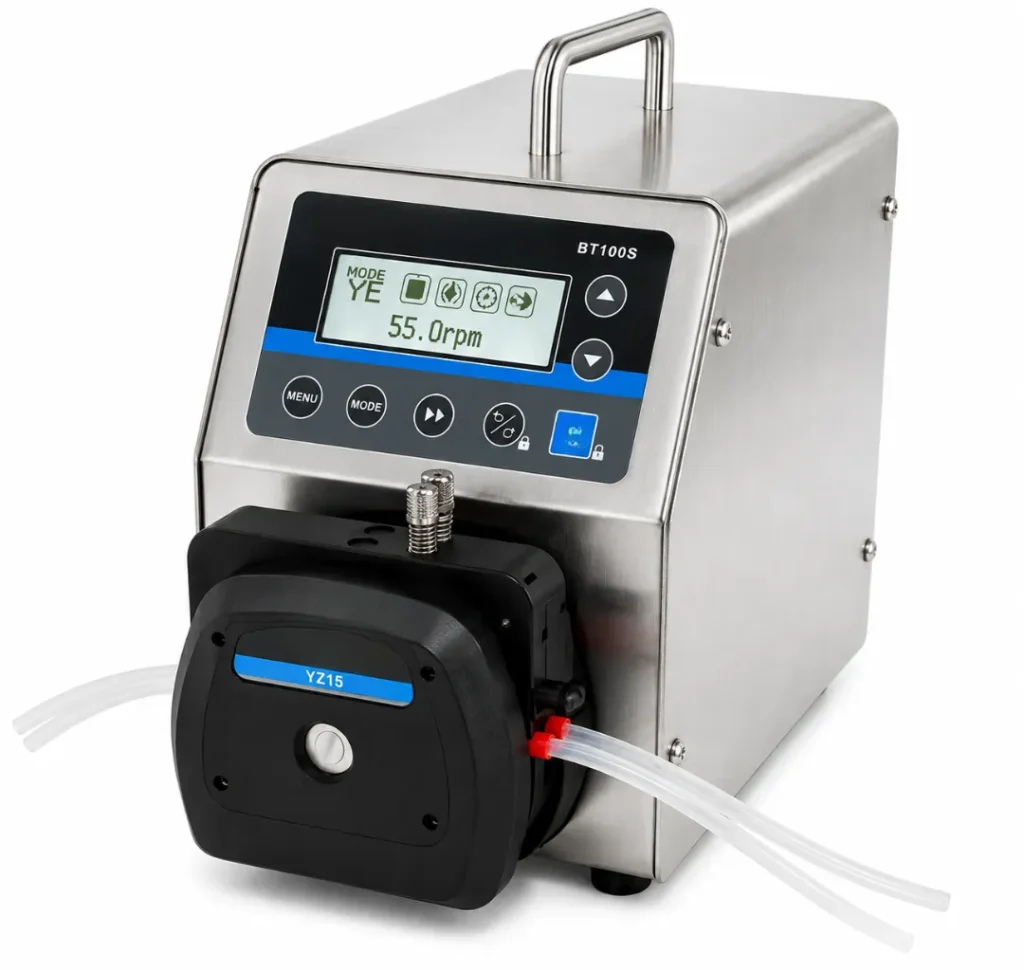
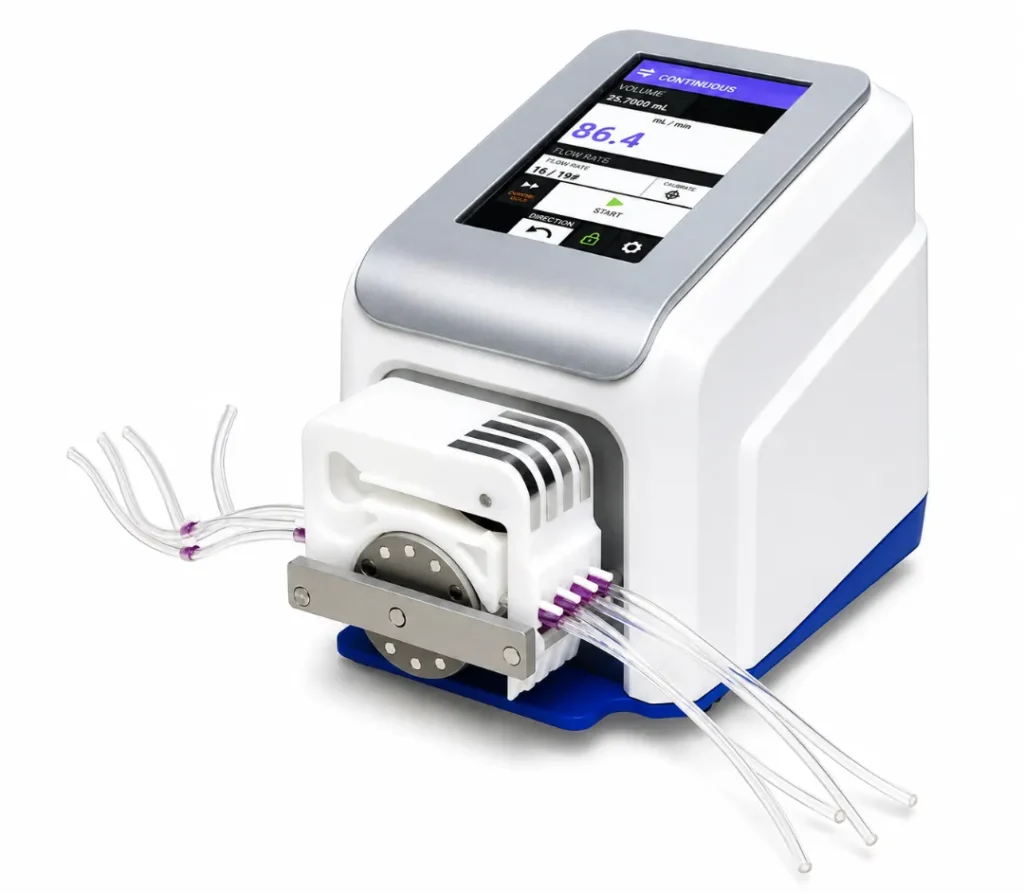
The rotor carrying 2–6 rollers compresses the flexible tube against the pump housing at each roller contact point. Ahead of each roller, the rebounding tube creates suction drawing fluid in; behind each roller the fluid slug is pushed toward the outlet. The fluid contacts only the tube interior never the pump mechanism. Roller count determines pulses per revolution (2–6 pulses); higher roller count gives smoother flow. Tube life is 500–5,000 hours depending on material, speed, and fluid.
Challenges
Tube Wear and Fatigue Failure
Repeated compression cycles cause silicone tube failure typically 500–2,000 hours at full speed.
Pulsating Flow (Pulses per Rev = Roller Count)
Roller-tube mechanism generates pressure pulsation requiring dampeners at high flow rates.
Limited Pressure Rating (<4 bar)
Flexible tube cannot sustain high differential pressure; limits high-resistance pipework applications.
Temperature Sensitivity of Tube Material
Silicone tubes degrade above 80°C; require specialised high-temperature formulations.
Low Flow Rate at High Viscosity
Above 30,000 cP, suction recovery time exceeds roller spacing; flow rate drops significantly.
Solutions
- Reinforced Multi-Layer Tube (3-Ply Silicone/PTFE): Extends tube life to 3,000–5,000 hours; handles 80°C continuous and 4 bar.
- 6-Roller Head Configuration: Reduces pulsation to near-continuous flow; eliminates need for downstream dampener.
- Inline Pulsation Dampener (Bladder Type): Reduces pressure variation to ±3% of mean for sensitive dosing applications.
- VFD Speed Control (0.1–300 RPM): Precise volumetric metering from micro-dosing (0.001 L/h) to batch transfer.
- Occlusion Adjustment Mechanism: Adjustable roller-to-tube gap optimises compression for tube life vs. pressure rating trade-off.
Applications
- Pharmaceutical: API dosing, binder liquid addition to granulators, sterile liquid metering under GMP.
- Biotechnology: Cell culture media addition, fermentation nutrient dosing, bioreactor feed control.
- Food & Beverage: Flavour dosing, additive metering, fragile product transfer, small-batch filling.
- Chemical: Aggressive chemical dosing, acid/base addition, hazardous fluid metering without seal leakage.
- Water Treatment: Chemical reagent dosing, coagulant addition, pH correction metering.
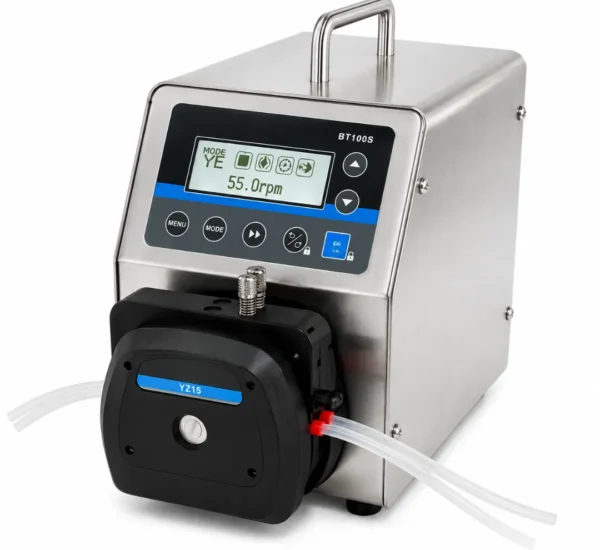
Product Catalogue & Technical Datasheet
Model | Flow Rate (L/h) | Speed (RPM) | Diff. Pressure (bar) | Viscosity Max (cP) | Tube ID (mm) | Rollers | Suction Lift (m) | L × W × H (mm) | Weight (kg) |
PRP-R-001 | 0.001–1 | 0.1–100 VFD | Up to 2 | 5,000 | 1.6–4.8 | 2–4 | Up to 5 | 150×120×130 | 2 |
PRP-R-010 | 0.5–10 | 1–150 VFD | Up to 2 | 10,000 | 6.4–9.6 | 3–4 | Up to 6 | 220×160×180 | 5 |
PRP-R-100 | 5–100 | 5–300 VFD | Up to 3 | 20,000 | 12.7–19 | 4–6 | Up to 7 | 380×250×280 | 14 |
PRP-R-500 | 50–500 | 5–300 VFD | Up to 3 | 25,000 | 25–32 | 4–6 | Up to 8 | 520×320×370 | 28 |
PRP-R-2000 | 200–2,000 | 5–200 VFD | Up to 4 | 30,000 | 38–50 | 4–6 | Up to 8 | 680×420×480 | 55 |
PRP-R-5000 | 500–5,000 | 5–150 VFD | Up to 4 | 30,000 | 64–76 | 4–6 | Up to 8 | 850×520×580 | 95 |