
Ultrasonic Inline Vacuum Siever (36 kHz Anti-Blinding)
An ultrasonic inline vacuum Siever integrates a 36 kHz ultrasonic transducer directly bonded to the screen frame within a standard sealed vacuum Siever body the ultrasonic vibration (amplitude 2–4 µm) prevents particle adhesion on fine screen apertures below 150 µm during vacuum-assisted powder transfer. Processing 20–1,500 kg/h with screen apertures of 20–500 µm, it enables sustained inline vacuum sieving at fine mesh ratings that would blind and block within minutes on standard vacuum Sievers the dedicated solution for sub-100 µm API, inhalation powder, battery electrode material, and ultra-fine specialty powder vacuum transfer with inline quality classification.
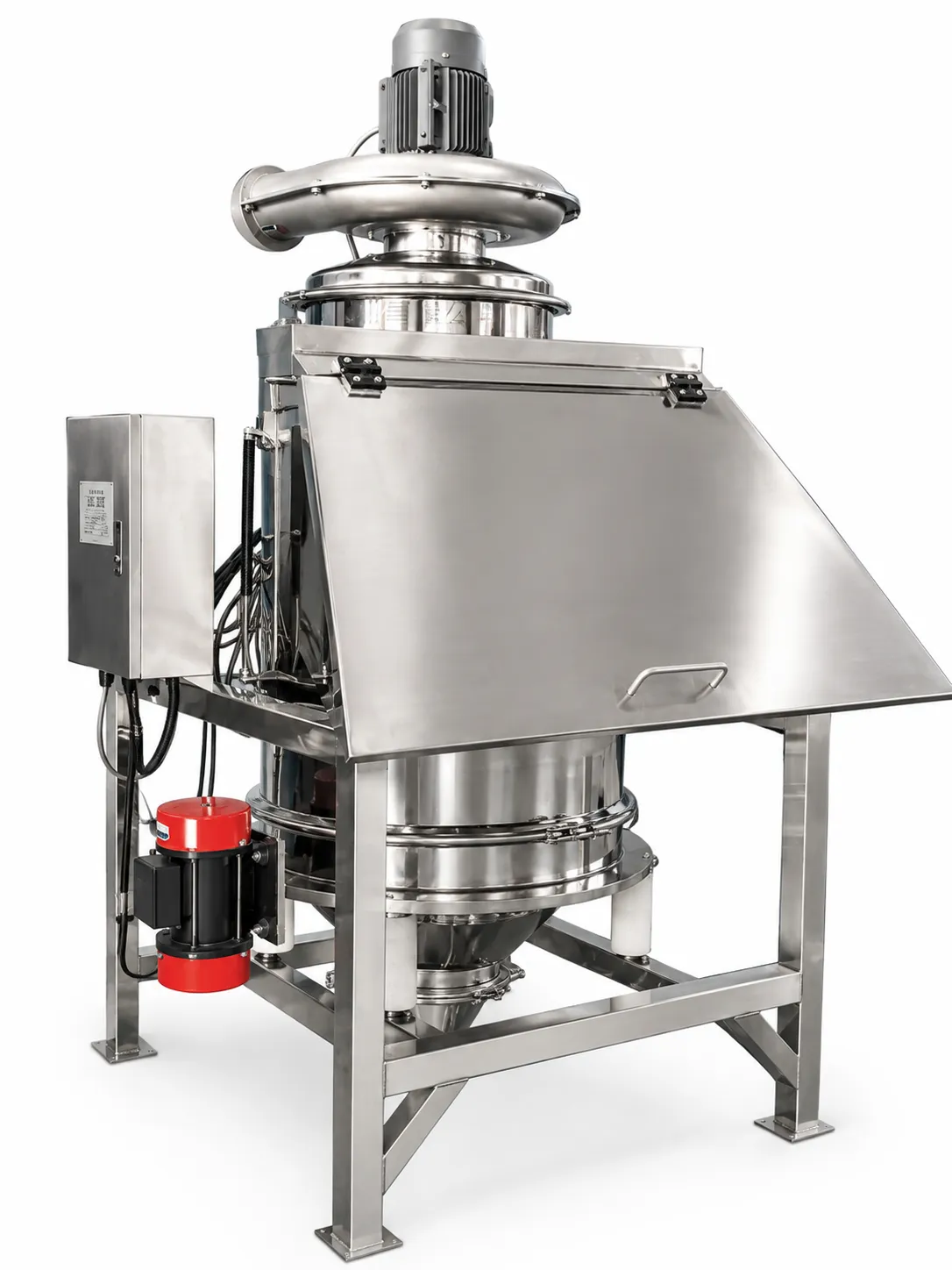
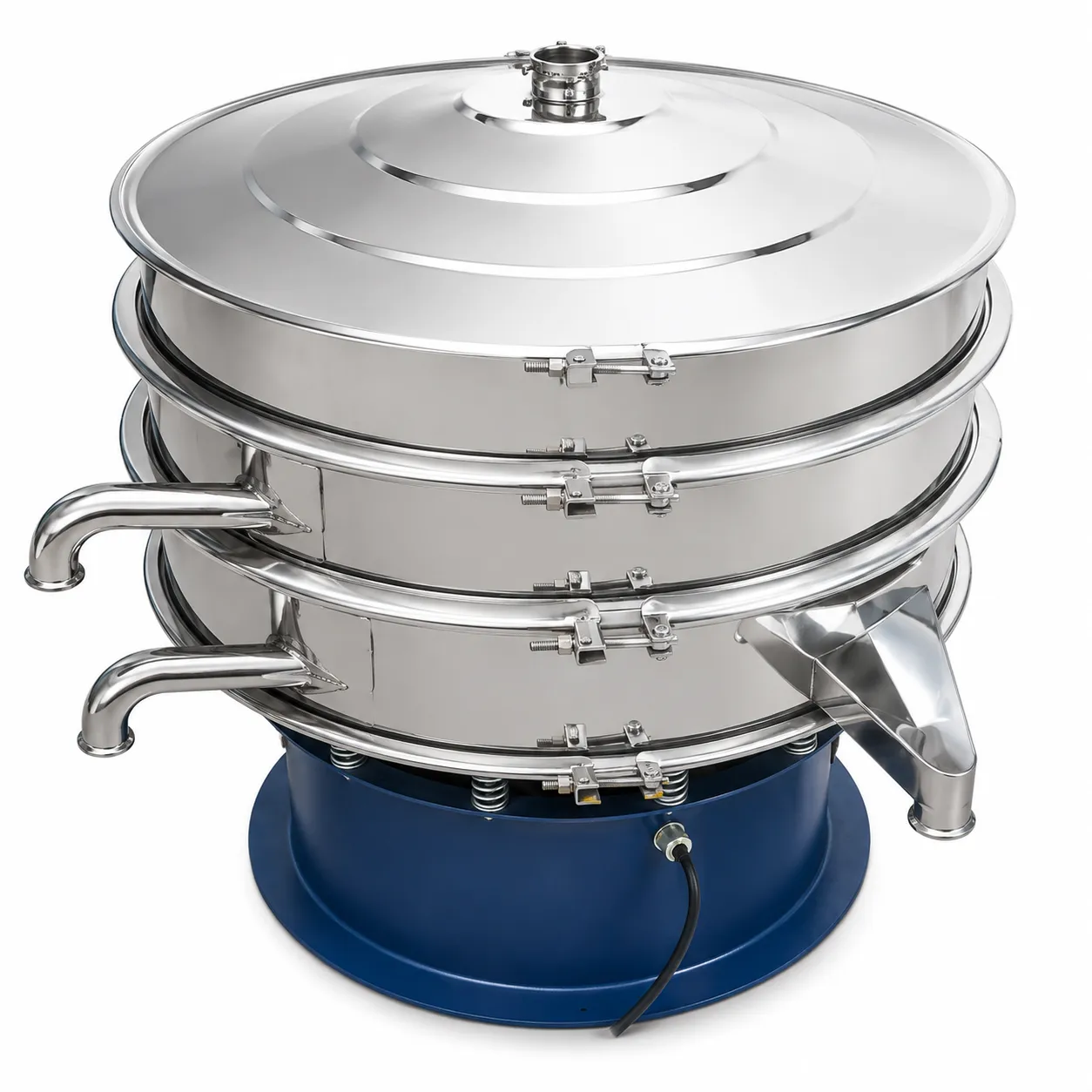
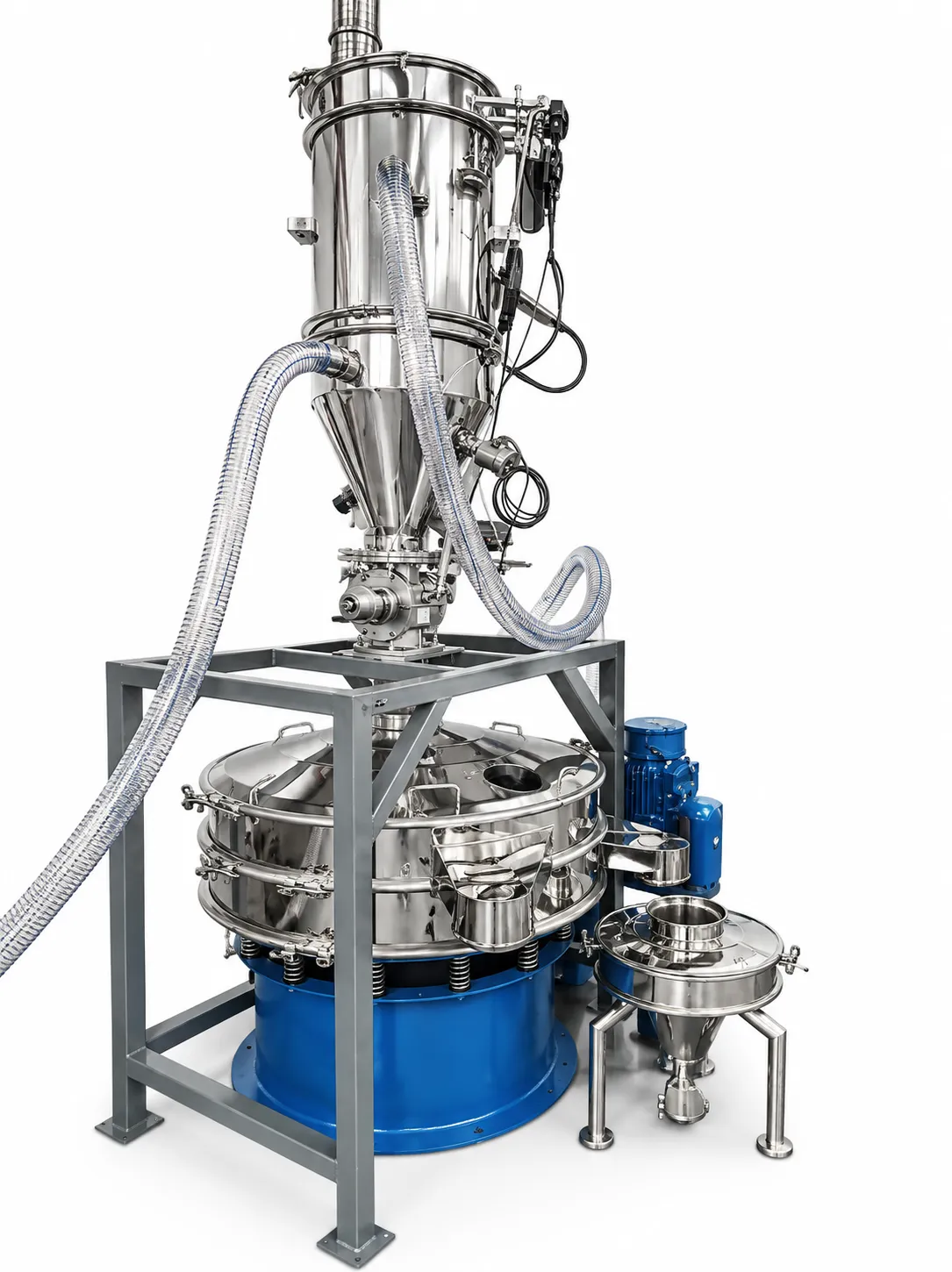
An ultrasonic inline vacuum Siever integrates a 36 kHz ultrasonic transducer directly bonded to the screen frame within a standard sealed vacuum Siever body the ultrasonic vibration (amplitude 2–4 µm) prevents particle adhesion on fine screen apertures below 150 µm during vacuum-assisted powder transfer. Processing 20–1,500 kg/h with screen apertures of 20–500 µm, it enables sustained inline vacuum sieving at fine mesh ratings that would blind and block within minutes on standard vacuum Sievers the dedicated solution for sub-100 µm API, inhalation powder, battery electrode material, and ultra-fine specialty powder vacuum transfer with inline quality classification.
The 36 kHz ultrasonic generator drives a transducer bonded to the screen frame high-frequency vibration prevents fine particles from bridging and adhering to screen wire surfaces during vacuum-driven powder flow. The standard gyratory or reverse-pulse cleaning system continues to operate alongside the ultrasonic providing two independent anti-blinding mechanisms simultaneously. Ultrasonic power (0–100% adjustable) is set per product and screen aperture fine screens at 20–50 µm operate at 80–100% power; coarser screens at 200–500 µm operate at 30–60% power. Each screen has one bonded transducer; multi-screen ultrasonic units have independent power control per transducer frequency verified to match screen mesh gauge.
Challenges
Transducer Electrical Lead Routing in Sealed Vacuum Environment
Transducer electrical cables must pass from inside sealed body to outside generator potential vacuum leak point.
Ultrasonic Heat Generation Raising Product Temperature at Maximum Power
Continuous 100% power operation raises screen surface temperature thermolabile API degradation risk.
Transducer Bond Failure Under Combined Vacuum and Ultrasonic Fatigue
Vacuum differential and continuous 36 kHz fatigue degrade transducer-to-screen bond power loss over time.
Moisture Condensation on Transducer Electrical Housing During CIP
CIP water ingress into transducer electrical connection damages piezoelectric crystal unit failure.
Higher Screen Assembly Cost vs. Standard (Bonded Transducer per Screen)
Ultrasonic screen assembly costs 4–6× standard screen replacement budget significantly higher.
Solutions
- Hermetically Sealed Electrical Feedthrough (Ceramic Compression Seal, Vacuum-Rated): Ceramic compression feedthrough passes electrical leads through body wall vacuum-tight at −0.9 bar abs.
- Duty Cycle Controller (30–80% Pulsed Ratio, User-Selectable per Product): Pulsed duty cycle limits average power extends transducer life and controls screen temperature rise.
- 8,000-Hour Rated Transducer Bond + Planned Replacement at 7,000 Hours: Premium transducer bond rated 8,000 hours; supplier replacement programme at 7,000 hours no failure.
- IP 68-Rated Transducer Housing with Silicone Potting (Fully Washdown-Proof): IP 68 housing and silicone-potted connections withstand full CIP immersion no moisture ingress.
- Frequency Certificate per Screen (Matched Transducer to Mesh Wire Gauge): Each screen supplied with frequency certificate confirming resonance match maximum power transfer.
Applications
- Pharmaceutical (Inhalation): Dry powder inhaler (DPI) API inline sieving sub-50 µm classification during vacuum transfer.
- Pharmaceutical (API): Micronized API vacuum transfer with inline 50–150 µm classification no separate offline sieving.
- Battery & Energy: Electrode powder (NMC, LFP, graphite) inline vacuum sieving fine PSD critical for cell performance.
- Chemical: Nano-pigment and specialty fine chemical inline vacuum classification sustained sub-100 µm aperture.
- Nutraceuticals: Fine botanical extract and collagen peptide vacuum transfer with inline sub-150 µm sieving.
Models & Capacities
| Type 4 Ultrasonic Inline Vacuum Siever (36 kHz): Models & Capacities | ||||||||||
|---|---|---|---|---|---|---|---|---|---|---|
| Model | Scale | Transfer Rate [kg/h] | Screen Ø [mm] | Screen Aperture [µm] | Ultrasonic Freq. [kHz] | Ultrasonic Power [W] | Vacuum Level [bar] | Inlet/Outlet Ø [mm] | Body L × Ø [mm] | Weight [kg] |
| IVS-US-LAB | Lab | 20–80 | Ø100 | 20–500 | 36 | 50 | −0.2 to −0.8 | Ø32 | 300×Ø140 | 18 |
| IVS-US-PIL | Pilot | 50–200 | Ø150 | 20–500 | 36 | 100 | −0.2 to −0.8 | Ø50 | 420×Ø195 | 32 |
| IVS-US-300 | Production | 100–500 | Ø200 | 25–500 | 36 | 100 | −0.2 to −0.8 | Ø65 | 550×Ø255 | 55 |
| IVS-US-600 | Production | 200–800 | Ø250 | 25–500 | 36 | 150 | −0.2 to −0.8 | Ø80 | 680×Ø310 | 85 |
| IVS-US-1000 | Production | 300–1,200 | Ø320 | 50–500 | 36 | 150 | −0.2 to −0.8 | Ø100 | 820×Ø385 | 128 |
| IVS-US-1500 | Production | 500–2,000 | Ø400 | 50–500 | 36 | 200 | −0.2 to −0.8 | Ø125 | 1,000×Ø470 | 195 |
| IVS-US2-500 | Production | 100–500 | Ø200 | 20–500 | 36 | 2×100 | −0.2 to −0.8 | Ø65 | 950×Ø255 | 88 |
| IVS-US2-1000 | Production | 200–1,000 | Ø320 | 25–500 | 36 | 2×150 | −0.2 to −0.8 | Ø100 | 1,200×Ø385 | 185 |