
Standard Inline Vacuum Siever (Single-Stage)
A standard inline vacuum Siever is a single-stage, closed, cylindrical sieving vessel integrated directly into a pneumatic vacuum conveying line powder is drawn through the Siever body under vacuum (−0.2 to −0.8 bar) from a source vessel and simultaneously sieved through a woven wire mesh screen (150 µm–5 mm aperture) before entering the downstream receiving vessel. Processing 50–3,000 kg/h continuously with zero operator contact and zero open powder transfer, it provides inline de-lumping, oversize rejection, and quality control sieving as an integral part of the pneumatic transfer step eliminating a separate offline sieving operation entirely.
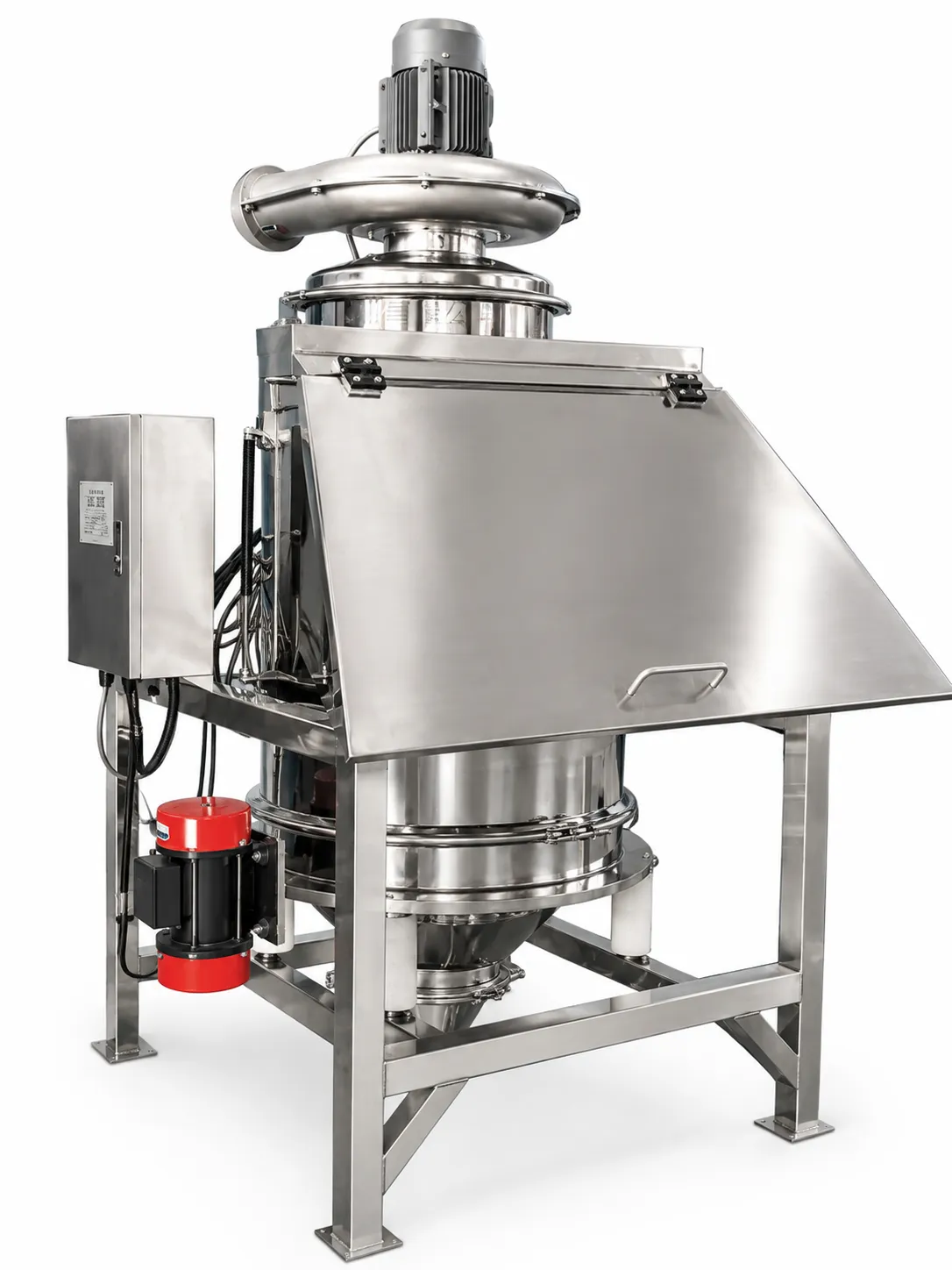
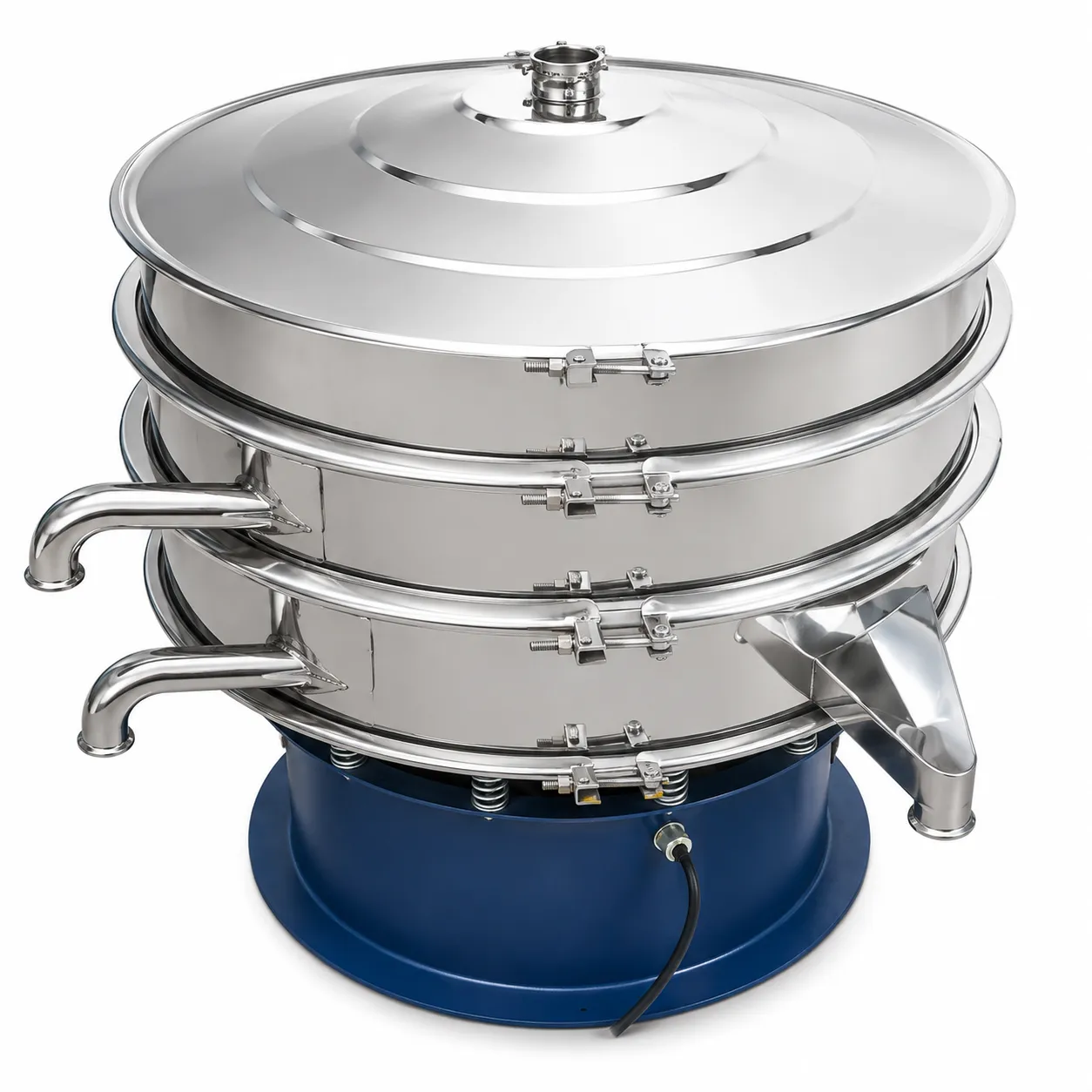
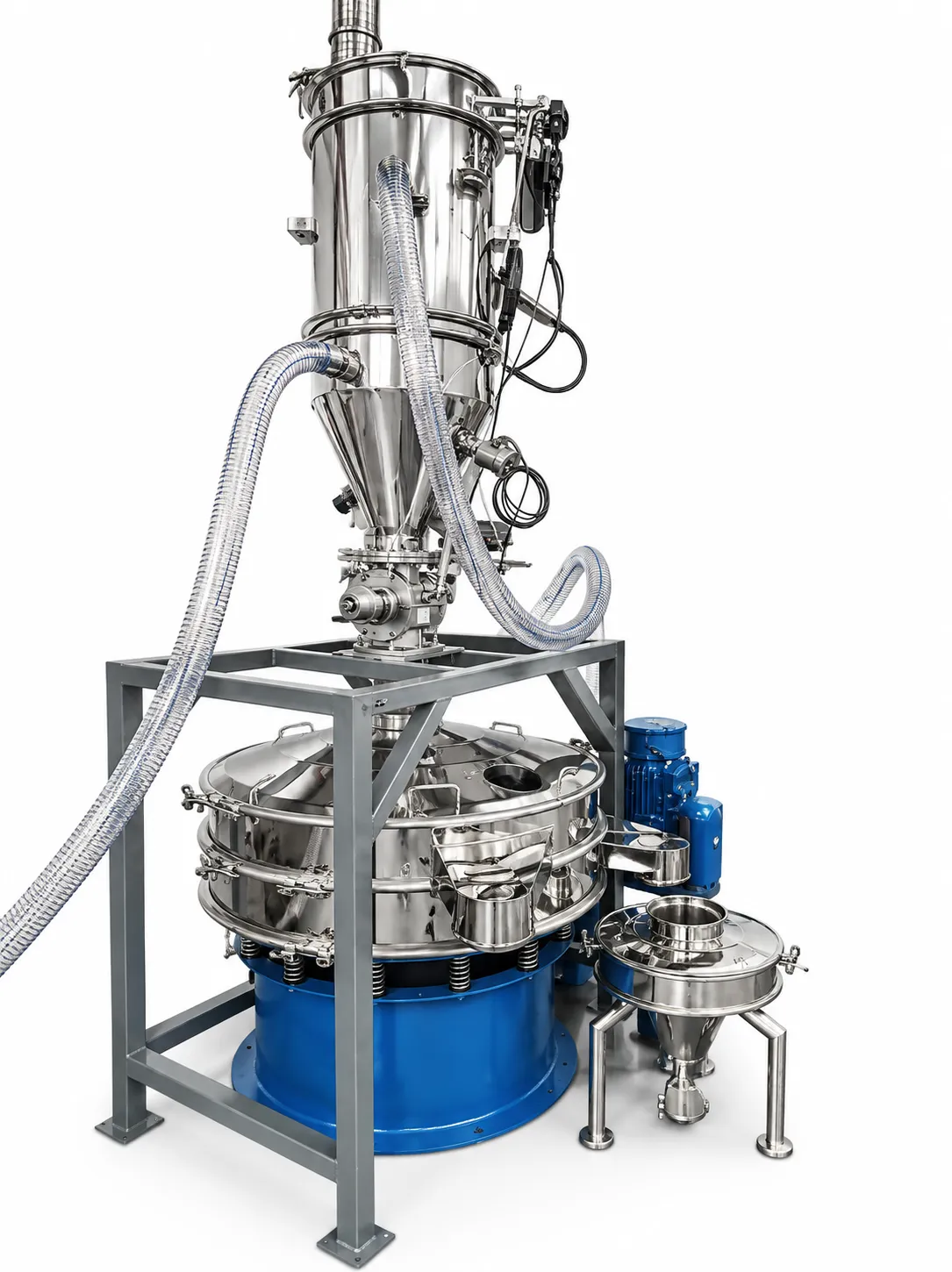
Vacuum from the vacuum pump evacuates the sealed receiving vessel below the Siever; the resulting negative pressure draws powder-laden air from the source through the inlet nozzle into the Siever body. Inside the Siever, a conical or flat circular screen (150 µm–5 mm) intercepts oversize particles while on-specification powder passes through the screen aperture and continues through the outlet nozzle into the receiving vessel below. Oversize particles accumulate on the screen surface and are discharged by a timed compressed-air reverse pulse or mechanical brush at the end of each transfer cycle. The entire sieving operation occurs within a completely sealed body no powder contacts the operator or environment at any point during normal operation.
Challenges
Screen Blinding During High-Throughput Continuous Transfers
Fine cohesive powder blinds screen mesh during extended high-rate vacuum transfer throughput progressively falls.
Reverse Pulse Insufficient for Dense or Sticky Oversize Reject
Compressed air pulse inadequate to dislodge compacted or sticky oversize from screen surface reject accumulates.
Pressure Drop Across Screen Reducing Effective Vacuum and Transfer Rate
As screen loads with product, pressure drop increases vacuum pump works harder and transfer rate falls.
Oversize Reject Accumulation Without Automatic Discharge System
Without timed reject discharge, oversize fills Siever body transfer stops and manual cleaning required.
Screen Mesh Damage from High-Velocity Particle Impact at Maximum Vacuum
Dense hard particles drawn at high velocity under full vacuum impact screen mesh aperture distortion.
Solutions
- Reverse Jet Pulse Cleaning (6 bar, 0.05 s Pulse Duration per Cycle): High-energy reverse pulse restores screen to <5% of new differential pressure every transfer cycle.
- Vibrating Screen Element (Pneumatic Vibrator, 50–200 Hz): Screen vibration breaks surface cake and dislodges sticky oversize maintains open screen throughout transfer.
- Differential Pressure Monitor Across Screen (PLC Alarm at 50 mbar Rise): PLC ΔP alarm triggers pulse-clean or cycle pause before throughput impact proactive screen management.
- Timed Automatic Oversize Reject Valve (Every 5–15 min, 3 s Discharge): Pneumatically actuated reject valve opens on timed schedule oversize purged to reject collection vessel.
- Heavy-Duty Punched Plate Screen (2 mm SS 316L) for Dense or Abrasive Product: Rigid punched plate replaces woven wire for abrasive/dense particles no aperture distortion under impact.
Applications
- Pharmaceutical: API powder inline sieving during vacuum transfer to tablet press hopper or blender zero open transfer.
- Nutraceuticals: Supplement powder inline de-lumping during central vacuum transfer system operation.
- Food & Beverage: Flour, sugar, and starch inline sieving during pneumatic transfer between silos and process equipment.
- Chemical: Pigment, catalyst, and specialty powder inline classification during vacuum conveying.
- Cosmetics: Mineral powder and talc inline de-agglomeration during vacuum transfer to filling machines.
Models & Capacities
| Type 1 Standard Inline Vacuum Siever (Single-Stage): Models & Capacities | ||||||||||
|---|---|---|---|---|---|---|---|---|---|---|
| Model | Scale | Transfer Rate [kg/h] | Screen Ø [mm] | Screen Aperture [µm–mm] | Screen Area [cm²] | Vacuum Level [bar] | Inlet/Outlet Ø [mm] | Pulse-Clean Pressure [bar] | Body L × Ø [mm] | Weight [kg] |
| IVS-S-LAB | Lab | 50–200 | Ø100 | 150 µm–5 mm | 79 | −0.2 to −0.8 | Ø32 | 6 | 250×Ø130 | 12 |
| IVS-S-PIL | Pilot | 100–500 | Ø150 | 150 µm–5 mm | 177 | −0.2 to −0.8 | Ø50 | 6 | 350×Ø185 | 22 |
| IVS-S-300 | Production | 200–800 | Ø200 | 150 µm–5 mm | 314 | −0.2 to −0.8 | Ø65 | 6 | 450×Ø240 | 38 |
| IVS-S-600 | Production | 400–1,500 | Ø250 | 150 µm–5 mm | 491 | −0.2 to −0.8 | Ø80 | 6 | 550×Ø295 | 58 |
| IVS-S-1000 | Production | 600–2,500 | Ø320 | 150 µm–5 mm | 804 | −0.2 to −0.8 | Ø100 | 6 | 680×Ø375 | 90 |
| IVS-S-2000 | Production | 1,000–4,000 | Ø400 | 200 µm–5 mm | 1,257 | −0.2 to −0.8 | Ø125 | 6 | 850×Ø460 | 145 |
| IVS-S-3000 | Large Prod | 1,500–6,000 | Ø500 | 200 µm–5 mm | 1,963 | −0.2 to −0.8 | Ø150 | 6 | 1,000×Ø575 | 220 |
| IVS-S-5000 | Large Prod | 2,500–10,000 | Ø630 | 250 µm–5 mm | 3,117 | −0.2 to −0.8 | Ø200 | 6 | 1,250×Ø720 | 360 |