
Twin-Shaft Horizontal Paddle Blender
A twin-shaft horizontal paddle blender uses two parallel shafts each carrying offset paddle blades that interleave in the overlap zone between shafts, creating intense material exchange that achieves blend uniformity faster than single-shaft designs. Used for cohesive powders, minor component dispersions, and multi-ingredient recipes requiring precise uniformity in pharmaceutical, food, and chemical batch operations.
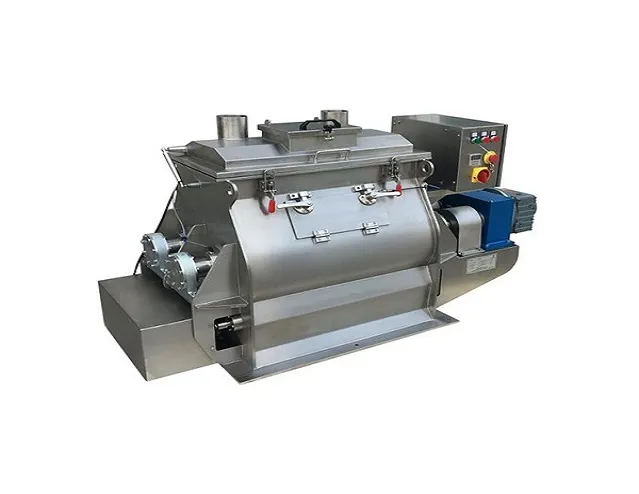
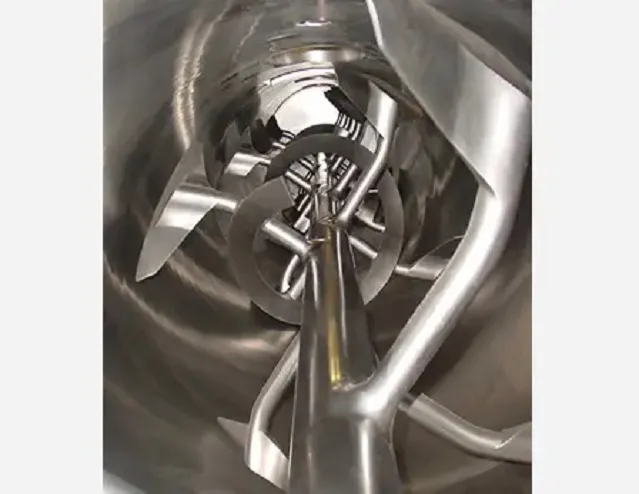
A twin-shaft horizontal paddle blender uses two parallel shafts each carrying offset paddle blades that interleave in the overlap zone between shafts, creating intense material exchange that achieves blend uniformity faster than single-shaft designs. Used for cohesive powders, minor component dispersions, and multi-ingredient recipes requiring precise uniformity in pharmaceutical, food, and chemical batch operations.
Both shafts are synchronised through a common gearbox maintaining a constant paddle phase relationship that prevents inter-shaft contact. As the shafts rotate, paddles from each shaft interleave at the centreline, capturing and exchanging material between both shaft domains with each pass. Counter-rotating mode adds dispersive shear at the nip zone, improving distribution of dense minor components such as lubricants and pigments.
Challenges
Inter-Shaft Collision Risk
Loss of gearbox synchronisation causes paddle-to-paddle contact, resulting in catastrophic mechanical failure and extended unplanned downtime.
Higher Capital Cost
The precision synchronising gearbox and dual drive train carry significantly higher capital cost than equivalent single-shaft configurations.
CIP Shadow at Inter-Shaft Zone
The overlap zone between rotating shaft assemblies creates spray shadow areas, increasing product residue accumulation risk between batches.
Unequal Torque Loading
Uneven feed distribution between shaft zones creates unequal torque loading on each shaft, accelerating gearbox wear over time.
Paddle Configuration Per Product
Optimal paddle pitch and stagger angle varies between products, requiring commissioning trials when introducing new formulations.
Solutions
- Keyed Gearbox Shafts with Timing Marks: Physically keyed output shafts with timing marks prevent incorrect phase assembly after maintenance, always restoring correct inter-shaft clearance.
- Single Motor Through Synchronising Gearbox: One motor driving both shafts through a synchronising gearbox reduces capital cost while maintaining the required shaft phase relationship.
- Twin CIP Spray Bars at Inter-Shaft Zone: One spray bar per shaft directing jets from opposing sides ensures full cleaning coverage of the inter-shaft shadow zone.
- Symmetric Feed Distributor Inlet: An inlet splitter dividing feed equally across both shaft zones maintains balanced torque loading throughout the blending cycle.
- Standardised Paddle Pitch Commissioning Protocol: Defined blending trials at different pitch angles during product introduction identifies optimum configuration without extended commissioning time.
Applications
- Pharmaceutical: Tablet blend with minor lubricant, capsule blend, highly uniform API + excipient blending.
- Food & Beverage: Spice blend, instant soup, powdered drink mix — fast cycle for high-throughput food lines.
- Chemical: Multi-component specialty chemical premix, highly filled compound preparation.
- Animal Feed: Micro-additive and vitamin dispersion into feed premix — even minor component coverage.
- Nutraceuticals: Multi-ingredient supplement blend, mineral premix, enzyme addition to base blend.
Models & Capacities
| Type 2 — Twin-Shaft Horizontal Paddle Blender: Models & Capacities | |||||||||||||
|---|---|---|---|---|---|---|---|---|---|---|---|---|---|
| Model | Scale | Net Vol. [L] | Gross Vol. [L] | Batch Size [kg] | Shaft Speed [RPM] | Motor [kW] | Paddles per Shaft | Trough L [mm] | Trough W [mm] | Trough H [mm] | Overall L [mm] | Overall H [mm] | |
| PB-TS-100 | Lab/Pilot | 60 | 100 | 18–45 | 20–80 VFD | 1.1 | 8×2 | 900 | 500 | 320 | 1,500 | 1,100 | |
| PB-TS-200 | Pilot | 120 | 200 | 36–90 | 15–70 VFD | 1.5 | 10×2 | 1,150 | 600 | 400 | 1,900 | 1,200 | |
| PB-TS-300 | Pilot | 180 | 300 | 54–135 | 15–60 VFD | 2.2 | 12×2 | 1,400 | 720 | 460 | 2,250 | 1,350 | |
| PB-TS-500 | Production | 300 | 500 | 90–225 | 12–50 VFD | 3.0 | 14×2 | 1,750 | 860 | 540 | 2,750 | 1,500 | |
| PB-TS-750 | Production | 450 | 750 | 135–340 | 12–45 VFD | 4.0 | 16×2 | 2,100 | 980 | 620 | 3,300 | 1,650 | |
| PB-TS-1000 | Production | 600 | 1,000 | 180–450 | 10–40 VFD | 5.5 | 18×2 | 2,400 | 1,100 | 700 | 3,750 | 1,800 | |
| PB-TS-1500 | Production | 900 | 1,500 | 270–675 | 10–35 VFD | 7.5 | 20×2 | 2,900 | 1,280 | 800 | 4,500 | 2,000 | |
| PB-TS-2000 | Production | 1,200 | 2,000 | 360–900 | 8–30 VFD | 11 | 24×2 | 3,350 | 1,420 | 900 | 5,200 | 2,200 | |
| PB-TS-3000 | Production | 1,800 | 3,000 | 540–1,350 | 8–25 VFD | 15 | 28×2 | 4,100 | 1,650 | 1,040 | 6,300 | 2,500 | |
| PB-TS-5000 | Large Prod | 3,000 | 5,000 | 900–2,250 | 6–20 VFD | 22 | 36×2 | 5,200 | 1,950 | 1,200 | 7,900 | 2,850 | |
| PB-TS-7500 | Large Prod | 4,500 | 7,500 | 1,350–3,375 | 5–18 VFD | 30 | 44×2 | 6,300 | 2,250 | 1,400 | 9,500 | 3,200 | |
| PB-TS-10000 | Large Prod | 6,000 | 10,000 | 1,800–4,500 | 5–15 VFD | 37 | 52×2 | 7,500 | 2,550 | 1,580 | 11,200 | 3,600 | |
| PB-TS-15000 | Large Prod | 9,000 | 15,000 | 2,700–6,750 | 4–12 VFD | 55 | 60×2 | 9,000 | 3,000 | 1,850 | 13,500 | 4,100 | |
| PB-TS-20000 | Large Prod | 12,000 | 20,000 | 3,600–9,000 | 4–10 VFD | 75 | 68×2 | 10,500 | 3,400 | 2,050 | 15,800 | 4,600 | |