
Tri-Blender
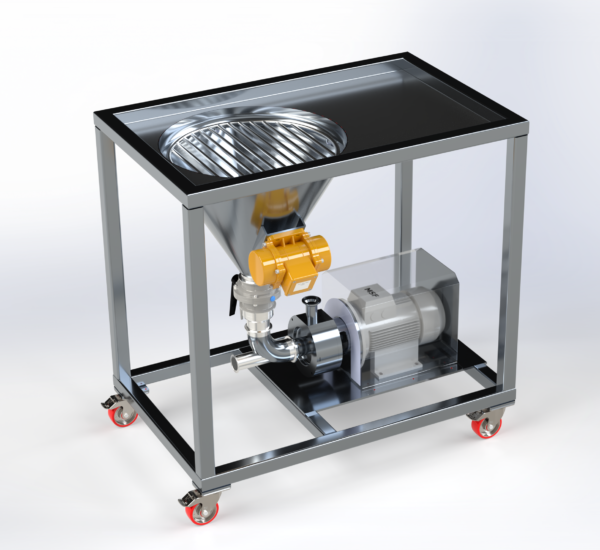
A tri-blender is a continuous inline mixing device combining a centrifugal pump with a rotor-stator assembly, simultaneously drawing liquid and powder through a high-speed impeller that disperses, wets, and dissolves powder at the rotor-stator interface in a single pass. Used for continuous powder induction and dispersion of hydrocolloids, proteins, and starches at production throughput without agglomerate formation.
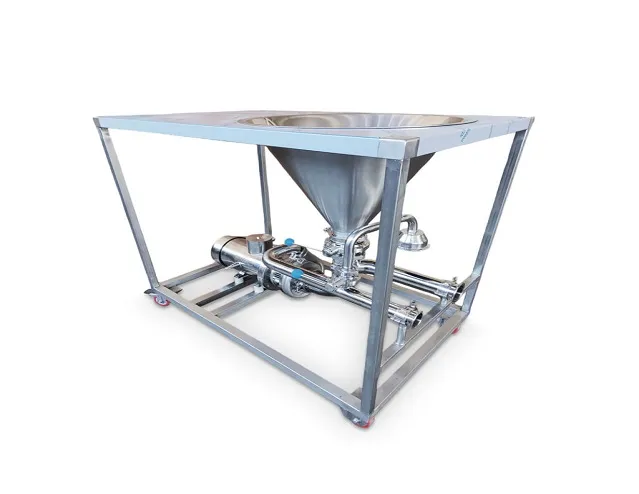
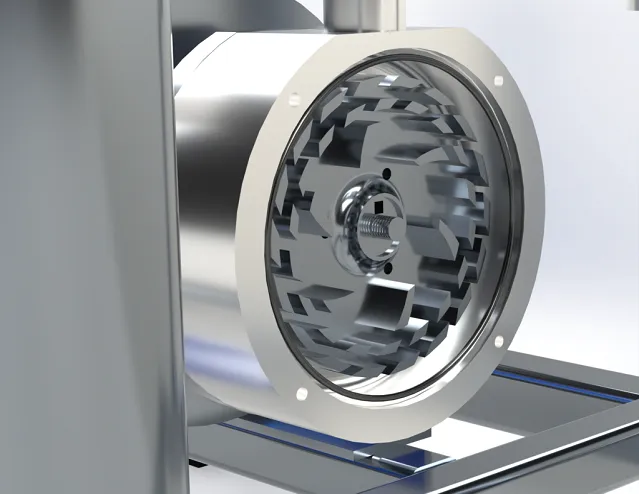
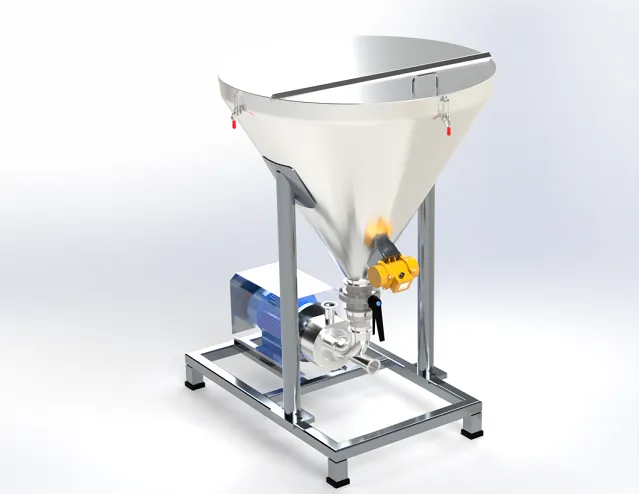
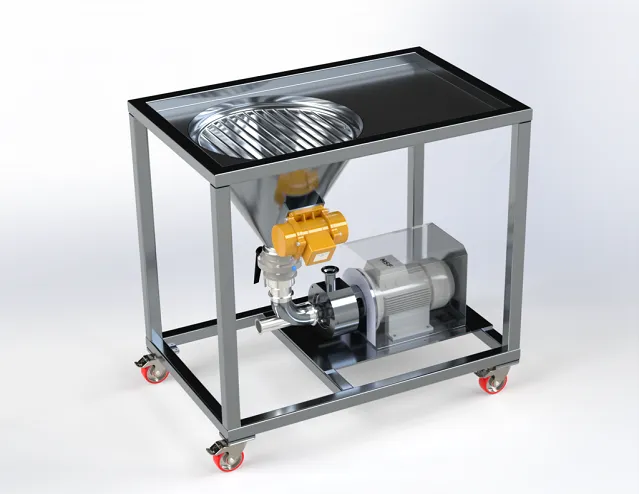
A tri-blender is a continuous inline mixing device combining a centrifugal pump with a rotor-stator assembly, simultaneously drawing liquid and powder through a high-speed impeller that disperses, wets, and dissolves powder at the rotor-stator interface in a single pass. Used for continuous powder induction and dispersion of hydrocolloids, proteins, and starches at production throughput without agglomerate formation.
Liquid enters under positive pressure while powder is inducted through a suction port at the low-pressure zone created by the spinning impeller. Both streams accelerate through the rotor-stator gap together, achieving rapid wetting and dispersion. Centrifugal action delivers the finished dispersion to the outlet pipeline under positive pressure, eliminating the need for a separate downstream transfer pump.
Challenges
Powder Induction Rate Variability
Fluctuations in powder bulk density or feed rate cause variable powder-to-liquid ratios at the rotor-stator interface, producing inconsistent dispersion concentration and hydration quality in the outlet stream.
Air Entrainment During Powder Induction
The powder induction process draws air into the liquid stream alongside the powder, introducing a dispersed gas phase that can destabilise downstream emulsions and produce foam in the finished product.
Product Temperature Rise at Rotor-Stator Gap
Viscous energy dissipation at the rotor-stator interface raises product temperature during processing, which can damage heat-sensitive hydrocolloids, proteins, and biological active ingredients in pharmaceutical applications.
Rotor-Stator Wear from Abrasive Powders
Processing abrasive mineral or starch powders progressively erodes the rotor-stator gap geometry, reducing shear intensity and dispersion quality over time and requiring scheduled inspection and replacement.
High Viscosity Limitation
As product viscosity increases beyond approximately 5,000 cP, the centrifugal pumping action becomes insufficient to maintain adequate flow rate through the rotor-stator gap, reducing dispersion effectiveness.
Solutions
- Loss-in-Weight Gravimetric Powder Dosing: Feeding powder through a gravimetric loss-in-weight feeder with PLC feedback control maintains a consistent powder-to-liquid ratio at the induction port throughout the production run, ensuring uniform dispersion concentration.
- Downstream Inline Vacuum Deaeration: Installing a vacuum deaeration vessel immediately downstream of the tri-blender removes entrained air from the dispersion before it reaches filling or further processing, preventing foam and emulsion destabilisation.
- Jacketed Rotor Housing with Cooling Water: Circulating cooling water through a jacketed rotor housing removes heat generated at the rotor-stator interface, limiting product temperature rise and protecting heat-sensitive ingredients during continuous processing.
- Hardened Rotor-Stator Materials for Abrasive Duty: Specifying tungsten carbide or ceramic rotor-stator assemblies for abrasive powder applications extends service life and maintains consistent gap geometry and shear performance between scheduled maintenance intervals.
- Recirculation Loop for High-Viscosity Products: For products that exceed the self-pumping viscosity limit, installing an external pump in a recirculation loop maintains adequate flow rate through the rotor-stator gap, extending the effective viscosity range of the tri-blender system.
Applications
- Food & Beverage: Hydrocolloid hydration (xanthan, guar, carrageenan), protein powder dispersion, starch slurry, emulsifier incorporation.
- Pharmaceutical: Polymer dispersion for coating solutions, API dispersion into liquid vehicles, excipient hydration.
- Dairy: Milk powder reconstitution, cream/processed cheese base, yogurt culture medium preparation.
- Chemical: Pigment dispersion into liquid carriers, polymer dispersion, specialty chemical slurry production.
- Cosmetics: Foundation and lotion base preparation, thickener hydration, emulsifier activation in cream manufacture.
Models & Capacities
| Standard Tri Blender — Models & Capacities (100 L/h Laboratory to 400,000 L/h Large Production) | ||||||||||||||||
|---|---|---|---|---|---|---|---|---|---|---|---|---|---|---|---|---|
| Model | Scale | Liquid Flow Rate [L/h] | Powder Draw Rate [kg/h] | Max Solids Loading [% w/v] | Impeller Speed [RPM] | Tip Speed [m/s] | Motor [kW] | Liquid Inlet Ø [mm] | Outlet Ø [mm] | Op. Pressure [bar] | Op. Temp [°C] | Overall L [mm] | Overall H [mm] | Weight [kg] | ||
| TB-LAB-100 | Lab | 100–500 | 5–25 | Up to 15 | 1,450–2,900 | 5–12 | 0.37 | DN 25 | DN 32 | Up to 3 | 2–95 | 420 | 320 | 18 | ||
| TB-LAB-500 | Lab/Pilot | 500–2,000 | 25–100 | Up to 15 | 1,450–2,900 | 5–12 | 0.55 | DN 40 | DN 50 | Up to 3 | 2–95 | 480 | 360 | 28 | ||
| TB-PIL-2000 | Pilot | 2,000–8,000 | 100–400 | Up to 20 | 1,450–2,900 | 6–14 | 1.1 | DN 50 | DN 65 | Up to 4 | 2–95 | 560 | 420 | 52 | ||
| TB-PIL-5000 | Pilot | 5,000–15,000 | 250–750 | Up to 20 | 1,450–2,900 | 6–14 | 2.2 | DN 65 | DN 80 | Up to 4 | 2–95 | 640 | 480 | 85 | ||
| TB-P-10000 | Production | 10,000–30,000 | 500–1,500 | Up to 25 | 1,450–2,900 | 8–16 | 4.0 | DN 80 | DN 100 | Up to 4 | 2–95 | 750 | 560 | 145 | ||
| TB-P-20000 | Production | 20,000–50,000 | 1,000–2,500 | Up to 25 | 1,450–2,900 | 8–16 | 7.5 | DN 100 | DN 125 | Up to 4 | 2–95 | 880 | 650 | 220 | ||
| TB-P-30000 | Production | 30,000–80,000 | 1,500–4,000 | Up to 25 | 1,450–2,900 | 8–16 | 11 | DN 125 | DN 150 | Up to 4 | 2–95 | 980 | 730 | 320 | ||
| TB-P-50000 | Production | 50,000–120,000 | 2,500–6,000 | Up to 25 | 960–1,450 | 6–14 | 15 | DN 150 | DN 200 | Up to 4 | 2–95 | 1,150 | 860 | 480 | ||
| TB-LP-80000 | Large Prod | 80,000–200,000 | 4,000–10,000 | Up to 25 | 960–1,450 | 6–14 | 22 | DN 200 | DN 250 | Up to 4 | 2–95 | 1,350 | 1,000 | 720 | ||
| TB-LP-150000 | Large Prod | 150,000–400,000 | 7,500–20,000 | Up to 25 | 720–1,450 | 5–12 | 37 | DN 250 | DN 300 | Up to 3 | 2–95 | 1,600 | 1,180 | 1,050 | ||