
Single-Shaft Horizontal Paddle Blender
A single-shaft horizontal paddle blender is a batch reactor with a central shaft carrying alternating offset paddle blades, generating simultaneous axial and radial three-dimensional material flow within a U-shaped trough. The most widely used batch blending configuration for pharmaceutical, food, chemical, and nutraceutical dry powder applications across laboratory and production scale.
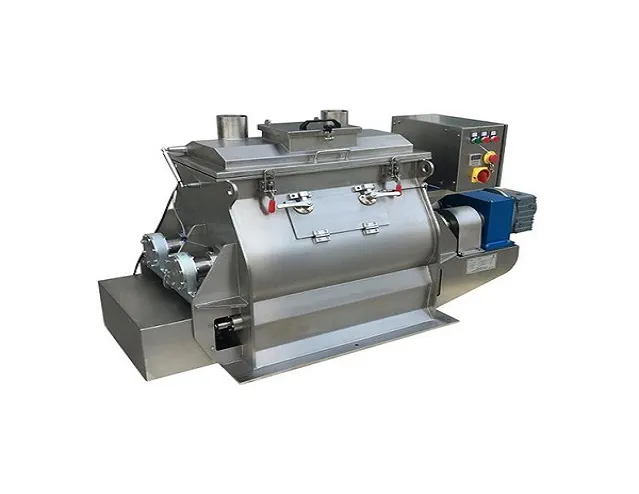
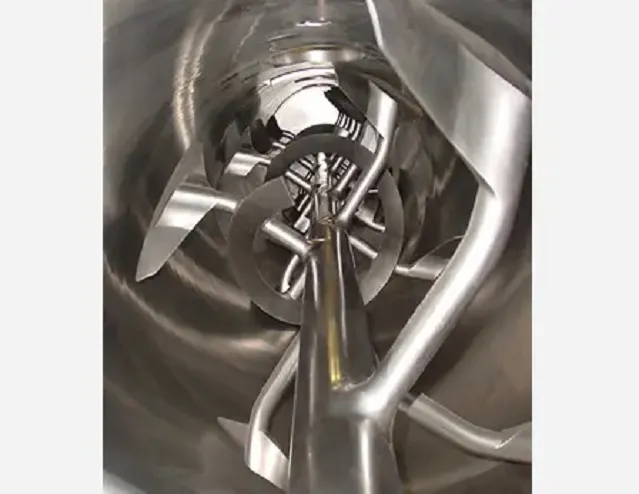
Dry material is charged through the top inlet. The rotating shaft carries alternating paddles at opposing angles, creating counter-flowing axial currents that push material simultaneously toward both trough ends. Combined axial and radial flow contacts every batch volume element progressively throughout the cycle. At blend end, the bottom discharge valve opens and gravity with residual paddle motion empties the batch.
Challenges
Radial Dead Zone at Low Fill Level
Below 40% fill, paddle tips do not effectively reach the trough base, leaving unblended material in the heel below the active paddle sweep zone.
Axial End-Zone Dead Volume
Paddle sweep does not reach the final section of each trough end, allowing material to stagnate at trough extremities outside the active blending pattern.
Segregation During Discharge
Components with significantly different particle sizes or bulk densities can re-segregate during batch discharge as material flows toward and through the discharge valve.
Paddle Wear from Abrasive Powders
Hard mineral powders progressively erode paddle faces and widen paddle-to-trough clearance over time, reducing blending efficiency and increasing maintenance frequency.
Dust Emission During Charging and Discharge
Open trough charging and discharge valve operation release airborne dust, creating operator exposure risk in pharmaceutical and potent compound handling environments.
Solutions
- Minimum Fill Level Interlock at 40% of Gross Volume: A PLC fill interlock prevents blender operation below the validated minimum fill level, ensuring all paddles remain submerged in product throughout the blending cycle.
- Trough-End Deflector Paddles: Angling the final paddle pairs at each trough end inward redirects stagnant end-zone material back into the active paddle sweep path, eliminating end-zone dead volume.
- Multi-Port Discharge Valve Sequence: Opening discharge ports in a defined sequence during batch emptying minimises cross-blade re-segregation, preserving blend uniformity achieved during the blending cycle through to complete batch discharge.
- Hardened Paddle Face Coating: Applying tungsten carbide or equivalent hard-surface coating to paddle faces extends service life against abrasive mineral and crystalline powders, maintaining consistent paddle-to-trough clearance between scheduled maintenance intervals.
- Dust-Tight Lid and Contained Discharge Assembly: Sealing the trough with a clamped dust-tight lid and fitting a contained butterfly discharge valve with a dust sock maintains operator exposure below acceptable limits during charging, blending, and discharge operations.
Applications
- Pharmaceutical: Dry blend for tablet compression, capsule fill blending, excipient and lubricant addition to granule blend.
- Food & Beverage: Seasoning blend, instant soup base, tea premix, bakery premix, food additive blending.
- Nutraceuticals: Supplement premix, vitamin and mineral blend, protein powder base preparation.
- Chemical: Specialty chemical premix, catalyst blend, fertiliser micro-nutrient addition to bulk.
- Cosmetics: Pressed powder premix, mineral cosmetic base, pigment and talc blend.
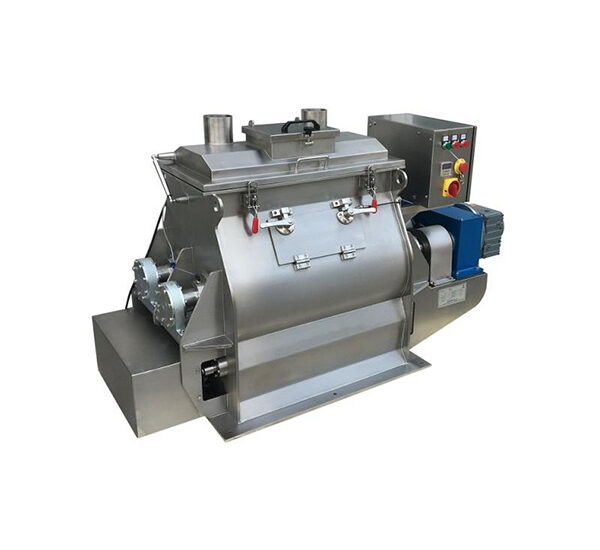
Models & Capacities
| Type 1 — Single-Shaft Horizontal Paddle Blender: Models & Capacities | |||||||||||||
|---|---|---|---|---|---|---|---|---|---|---|---|---|---|
| Model | Scale | Net Vol. [L] | Gross Vol. [L] | Batch Size [kg] | Shaft Speed [RPM] | Motor [kW] | Paddle Count | Trough L [mm] | Trough W [mm] | Trough H [mm] | Overall L [mm] | Overall H [mm] | |
| PB-SS-020 | Lab | 12 | 20 | 4–9 | 30–120 VFD | 0.37 | 6 | 500 | 250 | 200 | 900 | 850 | |
| PB-SS-050 | Lab | 30 | 50 | 9–22 | 25–100 VFD | 0.55 | 8 | 700 | 320 | 260 | 1,150 | 950 | |
| PB-SS-100 | Lab/Pilot | 60 | 100 | 18–45 | 20–80 VFD | 0.75 | 10 | 900 | 400 | 320 | 1,450 | 1,050 | |
| PB-SS-200 | Pilot | 120 | 200 | 36–90 | 20–70 VFD | 1.1 | 12 | 1,150 | 500 | 380 | 1,800 | 1,150 | |
| PB-SS-300 | Pilot | 180 | 300 | 54–135 | 15–60 VFD | 1.5 | 14 | 1,400 | 600 | 440 | 2,100 | 1,250 | |
| PB-SS-500 | Production | 300 | 500 | 90–225 | 15–50 VFD | 2.2 | 16 | 1,750 | 700 | 520 | 2,600 | 1,400 | |
| PB-SS-750 | Production | 450 | 750 | 135–340 | 12–45 VFD | 3.0 | 18 | 2,100 | 800 | 590 | 3,000 | 1,550 | |
| PB-SS-1000 | Production | 600 | 1,000 | 180–450 | 12–40 VFD | 4.0 | 20 | 2,400 | 900 | 650 | 3,500 | 1,700 | |
| PB-SS-1500 | Production | 900 | 1,500 | 270–675 | 10–35 VFD | 5.5 | 24 | 2,900 | 1,050 | 750 | 4,200 | 1,900 | |
| PB-SS-2000 | Production | 1,200 | 2,000 | 360–900 | 10–30 VFD | 7.5 | 28 | 3,350 | 1,150 | 820 | 4,800 | 2,050 | |
| PB-SS-3000 | Production | 1,800 | 3,000 | 540–1,350 | 8–25 VFD | 11 | 32 | 4,100 | 1,350 | 960 | 5,800 | 2,300 | |
| PB-SS-5000 | Large Prod | 3,000 | 5,000 | 900–2,250 | 6–20 VFD | 15 | 40 | 5,200 | 1,600 | 1,100 | 7,300 | 2,600 | |
| PB-SS-7500 | Large Prod | 4,500 | 7,500 | 1,350–3,375 | 6–18 VFD | 22 | 48 | 6,300 | 1,850 | 1,280 | 8,800 | 2,950 | |
| PB-SS-10000 | Large Prod | 6,000 | 10,000 | 1,800–4,500 | 5–15 VFD | 30 | 56 | 7,500 | 2,100 | 1,450 | 10,500 | 3,300 | |
| PB-SS-15000 | Large Prod | 9,000 | 15,000 | 2,700–6,750 | 4–12 VFD | 45 | 64 | 9,000 | 2,500 | 1,700 | 12,500 | 3,800 | |
| PB-SS-20000 | Large Prod | 12,000 | 20,000 | 3,600–9,000 | 4–10 VFD | 55 | 72 | 10,500 | 2,800 | 1,900 | 14,500 | 4,200 | |