
Batch Fluid Bed Dryer (FBD)
A standalone batch fluid bed dryer accepts wet granules discharged from an RMG, high-shear granulator, or plough shear mixer and dries them to LOD <2% using fluidised heated air (40–90°C, 0.5–2.5 m/s) without a spray system. Processing 1–500 kg batches in 15–60 minutes with inlet air volumes of 50–30,000 m³/h, it is the most widely used standalone pharmaceutical drying configuration : delivering fast cycle times, excellent heat and mass transfer through intimate air-particle contact, and straightforward GMP validation.
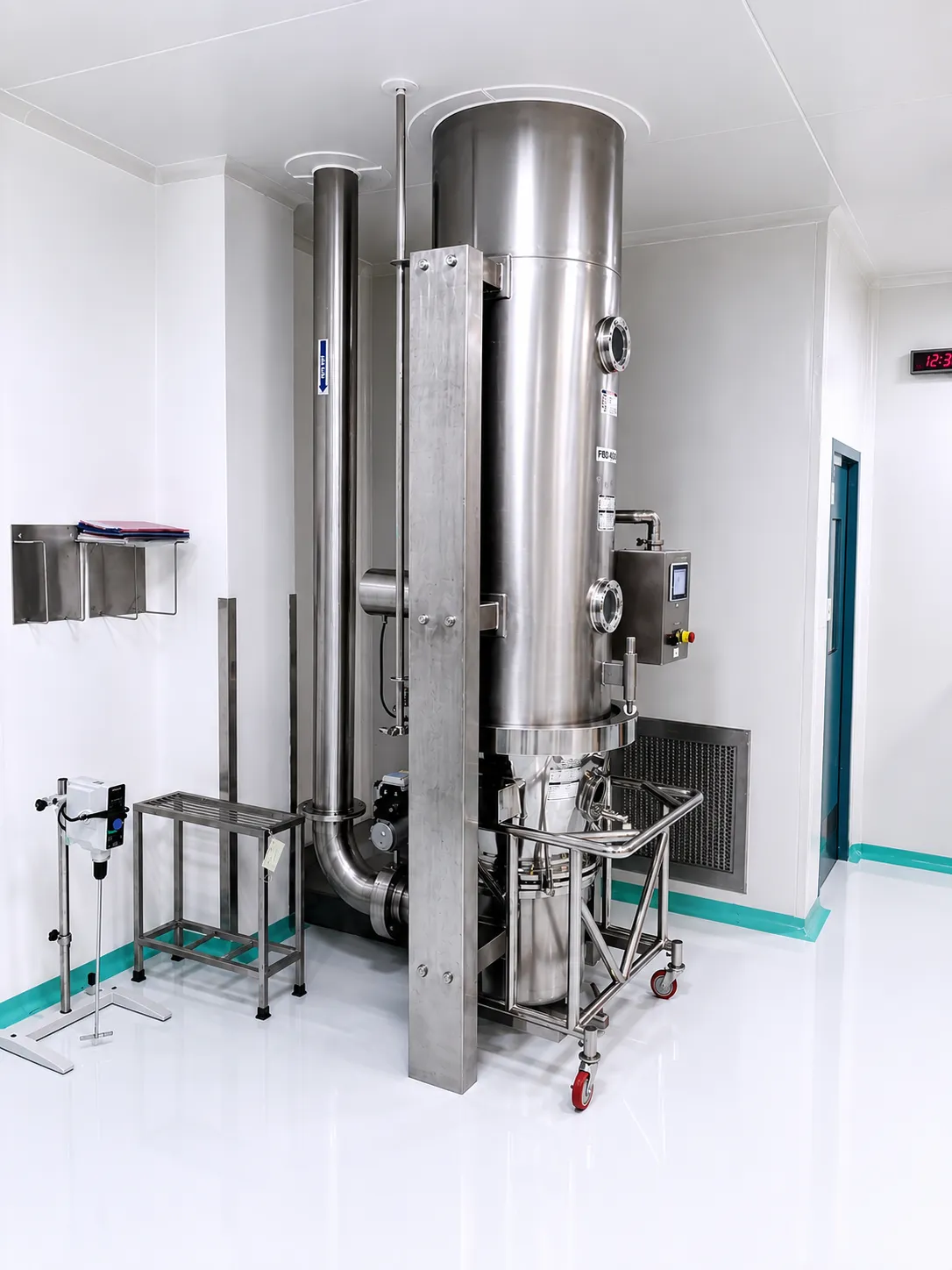
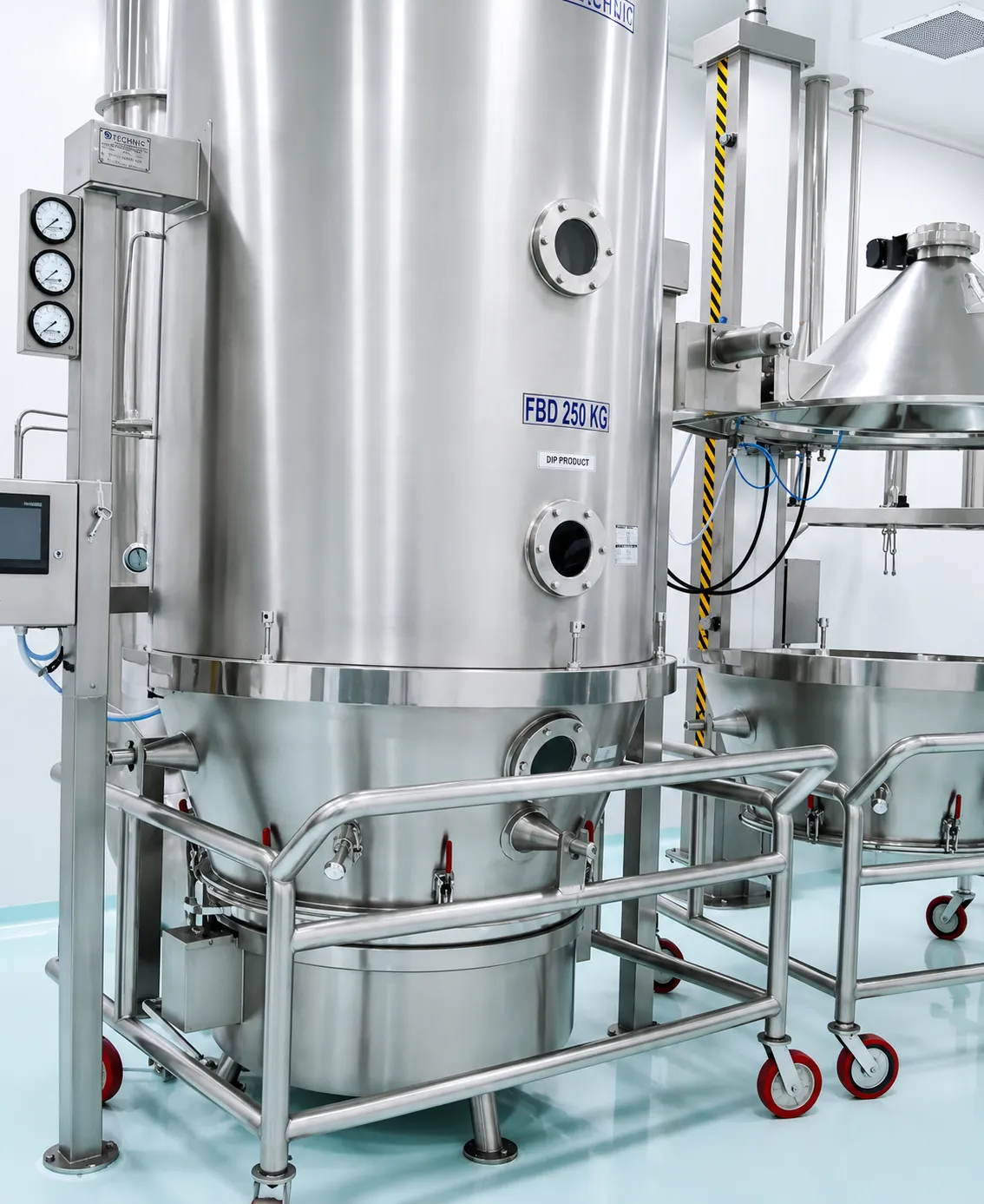
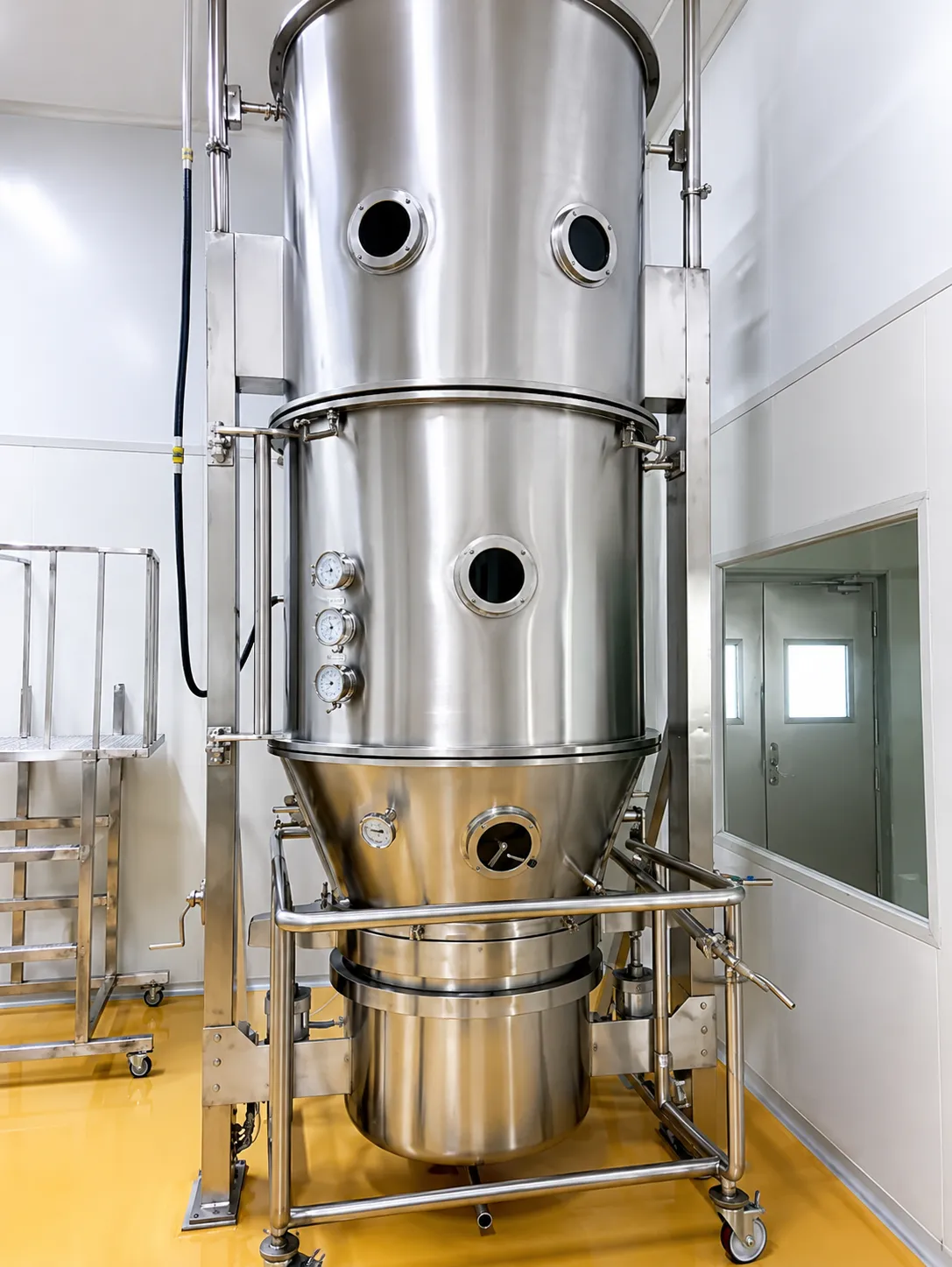
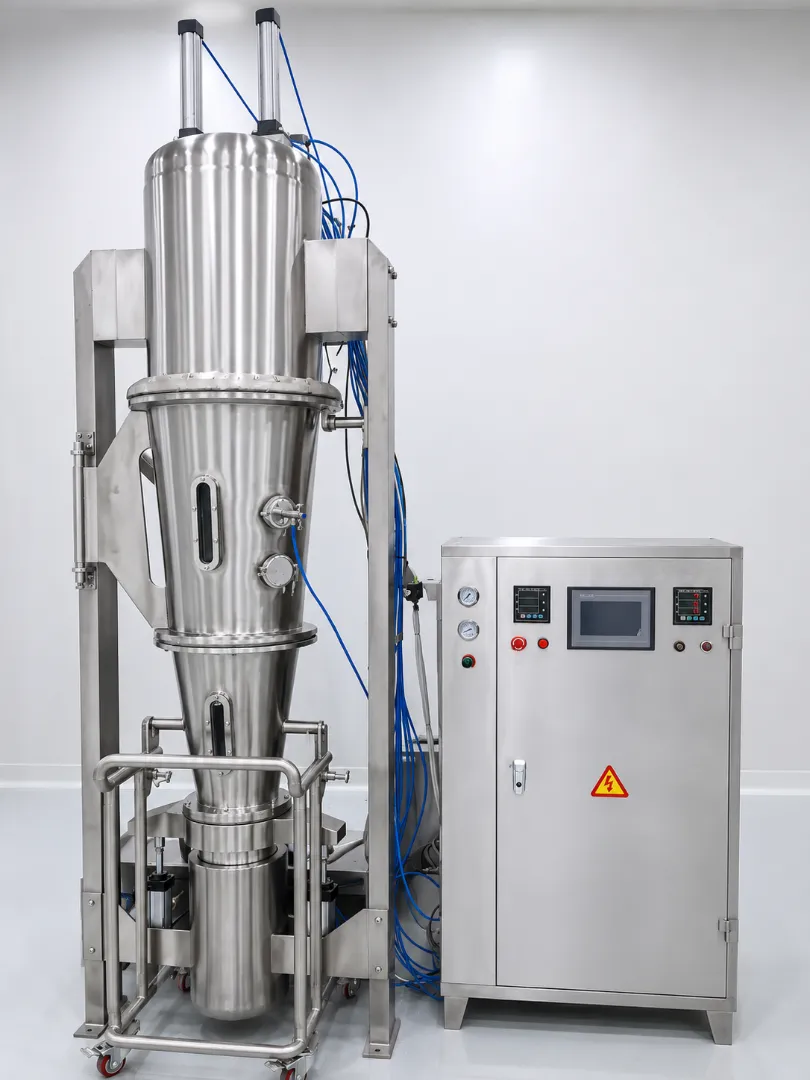
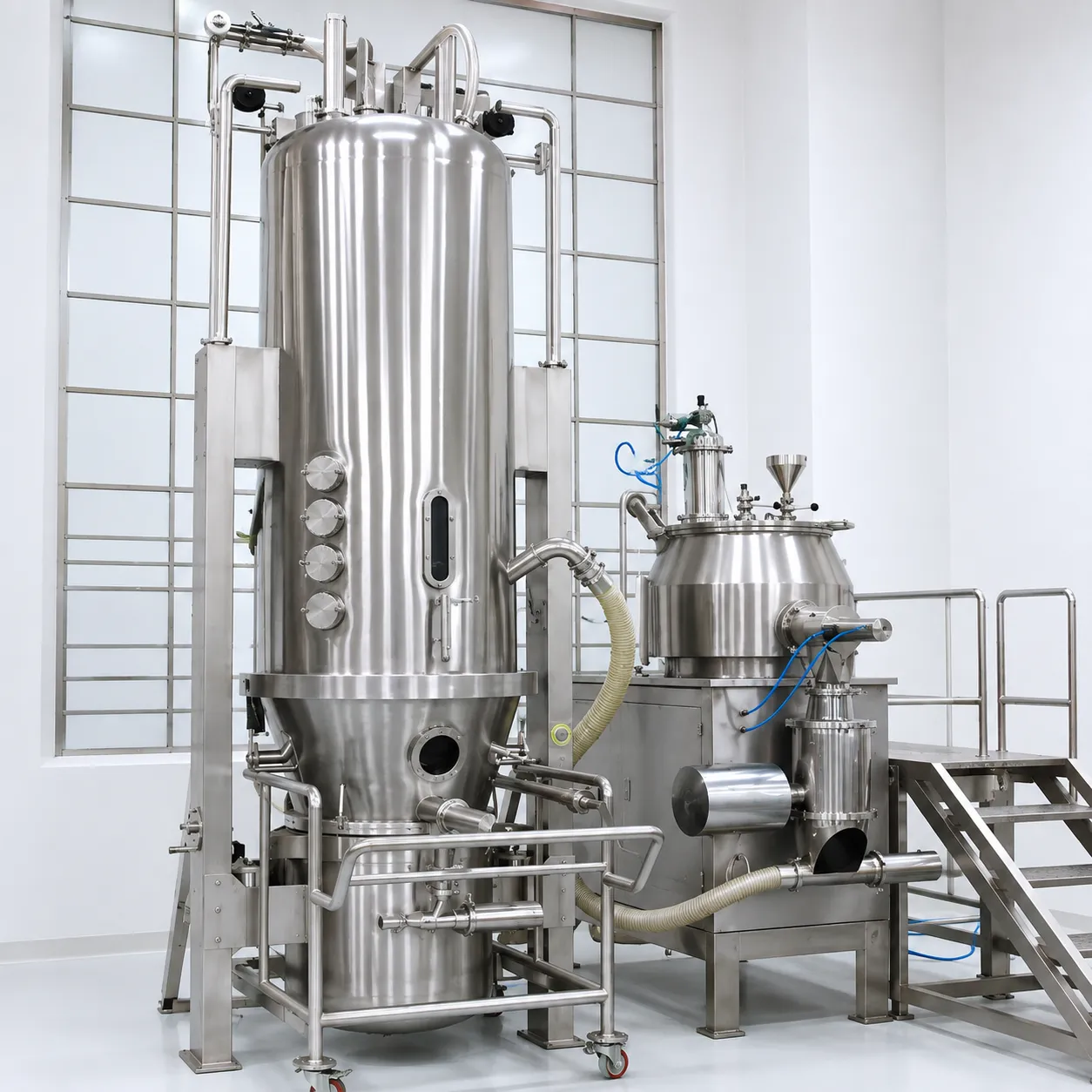
A standalone batch fluid bed dryer accepts wet granules discharged from an RMG, high-shear granulator, or plough shear mixer and dries them to LOD <2% using fluidised heated air (40–90°C, 0.5–2.5 m/s) without a spray system. Processing 1–500 kg batches in 15–60 minutes with inlet air volumes of 50–30,000 m³/h, it is the most widely used standalone pharmaceutical drying configuration : delivering fast cycle times, excellent heat and mass transfer through intimate air-particle contact, and straightforward GMP validation.
Wet granules from the upstream granulator are transferred into the product bowl. Heated inlet air (40–90°C) from the AHU enters through the distributor plate and fluidises the granule bed at 0.5–2.5 m/s. Moisture evaporates from the fluidised granule surface and exits with exhaust air through the bag filter above the bowl. Outlet air humidity and granule temperature confirm drying endpoint. The filter bag shakes automatically every 15–30 minutes returning collected fines to the bed. Inlet air velocity is VFD-ramped from 0.3 m/s at start to 2.0 m/s at steady state protecting fragile granules during initial drying.
Challenges
Granule Attrition at High Fluidisation Velocity
Fragile wet granules fracture above minimum velocity : fines increase in final product.
Granule Channelling from Distributor Plate Blockage
Product fines block plate holes : channelling and incomplete fluidisation results.
Over-Drying After LOD Endpoint
Continued airflow dries granules below target : over-dried brittle granule produced.
Transfer Loss and Segregation from RMG to FBD
Open gravity transfer generates dust and causes granule size segregation.
Filter Bag Cross-Contamination in Multi-Product Suite
API powder trapped in bag fabric between changeovers : contamination risk.
Solutions
- Inlet Air VFD Ramp (0.3 m/s Start → 2.0 m/s at 5 min): Gradual increase allows granule strength to develop before full fluidisation velocity.
- Vibration-Assisted Distributor Plate Pulse (Every 5 min): Plate vibration dislodges fines from holes : sustained uniform distribution.
- LOD-Based Automated Endpoint (Exhaust Humidity PID + Temperature Plateau): Dual-parameter control stops drying at target LOD : prevents over-drying.
- SBV Contained RMG-to-FBD Transfer: Split butterfly valve eliminates open transfer, dust, and segregation.
- Single-Use PE Filter Bag Liner (HPAPI) or Validated Ultrasonic Bag Wash: PE liner disposed per batch (HPAPI); ultrasonic validated wash for standard products.
Applications
- Pharmaceutical: Wet granule final drying after RMG, FBG or plough shear granulation for tablets and capsules.
- Nutraceuticals: Supplement granule drying : vitamin, mineral, herbal formulations after wet granulation.
- Food & Beverage: Instant food granule drying, seasoning granule moisture reduction.
- Chemical: Specialty chemical granule drying after wet agglomeration process.
- Cosmetics: Pressed compact granule drying after wet granulation.
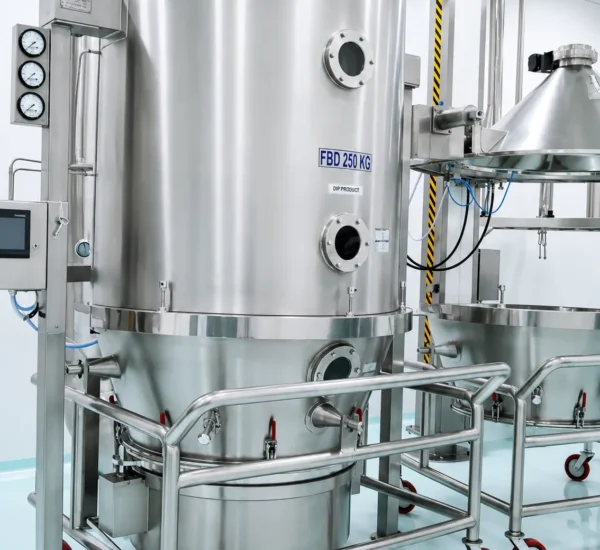
Models & Capacities
| Type 3A : Batch Fluid Bed Dryer: Models & Capacities (* At inlet air temperature 60°C) | |||||||||||||
|---|---|---|---|---|---|---|---|---|---|---|---|---|---|
| Model | Scale | Batch Size [kg] | Net Vol. [L] | Inlet Air [m³/h] | Inlet Temp [°C] | Max Evap. Water* [kg/h] | Max Evap. Ethanol* [kg/h] | LOD [%] | Filter Area [m²] | Bowl Ø [mm] | Bowl H [mm] | Overall H [mm] | Connected Load [kW] |
| FBD-001 | Lab | 1 | 1.5 | 50–250 | 30–90 | 1 | 3 | <2 | 0.5 | 300 | 350 | 2,000 | 4 |
| FBD-003 | Lab | 3 | 5 | 100–500 | 30–90 | 2 | 5 | <2 | 1.0 | 400 | 450 | 2,200 | 7 |
| FBD-010 | Lab/Pilot | 10 | 15 | 300–1,000 | 30–90 | 5 | 12 | <2 | 2.0 | 550 | 600 | 2,600 | 13 |
| FBD-030 | Pilot | 30 | 45 | 800–2,500 | 40–90 | 12 | 30 | <2 | 4.0 | 750 | 800 | 3,100 | 25 |
| FBD-060 | Pilot/Prod | 60 | 90 | 1,500–5,000 | 40–90 | 20 | 50 | <2 | 7.0 | 1,000 | 950 | 3,700 | 40 |
| FBD-120 | Production | 120 | 180 | 3,000–9,000 | 40–90 | 35 | 88 | <2 | 12 | 1,200 | 1,150 | 4,200 | 60 |
| FBD-200 | Production | 200 | 300 | 5,000–15,000 | 40–90 | 55 | 138 | <2 | 18 | 1,500 | 1,380 | 5,000 | 85 |
| FBD-300 | Production | 300 | 450 | 7,000–22,000 | 40–90 | 80 | 200 | <2 | 25 | 1,800 | 1,600 | 5,800 | 120 |
| FBD-500 | Large Prod | 500 | 750 | 10,000–30,000 | 40–90 | 120 | 300 | <2 | 40 | 2,200 | 1,900 | 7,000 | 180 |