
Dynamic Filter — Cross-Flow / Tangential Flow Filtration (TFF)
A cross-flow (tangential flow) filter circulates feed liquid tangentially across the filter membrane surface at high velocity — the cross-flow sweeps accumulated particles and rejected molecules continuously from the membrane surface, preventing cake formation and maintaining permeate flux over extended operating periods. Processing 0.001–500 m³/h at membrane pore sizes of 0.01–10 µm (microfiltration) or 1–1,000 kDa (ultrafiltration), it achieves steady-state continuous filtration of protein solutions, cell broth, and colloidal suspensions that would immediately blind any dead-end filter — the standard for biotech concentration, protein purification, and dairy membrane processing.
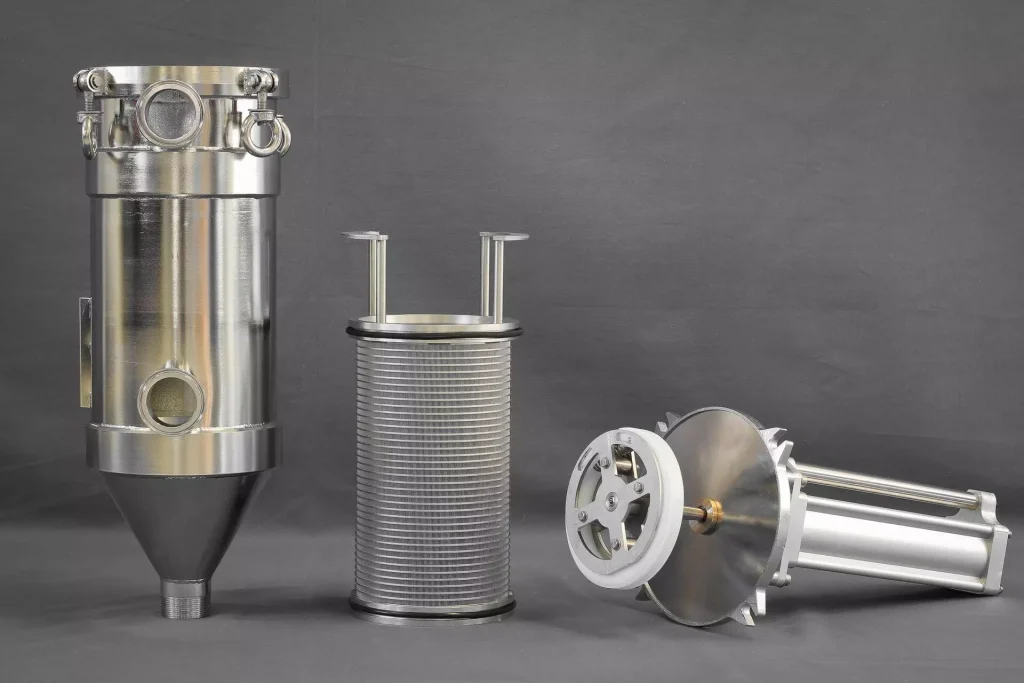
A cross-flow (tangential flow) filter circulates feed liquid tangentially across the filter membrane surface at high velocity — the cross-flow sweeps accumulated particles and rejected molecules continuously from the membrane surface, preventing cake formation and maintaining permeate flux over extended operating periods. Processing 0.001–500 m³/h at membrane pore sizes of 0.01–10 µm (microfiltration) or 1–1,000 kDa (ultrafiltration), it achieves steady-state continuous filtration of protein solutions, cell broth, and colloidal suspensions that would immediately blind any dead-end filter — the standard for biotech concentration, protein purification, and dairy membrane processing.
Feed is circulated by a recirculating pump (centrifugal or peristaltic) across the membrane surface at 2–6 m/s — the tangential velocity creates a shear stress at the membrane surface that continuously removes the concentration polarisation layer. A fraction of the liquid (permeate) passes through the membrane pores under transmembrane pressure (TMP) of 0.5–6 bar and exits as filtrate; the remainder (retentate) continues around the loop. The system concentrates product in the retentate while removing smaller molecules or solvents in the permeate. Diafiltration (adding water to the retentate loop) washes out impurities at constant product concentration.
Challenges
Membrane Fouling from Protein Adsorption and Cake Formation at Low Cross-Flow
At insufficient cross-flow velocity, proteins adsorb irreversibly to membrane surface — flux declines rapidly.
Concentration Polarisation Reducing Effective Membrane Cut-Off
High local concentration at membrane surface retains species that should permeate — apparent molecular weight cut-off rises.
Membrane Integrity Failure Contaminating Retentate with Permeate-Side Species
Membrane rupture or pinhole allows bidirectional contamination — retentate and permeate both compromised.
Heat Generation from High-Pressure Recirculation Pump in Biotech Service
Recirculating pump at 6 bar generates heat — temperature rise risks protein denaturation in biological applications.
Sanitisation Limitations on Hollow-Fibre Membranes (Internal Dead Zones)
Hollow-fibre lumens trap residual protein and cleaning agent — validated SIP coverage inside fibres is difficult.
Solutions
- Optimised Cross-Flow Velocity (3–5 m/s) at Constant TMP (0.5–2 bar): Cross-flow velocity and TMP optimised per product — maintains fouling-free steady-state flux.
- Temperature-Controlled Feed Loop (Peltier Chiller or Heat Exchanger on Retentate): Plate heat exchanger on retentate return loop maintains temperature within ±1°C — protects protein.
- Integrity Test (Pressure Hold, Bubble Point) Before and After Each Run: Pre- and post-run bubble point test — detects membrane failure before campaign and confirms integrity after.
- Caustic Cleaning-in-Place (NaOH 0.1–0.5 M, 30 min) + Forward Flush: Standard caustic CIP removes protein fouling — flux recovery >95% of original after CIP.
- Single-Use Disposable Hollow-Fibre Cassette (Gamma-Irradiated, GMP): Disposable cassette eliminates cleaning validation — 100% product integrity per run; ideal for HPAPI and clinical manufacturing.
Applications
- Biotechnology: Protein concentration, buffer exchange, viral filtration, monoclonal antibody purification, cell broth clarification.
- Pharmaceutical: Antibiotic concentration, excipient removal, sterile filtrate production, viral clearance studies.
- Dairy: Milk protein concentration, whey protein fractionation, lactose removal, butter milk processing.
- Food & Beverage: Juice clarification, beer clarification, sugar solution concentration — membrane filtration.
- Water Treatment: Drinking water microfiltration, reclaimed water reuse, industrial effluent treatment.
Models & Capacities
Type 5B — Cross-Flow / Tangential Flow Filtration (TFF): Models & Capacities | |||||||||||
Model | Scale | Membrane Area [m²] | Module Type | Pore Size / MWCO | Max TMP [bar] | Permeate Flux [L/m²/h] | Feed Flow [L/h] | Retentate Pump Type | Max Temp [°C] | Disposable Option |
|
TFF-LAB-001 | Lab | 0.001–0.01 | Hollow fibre / flat cassette | 0.01–10 µm / 1–300 kDa | 6 | 50–200 | 10–500 | Peristaltic | 40 | Yes (gamma) |
|
TFF-PIL-005 | Pilot | 0.05–0.5 | Hollow fibre / spiral wound | 0.01–10 µm / 1–300 kDa | 6 | 50–200 | 0.5–5k | Peristaltic / centrifugal | 40 | Yes (gamma) |
|
TFF-PIL-5 | Pilot | 0.5–5 | Spiral wound / hollow fibre | 0.01–10 µm / 1–300 kDa | 6 | 50–200 | 5k–50k | Centrifugal lobe | 50 | Gamma option |
|
TFF-P-050 | Production | 5–50 | Spiral wound | 0.1–10 µm / 5–300 kDa | 6 | 50–200 | 50k–500k | Centrifugal | 60 | No (CIP reuse) |
|
TFF-P-200 | Production | 50–200 | Spiral wound / tubular | 0.1–10 µm / 5–300 kDa | 4 | 50–150 | 200k–2M | Centrifugal | 65 | No (CIP reuse) |
|
TFF-LP-500 | Large Prod | 200–500 | Tubular / spiral wound | 0.1–10 µm / 5–300 kDa | 4 | 50–150 | 500k–5M | Multi-stage centrifugal | 65 | No |
|