
Standard Sigma Blade Mixer
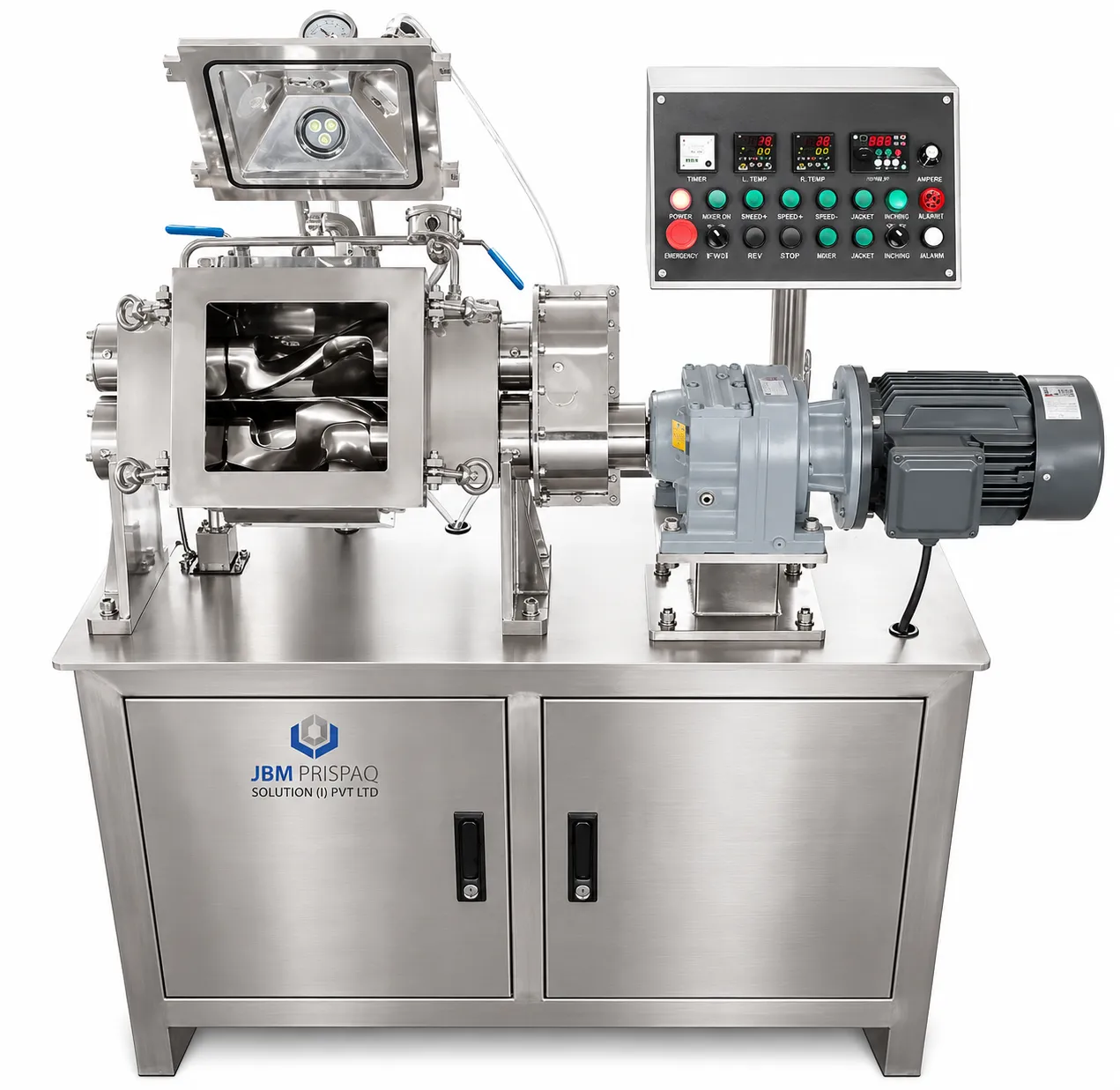
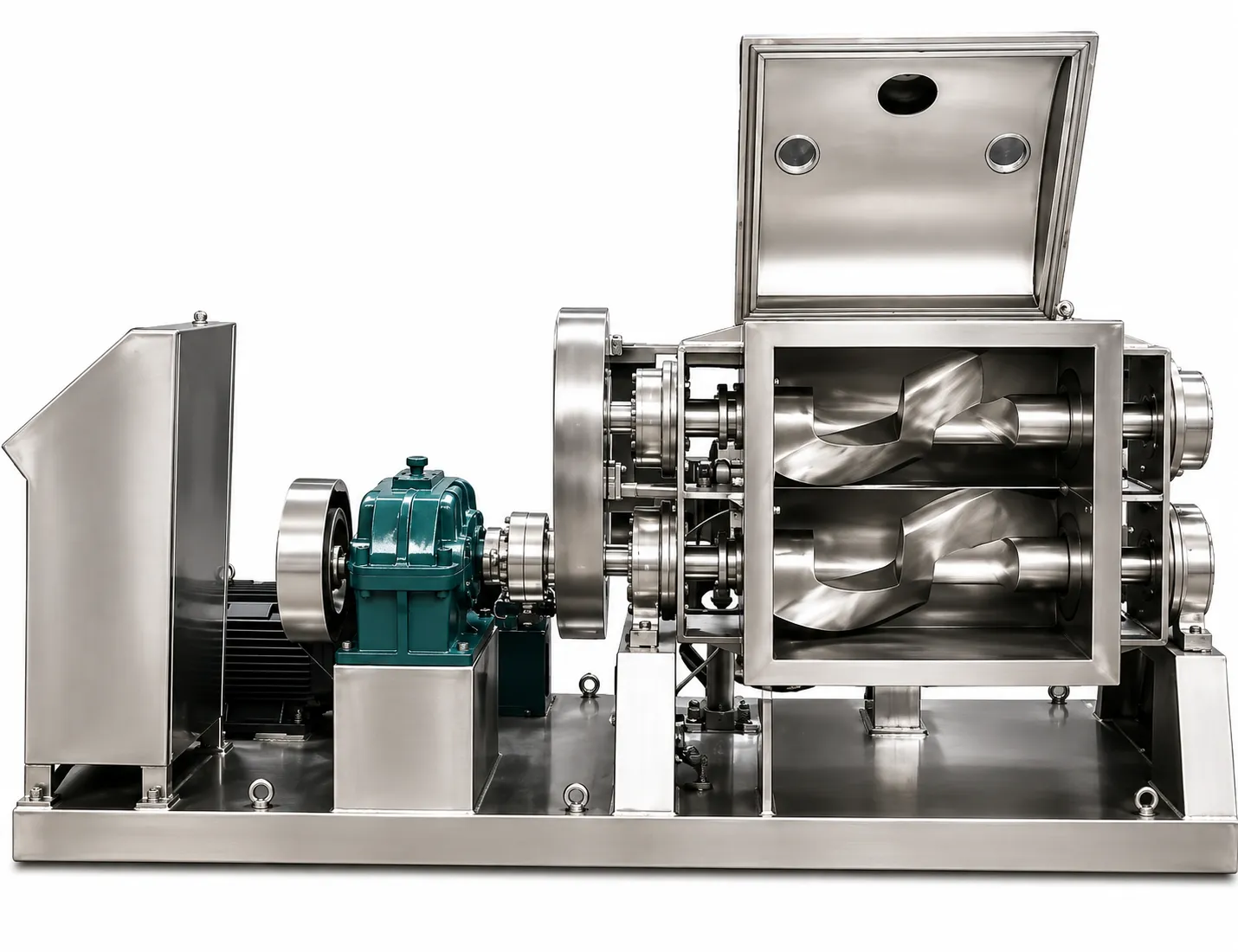
A standard sigma blade mixer is a W-trough batch reactor housing two counter-rotating sigma (σ) profile crescent blades at differential speed ratio 2:1 to 3:2, processing 1–5,000 L at viscosities of 1,000–500,000 cP and 10–60 RPM. The sigma blade generates folding-and-stretching extensional flow — distinct from Z-blade shear-nip action — making it ideal for rubber compounds, dense adhesives, food doughs, and pharmaceutical pastes requiring gentle kneading without blade-to-blade metallic contact.
A high-shear plough shear mixer with choppers integrates 2–4 wall-mounted chopper assemblies (1,500–3,000 RPM, tip speed 25–40 m/s) operating simultaneously with the main plough blades (60–250 RPM) — providing two independent shear zones within a single vessel. The choppers break primary agglomerates and disperse liquid binder at a localised high-shear rate while the plough blades maintain bulk three-dimensional circulation. Processing 10–3,000 kg, it achieves finer granule D90 (0.1–1.0 mm) and tighter PSD than standard configuration.
Front and rear sigma blades rotate at differential speeds (e.g., front 40 RPM, rear 20 RPM) creating a velocity gradient in the nip zone between blades. Material is repeatedly folded, stretched, and re-presented at different orientation each pass — distributing deformation history uniformly across all batch volume elements. Jacketed trough with hollow water-cooled blades maintains ±2°C thermal control. Hydraulic tilt through the front discharge door recovers >98% of processed batch. CIP-compatible electropolished surfaces (Ra <0.8 µm) facilitate validated cleaning between batches.
Challenges
Trough-End Dead Zones at Blade Sweep Radius Limit
Product stagnates in the annular zone beyond blade tip sweep — non-uniform shear history.
Ultra-High Viscosity Startup Torque Spike at Cold Batch
Dense cold charge of >500,000 cP causes motor trip at conventional start speed.
Heat Runaway in Sustained Kneading Above 100,000 cP
Viscous energy dissipation at blade-nip raises product temperature beyond formulation limit.
Blade Wear from Abrasive Fillers (Glass Fibre, CaCO₃, Carbon Black)
Mineral and fibre fillers abrade sigma blade profile — clearance widens, shear intensity falls.
Incomplete Discharge of High-Yield-Stress Material (>50 kPa)
High-yield-stress dried or cooled product resists hydraulic tilt discharge >2% residual.
Solutions
- Contoured Trough-End Deflector Plates (Matched to Blade Profile): Shaped end plates redirect dead-zone material back into the active blade sweep path.
- VFD Soft-Start with Torque-Limited Ramp (10–60 RPM Over 90 Seconds): Gradual acceleration profile limits peak startup torque to 1.5× rated prevents motor trip.
- Water-Cooled Hollow Blades + Full-Width Jacketed Trough (±2°C Control): Dual cooling path decouples viscous heat generation from product temperature requirement.
- HVOF Thermal Spray or Stellite 6 Hard-Facing on Blade Profile: Hard-surface coating extends sigma blade life 4–6× against mineral and abrasive fillers.
- Hydraulic Tilt + Compressed Air Injection at Trough Rear: Air injection dislodges high-yield-stress product from trough end — achieves >99% recovery.
Applications
- Chemical: Rubber compounding, pressure-sensitive adhesives, sealant formulation, epoxy paste production.
- Pharmaceutical: Dense tablet granulation base, herbal extract paste, veterinary ointment — GMP validated cleaning.
- Food Processing: Bread dough, nougat, caramel, marzipan, processed cheese base — food-contact CIP-compatible.
- Plastics & Elastomers: Thermoplastic elastomer compounding, carbon black dispersion, high-filler-load polymer systems.
- Cosmetics: Lipstick mass kneading, wax-polymer blending, pigment dispersion in semi-solid cosmetic bases.
Product Catalogue & Technical Datasheet
Model | Scale | Trough Vol. (L) | Batch Size (kg) | Front RPM | Rear RPM | Blade Motor (kW) | Viscosity Max (cP) | Jacket Temp (°C) | Trough L × W × H (mm) | Weight (kg) |
SM-001 | Lab | 1 | 0.5–0.8 | 20–60 VFD | 10–40 VFD | 0.75–1.5 | 500,000 | 0–200 | 500×250×300 | 120 |
SM-005 | Lab | 5 | 2–4 | 20–60 VFD | 10–40 VFD | 2.2–3.7 | 500,000 | 0–200 | 700×380×420 | 280 |
SM-025 | Lab/Pilot | 25 | 10–20 | 20–60 VFD | 10–40 VFD | 7.5–11 | 500,000 | 0–200 | 1,200×600×680 | 720 |
SM-100 | Pilot | 100 | 40–80 | 20–60 VFD | 10–40 VFD | 18.5–22 | 500,000 | 0–200 | 2,000×900×980 | 1,800 |
SM-250 | Production | 250 | 100–200 | 20–60 VFD | 10–40 VFD | 37–45 | 500,000 | 0–200 | 3,000×1,200×1,250 | 4,500 |
SM-500 | Production | 500 | 200–400 | 15–50 VFD | 8–33 VFD | 55–75 | 500,000 | 0–200 | 4,000×1,500×1,500 | 8,500 |
SM-1000 | Production | 1,000 | 400–800 | 10–40 VFD | 5–27 VFD | 90–110 | 500,000 | 0–200 | 5,500×1,900×1,900 | 16,000 |
SM-2000 | Large Prod | 2,000 | 800–1,600 | 10–35 VFD | 5–23 VFD | 160–185 | 500,000 | 0–200 | 7,500×2,300×2,300 | 30,000 |
SM-5000 | Large Prod | 5,000 | 2,000–4,000 | 10–30 VFD | 5–20 VFD | 280–315 | 300,000 | 0–200 | 11,000×3,200×3,000 | 70,000 |