
Ultrasonic Homogenizer (Sonicator)
An ultrasonic homogenizer converts electrical energy into 20–40 kHz mechanical vibration via a piezoelectric transducer, amplified through a titanium sonotrode to produce acoustic cavitation in the process liquid. Cavitation bubble collapse generates intense localised energy, enabling nanoemulsification, particle size reduction, and cell disruption. Processing 0.1 mL to 10 L, it delivers energy densities inaccessible to conventional mechanical mixing instruments.
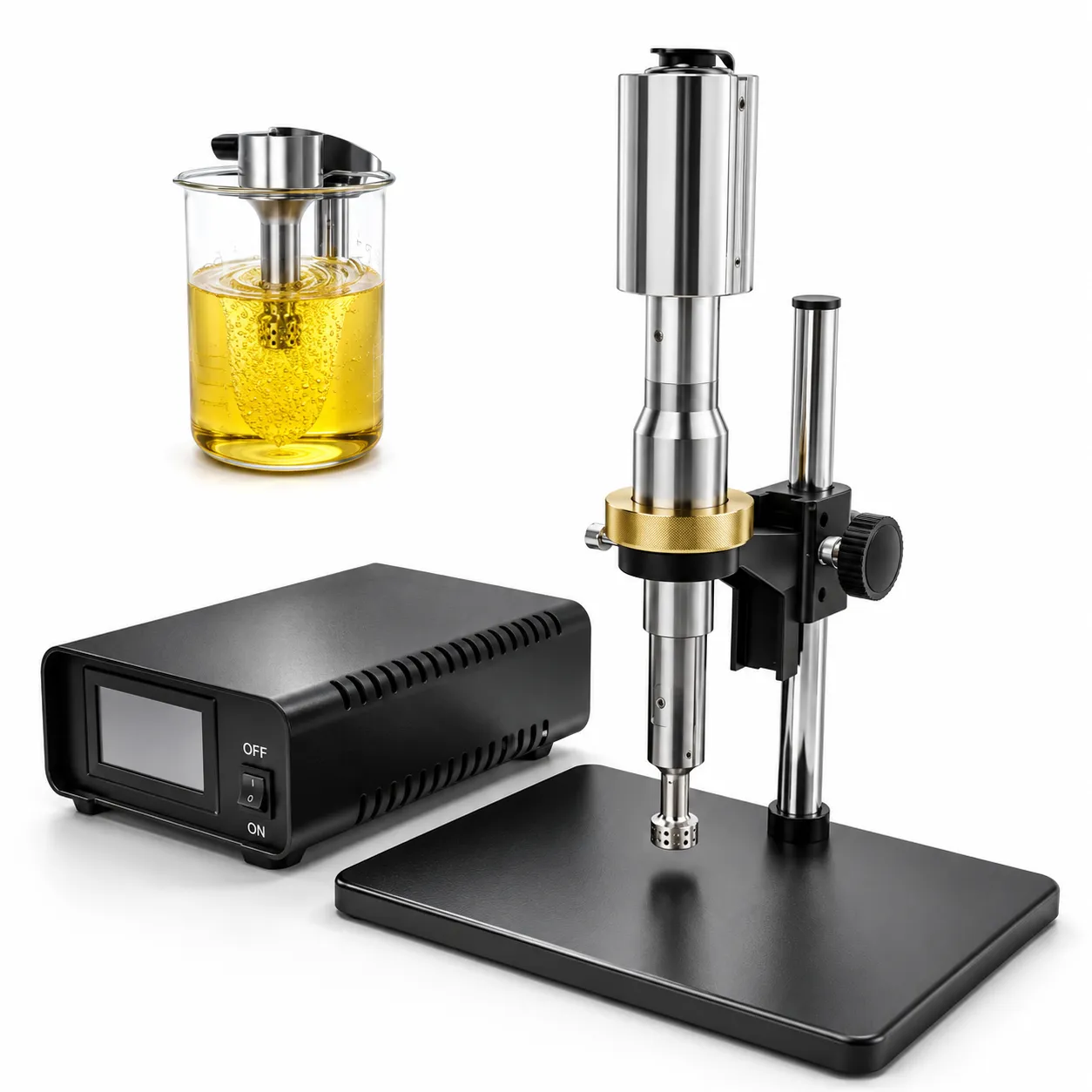
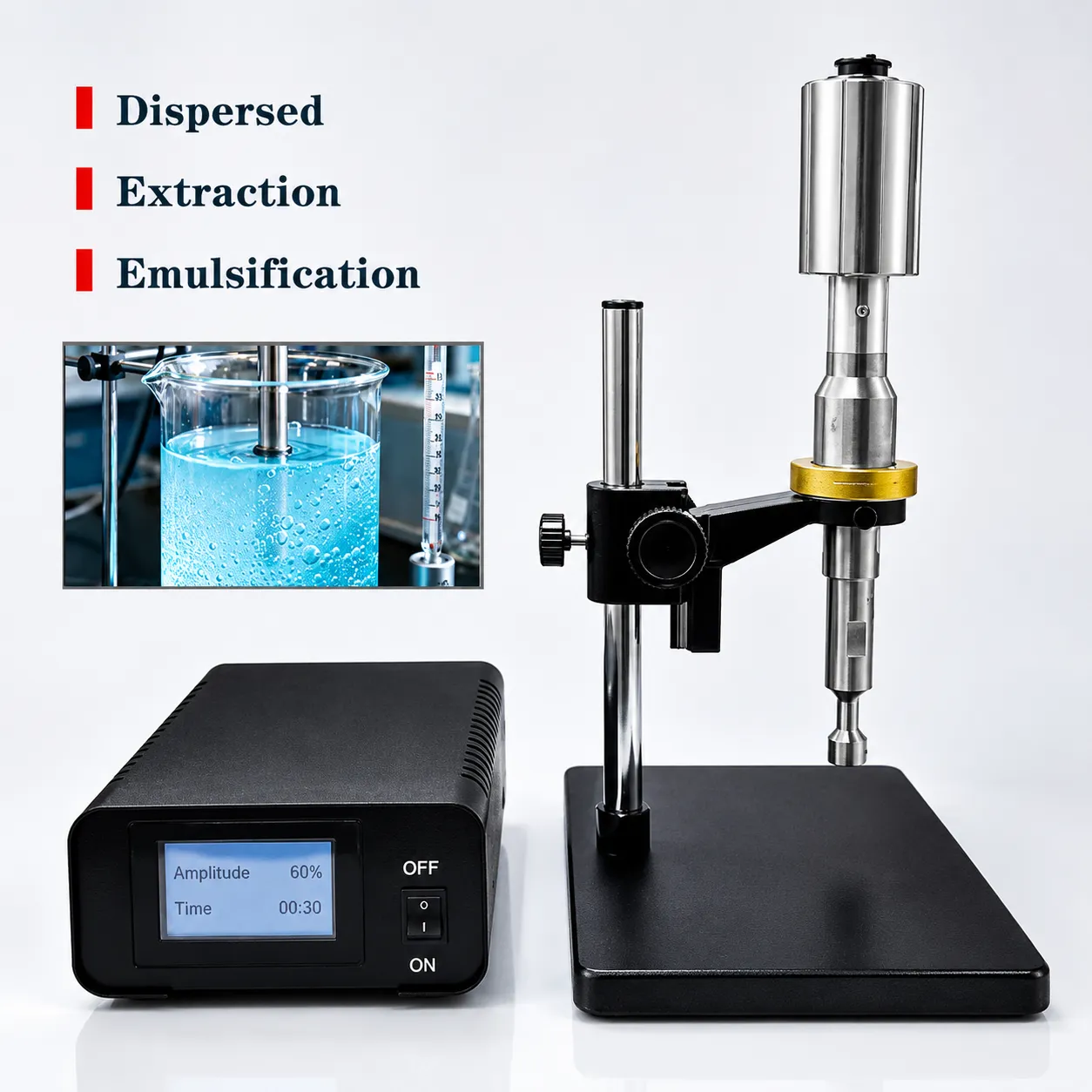
An ultrasonic homogenizer converts electrical energy into 20–40 kHz mechanical vibration via a piezoelectric transducer, amplified through a titanium sonotrode to produce acoustic cavitation in the process liquid. Cavitation bubble collapse generates intense localised energy, enabling nanoemulsification, particle size reduction, and cell disruption. Processing 0.1 mL to 10 L, it delivers energy densities inaccessible to conventional mechanical mixing instruments.
The vibrating probe tip generates alternating compression and rarefaction cycles in the liquid. Rarefaction nucleates cavitation bubbles; compression drives their violent collapse, releasing localised energy that disrupts particles, cells, and droplet interfaces. Acoustic streaming creates bulk recirculation drawing unprocessed material into the cavitation zone. Amplitude control and pulsed mode modulate energy dose and temperature rise throughout the processing cycle.
Challenges
Rapid Sample Heating
Continuous sonication raises sample temperature rapidly, causing protein denaturation, enzyme inactivation, and nucleic acid degradation in biological and pharmaceutical samples processed without active thermal management.
Probe Tip Erosion and Titanium Contamination
Cavitation progressively erodes the titanium probe tip, releasing metallic micro-particles into the sample. This contamination is unacceptable in pharmaceutical, bioanalytical, and food applications where product purity is critical.
Non-Uniform Energy Distribution
Cavitation intensity is highest immediately below the probe tip and drops sharply with distance, resulting in uneven processing across larger sample volumes and inconsistent particle size reduction or cell disruption throughout the batch.
Acoustic Noise Hazard
Operating at full amplitude generates significant airborne noise, requiring hearing protection for all nearby personnel and restricting open-bench operation in shared laboratory environments.
Aerosol Generation at the Liquid Surface
Surface cavitation produces fine airborne droplets containing biological, chemical, or pharmaceutical material, creating containment and operator exposure risks particularly when processing infectious or toxic samples.
Solutions
- Pulsed Mode with Active Cooling: Operating in pulsed cycles with the sample vessel immersed in an ice bath or connected to a recirculating cooler limits cumulative heat input, maintaining sample temperature within acceptable limits for thermally sensitive materials.
- Regular Probe Tip Inspection and Replacement: Monitoring probe tip condition and replacing at defined intervals prevents excessive erosion contamination. For pharmaceutical and analytical applications, using probe tips with validated erosion limits or ceramic alternatives reduces contamination risk.
- Flow-Through Sonication Cell: Pumping the sample continuously through a closed flow-through cell past the probe tip ensures each volume element receives a consistent and defined energy dose, improving processing uniformity across larger volumes.
- Acoustic Enclosure: Operating the sonicator within a purpose-built acoustic enclosure reduces external noise to levels compliant with occupational exposure limits, eliminating the need for hearing protection outside the enclosure.
- Sealed Vessel with Probe Fitting: Processing biological, toxic, or volatile samples in a sealed pressure-resistant vessel with a dedicated probe fitting fully contains aerosol throughout the sonication cycle, protecting operators and maintaining containment integrity.
Applications
- Pharmaceutical Nanoemulsion and Liposome Preparation: Production of sub-200 nm oil-in-water nanoemulsions and reduction of liposome particle size for lipid-based drug delivery systems requiring controlled droplet size distribution.
- API Nanocrystal and Nanosuspension Production: Particle size reduction of poorly water-soluble active pharmaceutical ingredients to sub-micron size, improving dissolution rate and bioavailability in oral and injectable formulations.
- Cell Disruption for Intracellular Protein and Nucleic Acid Extraction: Disruption of bacterial, yeast, and mammalian cells for recovery of intracellular proteins, enzymes, and nucleic acids in bioprocess and molecular biology workflows.
- DNA Shearing for Next-Generation Sequencing Library Preparation: Controlled fragmentation of genomic DNA to defined size ranges required for NGS library construction in genomics research and clinical diagnostic workflows.
- Nanoparticle Deagglomeration and Dispersion in Materials Science: Breakup of nanoparticle agglomerates and dispersion of carbon nanotubes and graphene in solvent systems for nanocomposite preparation and materials characterisation.
Models & Capacities
Standard Probe Sonicator — Models & Capacities (0.1 mL Micro to 20 L Production) | ||||||||||
Frequency [kHz] | Output Power [W] | Amplitude Range [µm] | Probe Ø [mm] | D50 Achievable [nm – µm] | Temp Rise [°C/min] | Pulsed Mode | Timer | Overall H [mm] | Weight [kg] |
|
20 | 20 | 10–60 | Ø2 (micro tip) | 10–500 nm | 30–50 | 20–80% duty | 1 s–99 min | 280 | 0.5 |
|
20 | 50 | 20–90 | Ø3 | 20–1,000 nm | 20–40 | 20–80% duty | 1 s–99 min | 310 | 0.7 |
|
20 | 100 | 20–100 | Ø6 | 20–2,000 nm | 15–35 | 10–90% duty | 1 s–99 min | 340 | 1.0 |
|
20 | 150 | 20–100 | Ø10 | 0.05–5 µm | 12–30 | 10–90% duty | 1 s–99 min | 370 | 1.3 |
|
20 | 200 | 20–100 | Ø13 | 0.1–10 µm | 10–25 | 10–90% duty | 1 s–99 min | 400 | 1.6 |
|
20 | 300 | 20–100 | Ø19 | 0.1–20 µm | 8–20 | 10–90% duty | 1 s–99 min | 440 | 2.2 |
|
20 | 400 | 20–100 | Ø22 | 0.2–30 µm | 8–20 | 10–90% duty | 1 s–99 min | 480 | 2.8 |
|
20 | 500 | 20–100 | Ø25 | 0.5–50 µm | 6–15 | 10–90% duty | 1 s–99 min | 510 | 3.5 |
|
20 | 750 | 20–100 | Ø34 | 0.5–100 µm | 5–12 | 10–90% duty | 1 s–99 min | 560 | 4.5 |
|
20 | 1,000 | 20–100 | Ø40 | 1–200 µm | 4–10 | 10–90% duty | 1 s–99 min | 620 | 7.0 |
|
20 | 1,500 | 20–100 | Ø50 | 1–500 µm | 3–8 | 10–90% duty | 1 s–99 min | 680 | 10 |
|
20 | 2,000 | 20–100 | Ø50 | 2–1,000 µm | 2–6 | 10–90% duty | 1 s–99 min | 720 | 14 |
|
40 | 100 | 10–60 | Ø10 | 50–500 nm | 10–25 | 20–80% duty | 1 s–99 min | 350 | 1.2 |
|
40 | 300 | 10–60 | Ø19 | 50–500 nm | 8–18 | 20–80% duty | 1 s–99 min | 440 | 2.5 |
|