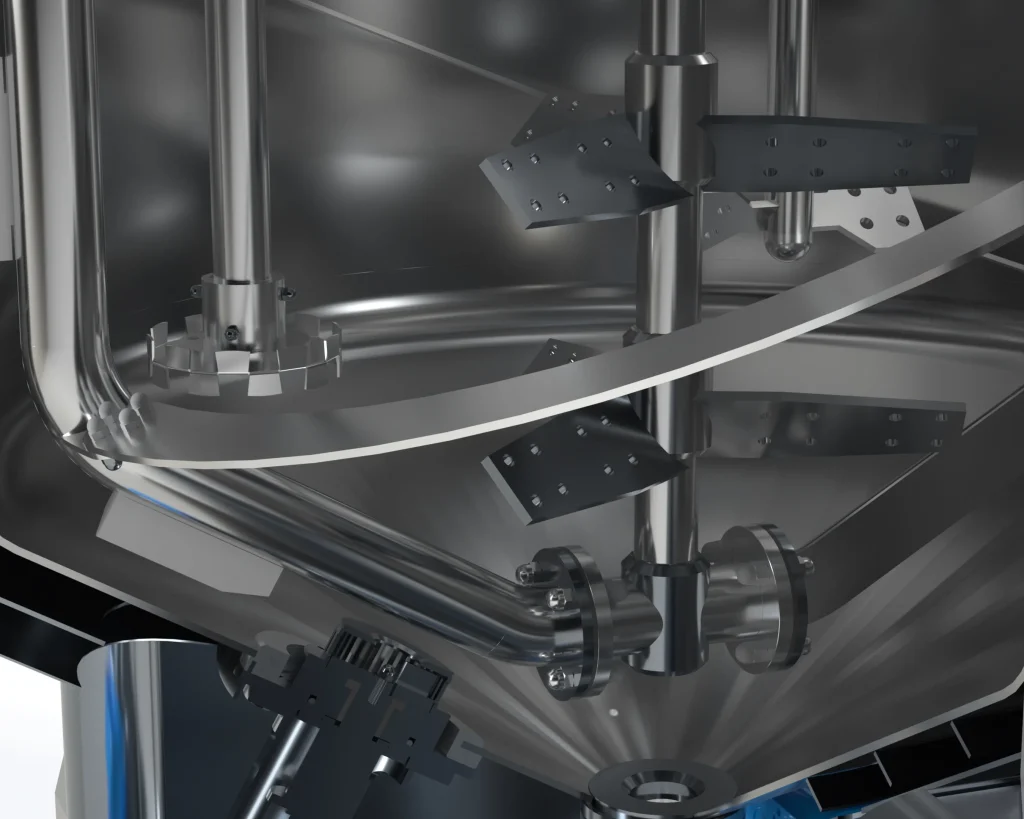
Universal Mixer
What It Is
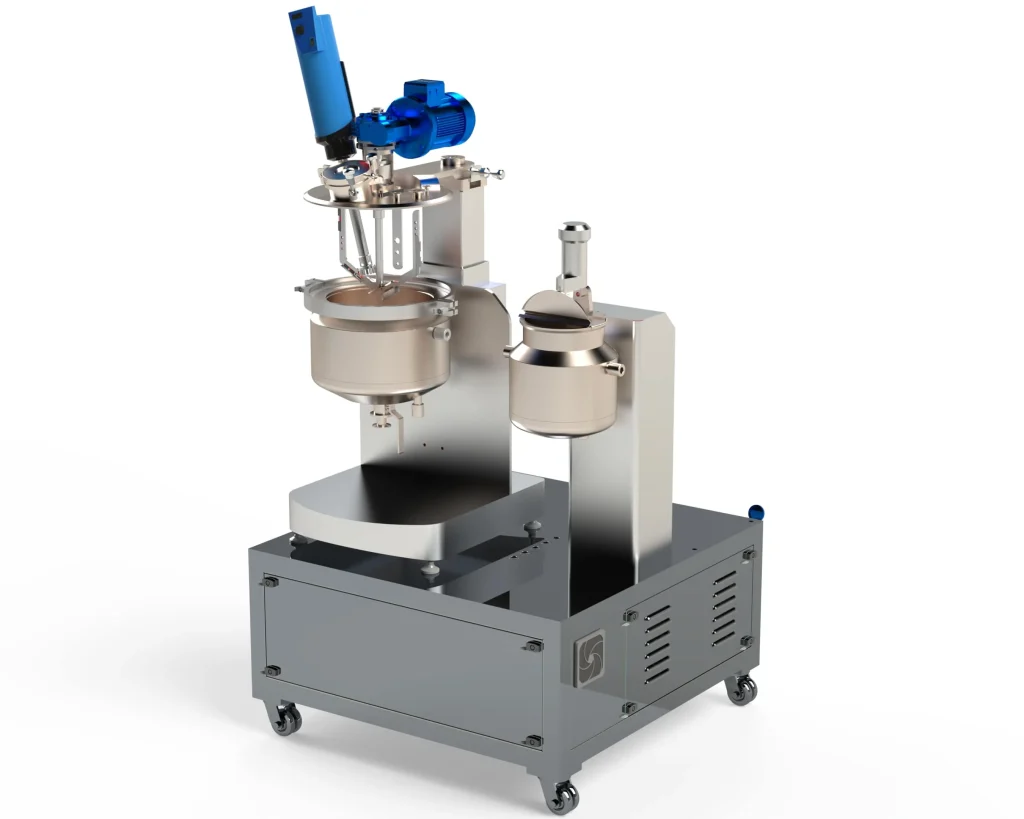
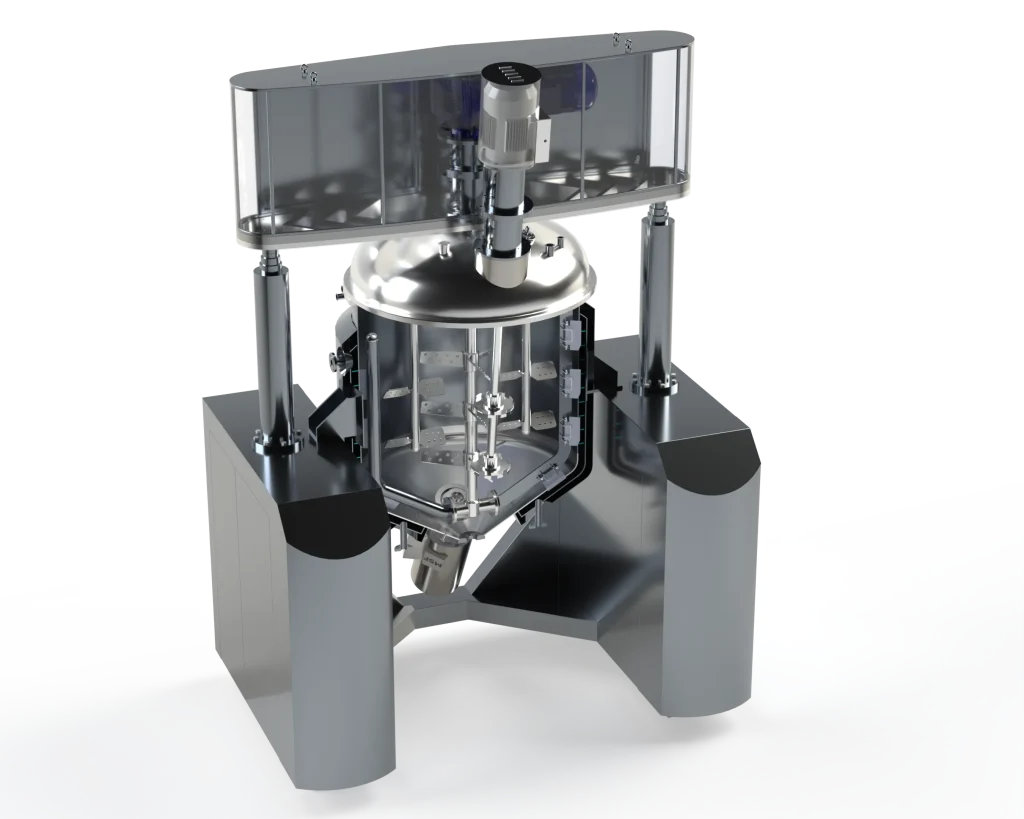
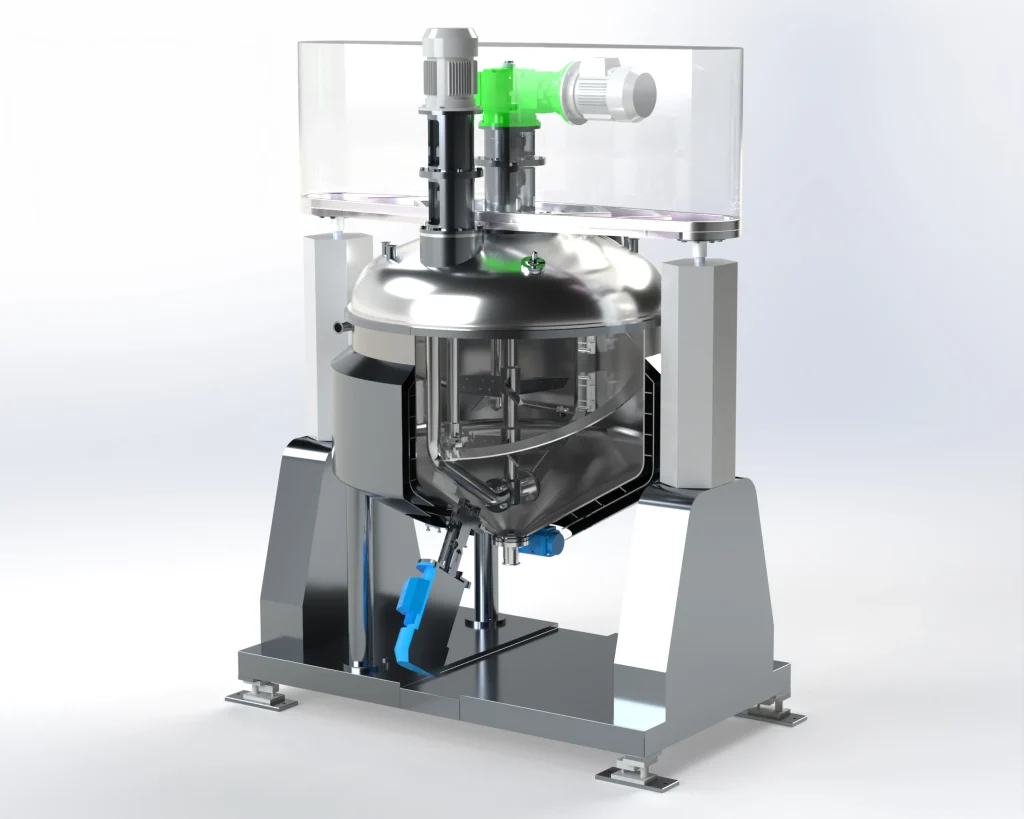
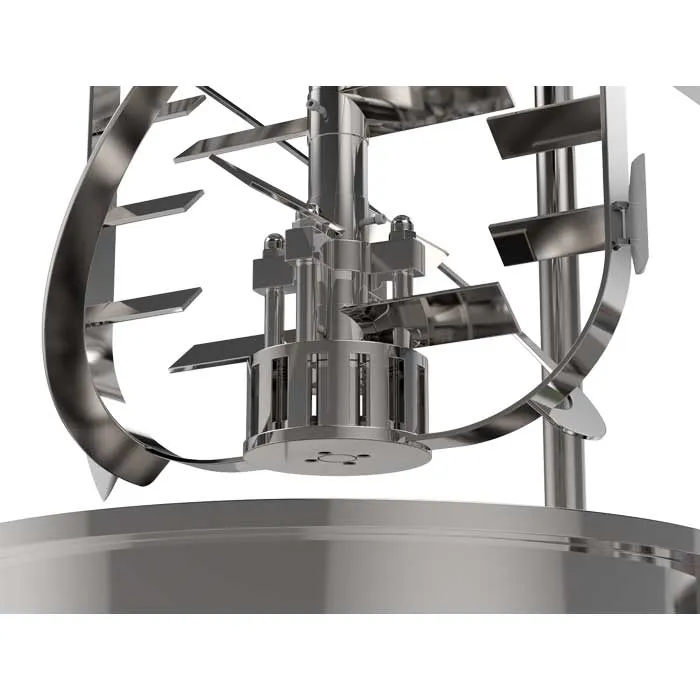
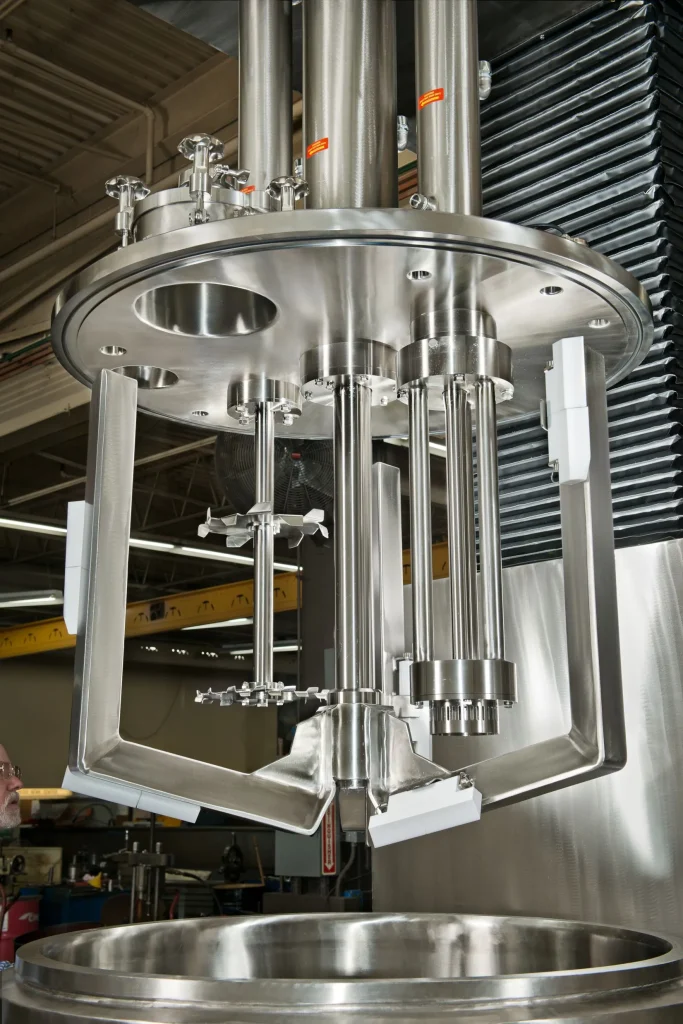
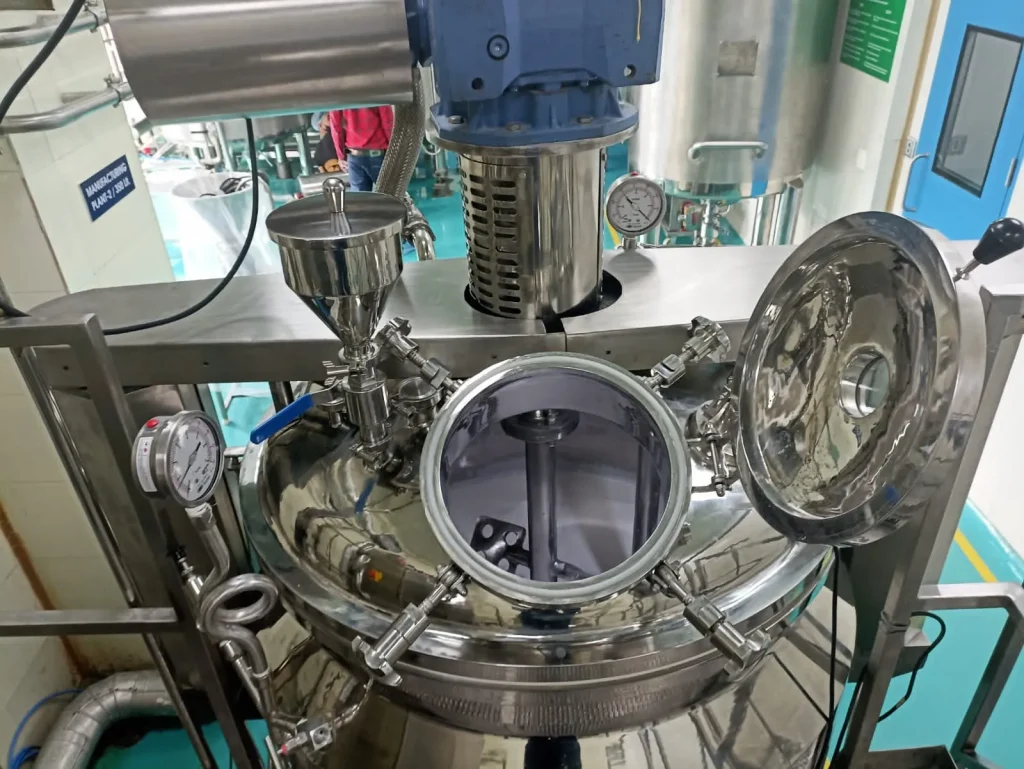
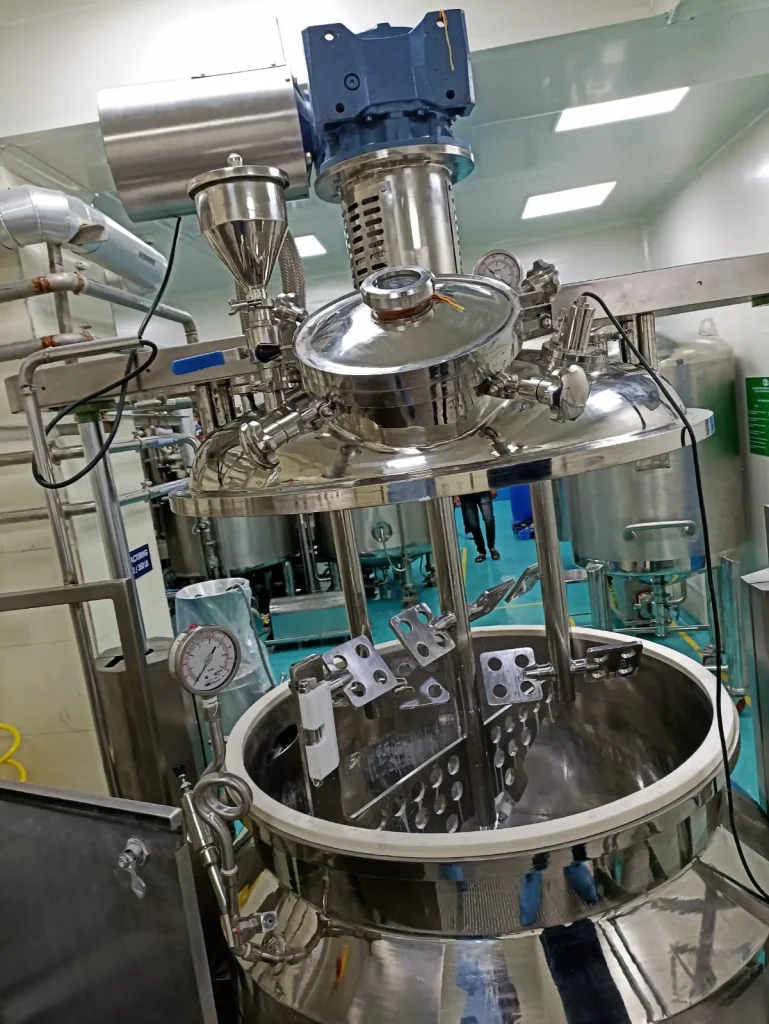
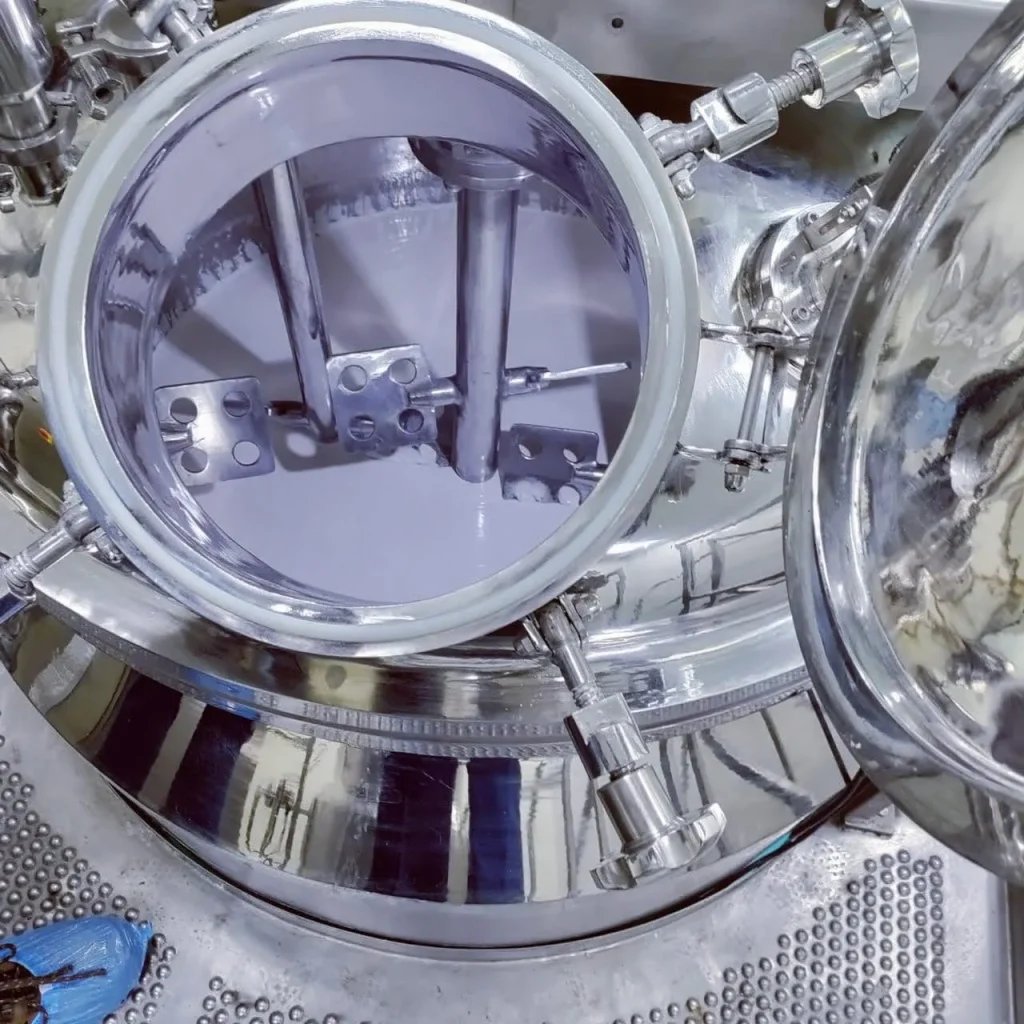
A universal mixer is a jacketed batch mixer with a U-shaped trough housing two counter-rotating blades, a primary axial-circulation blade and a secondary wall-scraping blade, making it the benchmark mixer for pharmaceutical ointments, cosmetic gels, and toothpaste bases.
How It Works
Blades engage at 60–90 RPM during charging to prevent aeration. The primary blade drives axial bottom-to-surface flow; the scraper returns wall-layer material to the bulk, turning over the full volume multiple times per minute. Laminar shear (tip speed 1–3 m/s) at the blade overlap disperses agglomerates. The trough tilts for gravity-assisted discharge achieving 95–99% batch recovery in 20–60 minutes.


Challenges
Wall Buildup and
Stagnant Zones
Viscous materials adhere to jacket-cooled walls between scraper passes, reducing heat transfer area and causing yield loss during discharge.
Scale-Up
Inconsistency
Blade geometry and tip speed optimized at lab scale do not translate linearly to production scale, leading to batch-to-batch variability in texture and homogeneity.
Temperature Gradient
Across Batch
The jacket heats or cools only the wall region; bulk material at the trough center can lag significantly, creating inconsistencies for heat-sensitive formulations.
Discharge and
Cleaning
High-viscosity products cling to trough surfaces and blade assemblies, making complete discharge difficult and increasing changeover time in multi-product facilities.
Aeration During
Mixing
Counter-rotating blades can entrain air into the product at higher speeds, requiring additional degassing steps that extend cycle time.
Solutions
- Spring-Loaded Scrapers (<0.5 mm Clearance): Continuously renew the thermal boundary layer, eliminating stagnant film and improving overall heat transfer coefficient.
- High-Torque VFD Soft-Start: Smooth acceleration handles viscosity peaks; PLC load monitoring prevents motor overload during dense charging.
- Mirror-Polished Jacketed Surfaces: Maximizes thermal contact area for isothermal or programmed temperature-ramp processing, reducing temperature gradients across the batch.
- Optimized Blade Geometry for Scale-Up: Blade pitch and counter-rotation speed ratios are engineered to maintain consistent tip speed and shear profile from lab to production scale, improving batch-to-batch homogeneity.
- Mechanical Seal with Barrier Fluid: Maintains full vacuum integrity, eliminating contamination risk during degassing and extending seal service life under differential pressure conditions.
- Controlled RPM Profiling: Graduated speed ramps during mixing minimize air entrainment, reducing foam formation and eliminating the need for extended degassing cycles.
Applications

Pharmaceutical
Ointments, antibiotic pastes, sterile gels, hormone creams under strict GMP RTD control.

Cosmetics
Face creams, shampoo bases, body lotions, toothpaste formulations.

Food & Beverage
Fruit pastes, chocolate spreads, Savory sauce bases with temperature-controlled processing.

Chemical
Silicone sealants, epoxy pastes, pigment dispersions under controlled shear conditions.
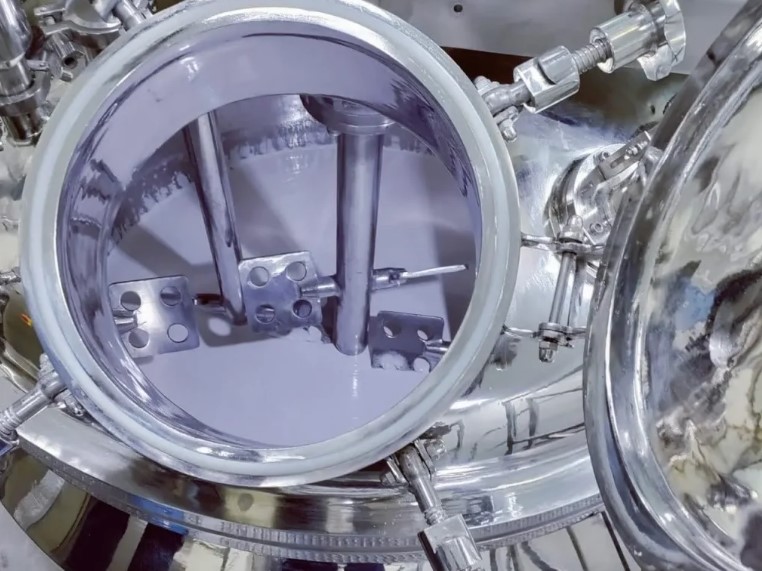
Models & Capacities
|
Model |
Net Vol. [L] |
Jacket Area [m²] |
Viscosity [cP] |
Speed [RPM] |
Motor [kW] |
Pressure [bar] |
Temp [°C] |
Max Evap. [kg/h] |
Dimensions [mm] |
||
|
(Water) |
L |
W |
H |
||||||||
|
UM-100 |
100 |
0.85 |
80,000 |
15–60 VFD |
3.7 |
-0.9 to +2 |
-10 to 150 |
6.5 |
1,600 |
800 |
1,100 |
|
UM-200 |
200 |
1.35 |
80,000 |
15–60 VFD |
5.5 |
-0.9 to +2 |
-10 to 150 |
11 |
2,200 |
1,000 |
1,300 |
|
UM-500 |
500 |
2.84 |
80,000 |
15–60 VFD |
11 |
-0.9 to +2 |
-10 to 150 |
25 |
3,000 |
1,200 |
1,500 |
|
UM-1000 |
1000 |
4.58 |
80,000 |
15–60 VFD |
22 |
-0.9 to +2 |
-10 to 150 |
35 |
4,200 |
1,500 |
1,800 |
|
UM-2000 |
2000 |
7.5 |
80,000 |
15–60 VFD |
37 |
-0.9 to +2 |
-10 to 150 |
58 |
5,800 |
1,800 |
2,100 |
|
UM-3000 |
3000 |
10.2 |
80,000 |
15–60 VFD |
55 |
-0.9 to +2 |
-10 to 150 |
80 |
7,000 |
2,100 |
2,400 |
|
UM-5000 |
5000 |
13 |
80,000 |
15–60 VFD |
75 |
-0.9 to +2 |
-10 to 150 |
100 |
8,500 |
2,500 |
2,800 |